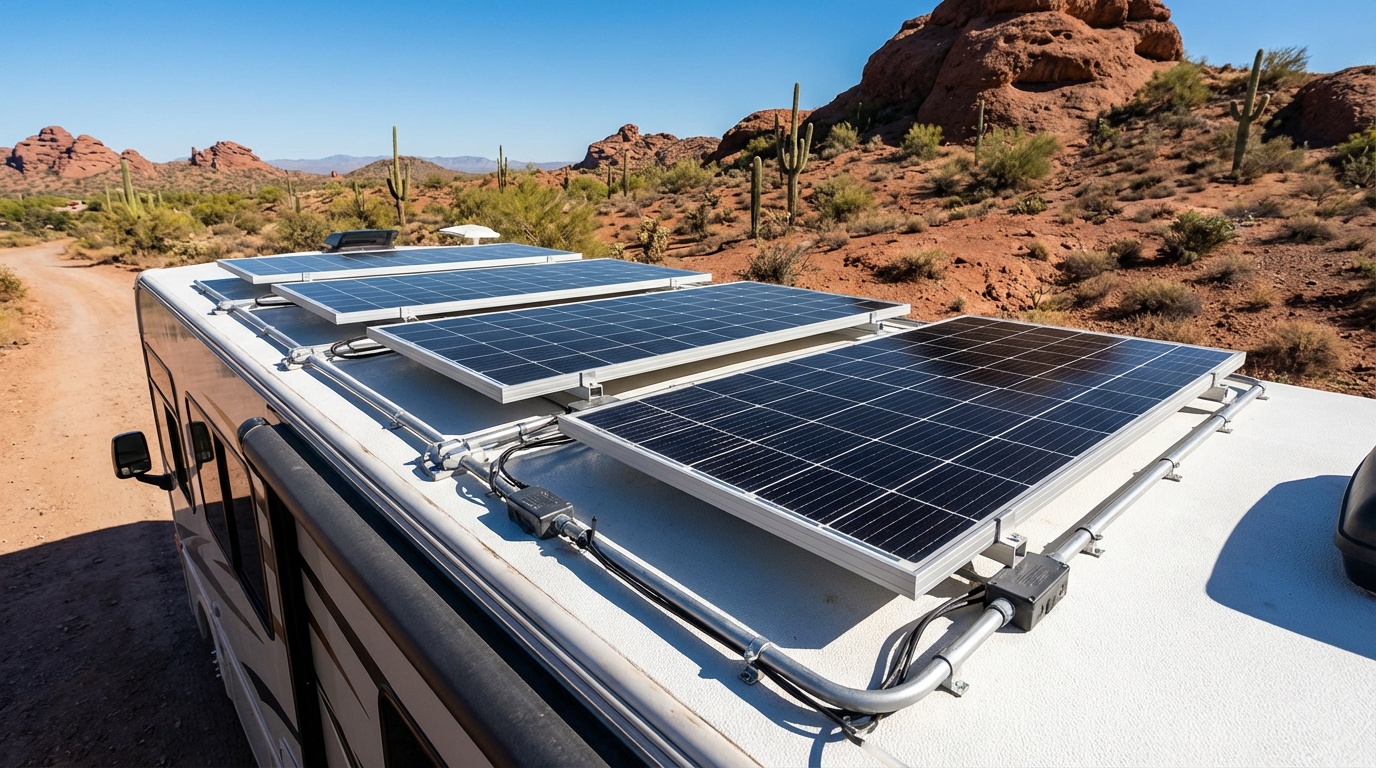
Best Solar Panels for RV Use in 2026: The Panels, and the Complete Kits They Belong In
The Renogy 200W monocrystalline leads the 2026 shortlist of solar panels for RV roofs, pairing 21 percent efficiency and a 25 year warranty with fair pricing.
A panel alone does not run anything, so each pick below is matched to the battery and charge controller that complete it.
Sized on published specs and verified user reviews, for your rig and your power needs.
Free shipping on qualifying orders.
Affiliate Disclosure
This page contains affiliate links to A1 SolarStore.
When you purchase from A1 SolarStore through these links, we may earn a commission at no additional cost to you.
This helps support our free calculators, guides, and research tools. Read our full disclosure
Weekend and part time arrays pair well with the Renogy 200W value pick or the Rich Solar 200W budget pick, while full timers often step up to Victron for premium build quality.
Affiliate link. Smart RV Hub may earn a commission on qualifying A1 SolarStore purchases at no extra cost to you.
A1 SolarStore does not carry Renogy or Rich Solar. They stock panels from JA Solar, Canadian Solar, Mission, Trina, REC, Longi, Hyundai, Jinko, Silfab and Qcells, verified August 2026.
New to the terms? Learn what a monocrystalline panel is in our RV glossary.
📋 What you'll discover
- Compare top rated solar panels for RV roofs with manufacturer specifications and owner reported output
- Match a panel to your budget and power needs
- Avoid common buying mistakes with expert analysis
- Get sizing recommendations based on your RV type
- See specifications and real user feedback on top panels
Choosing the right solar panels for RV use requires understanding real world performance across different conditions and price points.
Highly reviewed panels are not always the best performers.
Price does not always equal quality.
And some manufacturers' specs are closer to fiction than reality.
Here is what the data actually shows.
How Did We Choose the Best Solar Panels for RV Use?
Each panel was ranked on six factors: long term performance data, real world output versus rated specifications, durability reports, build quality, warranty support, and price to performance value.
Selection is based on published specifications, verified owner reviews, and independent third party data across dozens of solar panels for RV roofs.
Every panel is evaluated based on:
Long Term Performance Data: At least 3 months of owner reported performance data across varying weather conditions is reviewed
Real World Output Analysis: Owner reported power output data compared against manufacturer specifications
Durability Reports: Owner experiences in extreme heat, cold, rain, hail, and high winds
Build Quality Assessment: Junction box quality, waterproofing, cable management based on owner feedback and spec sheets
Warranty Support Review: How manufacturers handle warranty issues based on verified owner reports
Value Analysis: Price to performance ratio, long term ROI calculations
Data sources: Manufacturer specifications, verified owner reviews, and independent performance benchmarks across hot desert and cold mountain climates.
Not sure what size solar system you need?
Before diving into specific panel reviews, estimate your panel and battery needs from your daily power consumption and travel patterns.
Estimate My System SizeNew to RV solar? Start with how RV solar actually works to understand the basics of RV solar systems, components, and installation before choosing specific panels.
Which RV Solar Panel Performs Best in 2026?
Of the solar panels for RV roofs compared here, the Renogy 200W monocrystalline ranks first overall. Victron 175W BlueSolar leads on premium build quality and Rich Solar 200W is the budget pick.
| Panel Model | Power | Efficiency | Owner Reported Output | Warranty | Price | Best For |
|---|---|---|---|---|---|---|
Renogy 200W Mono | 200W | 21% | 185 to 205W (92%+) | 25 years | ~$150 to $220 | Overall Value |
| Victron 175W BlueSolar | 175W | 22% | 165 to 180W (94%+) | 25 years | ~$100 to $150 | Premium Quality |
| Rich Solar 200W | 200W | 21% | 180 to 200W (90%+) | 25 years | ~$130 to $180 | Budget Pick |
| Go Power! 190W | 190W | 20% | 170 to 185W (90%) | 25 years | $329 | Pre Wired Kits |
| Zamp Solar 170W | 170W | 19% | 155 to 170W (91%) | 25 years | $399 | RV Specific |
Affiliate link. Smart RV Hub may earn a commission on qualifying purchases at no extra cost to you.
Which RV Battery Type Works Best for Solar?
LiFePO4 lithium batteries deliver the best long term value for RV solar, offering 10 to 15 year lifespans and 80 to 90 percent usable capacity compared to 50 percent for lead acid and AGM.
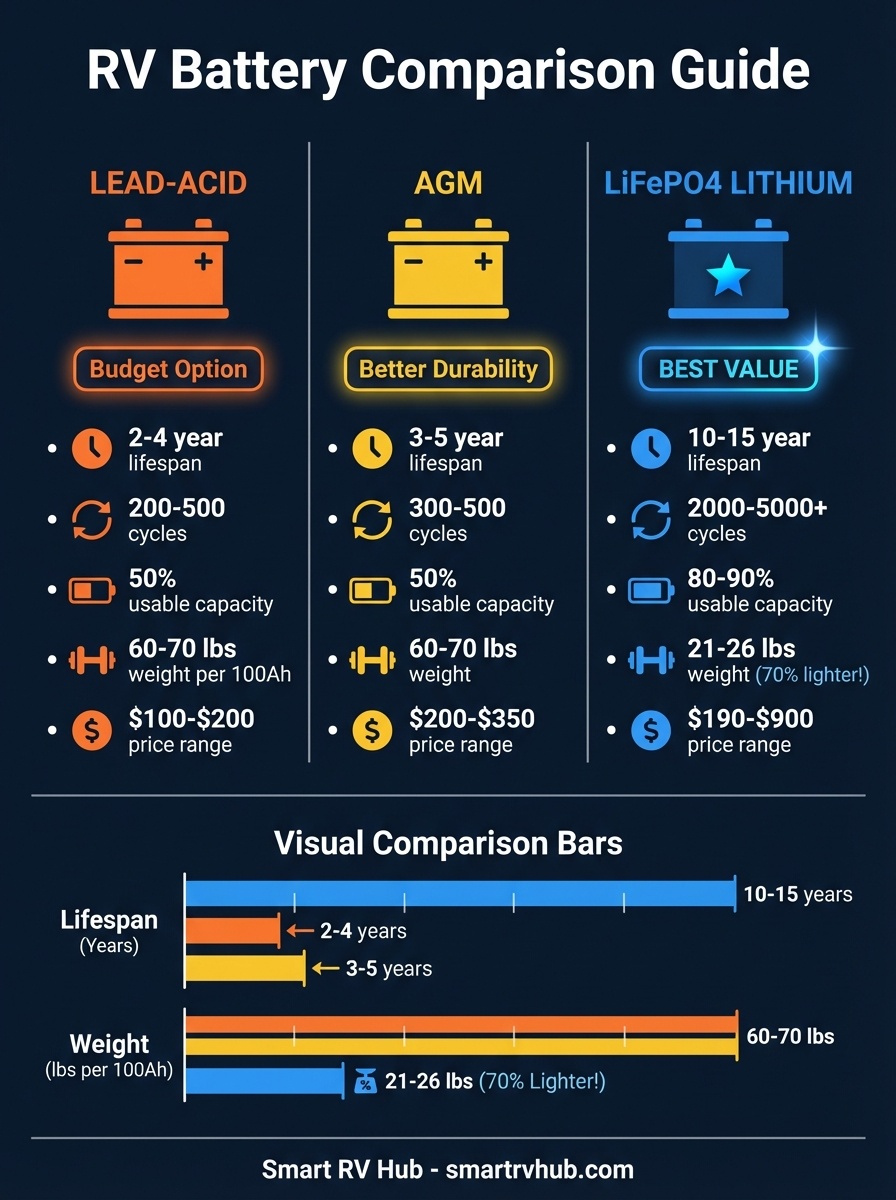
LiFePO4 lithium batteries offer the best long term value despite higher upfront cost
What Is the Best RV Solar Kit for Your Rig?
The best RV solar kit for most rigs is the 800W build: four Renogy 200W panels, a Victron MPPT controller and a 400Ah LiFePO4 battery. A 400W kit suits weekend campers, and a 1200W kit is built for heavy off grid power draws like air conditioning.
Solar panels for RV roofs are only one part of a complete kit. A working setup also includes a charge controller, battery bank, and properly sized wiring.
Not sure how much power you need? See the sizing calculation walked through with real examples.
For a detailed breakdown of all in one solutions, see our complete guide to RV solar installation kits.
Our write up on ordering from A1 SolarStore covers what the retailer stocks and how shipping works.
Here are the three RV solar kit sizes to consider, based on your power needs:
400W Basic System
Perfect for weekend/vacation RVers
- • 2× Renogy 200W panels
- • Victron MPPT 75/15 controller
- • 200Ah LiFePO4 battery
- • Mounting hardware & cables
~$1,600
Get the 400W Kit(opens in new tab)Affiliate link. Smart RV Hub may earn a commission on qualifying A1 SolarStore purchases at no extra cost to you.
800W Standard System
Best for full timers & boondockers
- • 4× Renogy 200W panels
- • Victron MPPT 100/30 controller
- • 400Ah LiFePO4 battery
- • Premium mounting & wiring
~$3,200
Get the 800W Kit(opens in new tab)Affiliate link. Smart RV Hub may earn a commission on qualifying A1 SolarStore purchases at no extra cost to you.
1200W Premium System
Maximum power for off grid living
- • 6× Renogy 200W panels
- • Victron MPPT 150/35 controller
- • 600Ah LiFePO4 battery
- • Professional installation
~$6,500
Get the 1200W System(opens in new tab)Affiliate link. Smart RV Hub may earn a commission on qualifying A1 SolarStore purchases at no extra cost to you.
Affiliate link. Smart RV Hub may earn a commission on qualifying purchases at no extra cost to you.
Power Your Off Grid Adventures
Compare complete kits, solar panels for RV roofs, lithium batteries, and MPPT charge controllers from our trusted affiliate partners
A1 Solar Store: Complete RV Solar Systems
Solar panels, complete kits, lithium batteries, and MPPT charge controllers, stocked for RV builds.
- • Complete Solar Kits
- • LiFePO4 Batteries
- • MPPT Controllers
- • Over 60 Fulfillment Centers
Affiliate link. We may earn a commission at no extra cost to you.
A1 SolarStore: Battery & Power Solutions
Lithium batteries, charge controllers, and inverters.
Check the warranty term on each product page before you order.
- • LiFePO4 Batteries
- • Charge Controllers
- • Quality Inverters
- • Extended Warranties
Affiliate link. We may earn a commission at no extra cost to you.
Affiliate link. We may earn a commission at no extra cost to you.
How Do the Top 3 RV Solar Panels Compare?
These three solar panels for RV roofs show the current 2026 market, with verified output ranges from roughly 165 to 205 watts and street prices from $100 to $220. A panel on its own only produces power once it is matched to a battery and a charge controller, so the panel choice is one part of sizing a complete kit.
| Panel | Watts | Efficiency | Weight | Best for | Price band |
|---|---|---|---|---|---|
| Renogy 200W Monocrystalline | 200W | 21% | 15.4 lbs | Balanced efficiency and price | ~$150 to $220 |
| Victron 175W BlueSolar | 175W | 22% | Not listed | Premium build quality | ~$100 to $150 |
| Rich Solar 200W | 200W | 21% | 12.8 lbs | Budget pick | ~$130 to $180 |
Rich Solar 200W - Best Budget Pick
Rich Solar offers compelling value for budget conscious RVers without major compromises.
While build quality is not quite at Renogy's level, performance is solid and the savings add up when building a multi panel array.
Pros
- Competitive cost per watt: strong value for a 200W panel at this price
- Solid performance: 180 to 200W real world output (90 to 100% of rating)
- Lighter weight: 12.8 lbs vs Renogy's 15.4 lbs
Cons
- Slightly lower efficiency: Performance drops 5 to 8% in less than ideal conditions
- Basic junction box: Less weatherproofing than Renogy/Victron
Best For:
Budget conscious RVers building 400W+ arrays where savings multiply, weekend/vacation RVers who don't need premium durability, and anyone prioritizing upfront cost over long term optimization.
Affiliate link. Smart RV Hub may earn a commission on qualifying purchases at no extra cost to you.
A1 SolarStore does not carry Renogy or Rich Solar. They stock panels from JA Solar, Canadian Solar, Mission, Trina, REC, Longi, Hyundai, Jinko, Silfab and Qcells, verified August 2026.
Victron 175W BlueSolar - Premium Choice
When you want premium build quality and are willing to pay for it, Victron delivers.
This Dutch made panel represents the premium tier of RV solar with marine grade components, strong low light performance, and warranty support that owner reviews rate highly. Victron Energy
Pros
- Highest build quality: Marine grade components, exceptional waterproofing
- Best low light performance: Produces power earlier/later in day than competitors
- Industry leading efficiency: 22% efficiency rating (highest of the panels compared here)
- Warranty service rated highly by owners: Victron publishes a 25 year performance warranty
Cons
- Premium brand positioning: Victron commands brand premium for quality
- Lower total wattage: 175W vs 200W competitors at similar price
Best For:
Full time RVers, marine/harsh environment use, anyone wanting absolute best quality regardless of price, and those who value brand reputation and warranty support above all.
Affiliate link. Smart RV Hub may earn a commission on qualifying purchases at no extra cost to you.
Renogy 200W Monocrystalline RV Solar Panel
Most balancedBased on published manufacturer specifications and verified owner reviews, the Renogy 200W Monocrystalline panel consistently delivers performance at or near its rated capacity, with owners reporting strong output across varied weather conditions. Renogy
Reviewers commonly report this panel ranks among the strongest performers in its price range.
Before purchasing, work through our full system design guide to settle on the exact system size you need.
Pros
- Strong owner reported output: 185 to 200W typical output in field reports (93 to 100% of rated capacity)
- Strong price to performance: dependable output for the price with a strong reliability record in owner reviews
- Excellent warranty support: 25 year power output warranty, fast claim processing
- Z bracket mounting included: Saves $30 to 40 compared to buying separately
- Universal compatibility: Works with all major MPPT charge controllers
- Durable construction: Heavy duty aluminum frame, corrosion resistant coating
Cons
- Heavier than competitors: 15.4 lbs vs 12 to 13 lbs for some alternatives
- Not ideal for curved roofs: Rigid panel, requires flat mounting surface
- Slightly larger footprint: 59 x 26.5 inches may not fit all RV roof layouts
Best For:
Most RV owners seeking proven, reliable solar power with excellent value. Ideal for standard flat RV roofs, permanent installations, and anyone wanting best bang for buck without sacrificing quality.
Key Specifications:
Affiliate link. Smart RV Hub may earn a commission on qualifying purchases at no extra cost to you.
A1 SolarStore does not carry Renogy. They stock panels from JA Solar, Canadian Solar, Mission, Trina, REC, Longi, Hyundai, Jinko, Silfab and Qcells, verified August 2026.
Sizing an array rather than picking a brand?
A1 SolarStore carries RV specific panels, kits and Victron components, shipped from over 60 fulfillment centers. Our buyer's guide walks through ordering the right configuration.
- Over 60 Fulfillment Centers
- Free Shipping on Qualifying Orders
- Rated Excellent on Trustpilot, checked August 2026 (opens in a new tab)
Trust signals verified August 2026. Check a1solarstore.com for current details.
A1 SolarStore specializes in complete RV solar kits, lithium batteries, and MPPT controllers, with phone support 10AM to 6PM EST and over 60 fulfillment centers across the US for fast shipping.
Every panel in this comparison carries a 25 year warranty from its manufacturer.
Every Panel, Battery and Sizing Guide
Go deeper on any part of the build, or check what a system produces where you camp.
- RV Solar Panels: Complete Guide for Off Grid Power 2026
- 200 Watt RV Solar Kit: What It Powers and What to Buy
- 400 Watt RV Solar Kit: What It Powers and What to Buy
- 600 Watt RV Solar Kit Review: The Part Timer's Sweet Spot
- 800 Watt RV Solar Kit Review: The Standard Full Timer Build
- Best Lithium RV Batteries 2026: Half the Weight, Double the Usable Energy
- MPPT vs PWM Charge Controllers: Which One for Your RV Solar Setup?
- Winter Boondocking on Solar in the Arizona Desert
- RV Solar Battery Guide: Why LiFePO4 Wins (vs AGM and Gel)
- RV Solar by State: Sun Hours and Sizing Compared
- California RV Solar: From Coastal Fog to Full Mojave Sun
- Colorado RV Solar: Altitude, Canyon Shade and Snow Load
- Florida RV Solar: Humidity, Oak Shade and Afternoon Storms
- Nevada RV Solar: Clear Skies, Public Land, No Hookups
- New Mexico RV Solar: High Desert Elevation and Intense Sun
- Texas RV Solar: The West Texas and Gulf Coast Split
- Utah RV Solar: Canyon Country Stays on Battery Power
- RV Solar Wiring: Series vs Parallel
Smart RV Hub Editorial Team
RV Technology Research and Reviews
Our writers research smart RV technology full time, covering solar power, connectivity, security, and power management.
Every guide draws on published manufacturer specifications and verified owner reviews, so you can compare options with confidence.
Meet the editorial team and our review standardsSize Your System and Build Your RV Solar Kit
Complete kits start around $1,600 for 400W. Size your system with our solar calculator, then order the solar panels for RV use that fit your roof and your power draw.
Want to compare retailers first? Our buyer's guide covers solar kits at every price point.
Affiliate link. Smart RV Hub may earn a commission on qualifying purchases at no extra cost to you.
A1 SolarStore does not carry Renogy or Rich Solar. They stock panels from JA Solar, Canadian Solar, Mission, Trina, REC, Longi, Hyundai, Jinko, Silfab and Qcells, verified August 2026.
Not sure on wattage yet? Size your system first, or add LiFePO4 batteries to complete the kit.
Rooftop Panels or a Portable Solar Panel?
Everything above covers rigid rooftop solar panels for RV use, which is the right answer for most rigs and the reason solar panel kits are sold that way.
A portable solar panel solves a different problem, and plenty of RVers end up owning both.
The case for portable is shade, because you can park the rig under a tree and walk the panel out into the sun on an extension cable.
Most portable units are a foldable suitcase design with a handle, light enough to be easy to carry and quick to stow.
Brands in this category include Renogy, Rich Solar and BougeRV, and the same panels are often bundled with a power station rather than wired into the rig.
Power stations from Bluetti, Jackery and EcoFlow pair with a portable panel to give you a self contained kit with no installation at all.
That suits renters, van conversions and anyone who does not want to drill a roof, though it costs more per usable kWh than a fixed install.
Flexible solar sits between the two, bonding to a curved roof where a rigid frame will not sit flat.
Based on published specs, flexible panels run hotter and carry shorter warranties than rigid, so treat them as a shape solution rather than a value one.
Bifacial panels, which capture reflected light on the underside, are becoming common in home arrays but gain little on an RV roof where the underside faces a dark cavity.
One wiring note catches people out, based on published controller specs. A 200W panel on a 24V system needs a controller rated for that voltage, and a 24V array on a 12V bank will not charge without the right MPPT unit.
The short version is that a rooftop array is the cheaper permanent answer, and a portable panel is the flexible supplement.
Our portable solar panel comparison takes that decision apart properly, with what each foldable size actually recovers in a day.
What to Check Before You Order
Measure the usable roof of your vehicle first, not the total roof, because vents, hatches and the air conditioner shroud take a surprising share of it.
Panels mounted on the roof also need clear runs for cable, so leave room to route the leads to wherever the solar charge controller will live.
Check the connector type while you are at it, since almost every modern panel uses MC4 and a mismatch means an adapter you did not plan for.
Confirm the panel voltage suits your solar charge controller, because that pairing is what decides whether the panels charge the bank properly or trickle.
If you have limited space, fewer high efficiency panels beat more cheap ones, and this is the one place where paying up genuinely buys you output.
A 200 watt solar panel is the common building block for that reason, giving a good ratio of output to the roof area it consumes.
The payoff for getting this right is reliable power that arrives silently, which is the real argument against running a noisy gas generator at a quiet campsite.
Overlanders and van builders often go further and add portable power in the form of a station, so they can carry energy away from the vehicle entirely.
Get the roof space, the connectors and the controller right, and the panels will power your RV for longer than you keep the rig.
How the Cell Technology Changes What You Get
Every panel here works the same way at heart, using semiconductor cells to convert sunlight into direct current.
What separates them is how much of that sunlight each cell captures, and how the panel behaves when conditions are less than perfect.
Monocrystalline is the highly efficient option and the default for RV roofs, because it returns the most watts from a fixed area.
It performs best in direct sunlight, which is why panel angle and shading matter as much as the rating on the box.
Thin film types, including CIGS, trade efficiency for flexibility and weight, making them extremely lightweight and able to follow curved surfaces.
Based on published specs, that flexibility costs roughly a third more roof area for the same output, so it is a shape choice rather than a performance one.
A high wattage panel is not automatically the better buy either, since fewer large panels are harder to fit around obstructions than several smaller ones.
What you are really paying for in the premium tier is efficiency and durability together, because an efficient solar panel that delaminates in five years has saved you nothing.
Check what connector cables are supplied as well, since kits vary on whether extension leads are included or extra.
For occasional camping trips a modest camping setup with one or two panels is plenty, and the technology question only really matters once you are living off the array.
Matching the Array to How You Camp
Based on published output figures, a 100W panel is the smallest sensible starting point, and a single 100 watt module keeps a battery topped up between weekends without any real planning.
Step up to 400W and the camping experience changes, because the fridge and the devices stop being a daily calculation.
Anyone boondocking full time should plan from 600W upward, since that is the point where solar energy covers the load rather than merely slowing the drain.
Remember that anything running at 120V goes through the inverter, and the inverter is usually the reason a system that looked adequate on paper is not.
Among portable units, look for foldable options with an adjustable kickstand, because the angle you can set is worth more output than a slightly higher rating.
Every panel shortlisted here carries a 25 year output warranty, which is the industry standard and a reasonable minimum to insist on.
If you already own a rig with a battery and a converter, you can add solar to it without replacing anything else, which is why retrofits are so common.
It is also the eco friendly option in the sense that matters at a campsite, because a panel makes no noise and burns no fuel while it works.
Frequently Asked Questions
How many solar panels do I need for my RV?
Many RVers need 400 to 800 watts of solar capacity. Weekend campers typically do fine with 400W (2x 200W panels), while full timers usually need 600 to 800W (3 to 4x 200W panels).
Use our solar calculator to determine your exact needs based on your power consumption.
What's the difference between monocrystalline and polycrystalline panels?
Monocrystalline panels are more efficient (19 to 22%), perform better in low light, and last longer.
Polycrystalline panels are cheaper but less efficient (15 to 17%) and take up more roof space for the same power output.
For RVs where roof space is limited, monocrystalline produces more watts per square foot.
Do I need an MPPT or PWM charge controller?
MPPT (Maximum Power Point Tracking) controllers are worth the extra cost for RV solar systems. They are 20 to 30% more efficient than PWM controllers, especially in less than ideal conditions.
For a 400W+ system, the efficiency gains pay for the controller upgrade within 1 to 2 years. Victron MPPT controllers are known for reliability in RV applications.
Can I install RV solar panels myself?
Yes, if you are comfortable with basic electrical work and roof mounting. Panel installation requires drilling into your RV roof (proper sealing is critical), running cables, and wiring the charge controller.
If you are not confident in your abilities, professional installation costs $500 to 1,000 but ensures proper setup and maintains your RV warranty.
How long do RV solar panels last?
Quality solar panels like Renogy and Victron typically last 25 to 30 years. They are warrantied for 25 years with guaranteed power output (usually 80% of original capacity).
Real world degradation is about 0.5% per year, so after 25 years, panels still produce 85 to 90% of original power. The mounting hardware and cables may need replacement before the panels do.
How many watts of solar do I need for my RV?
Most RVs need 400 to 800 watts of solar capacity. Weekend campers typically do fine with 400W using two 200W panels, while full timers usually need 600 to 800W using three to four 200W panels.
Your exact figure depends on daily power consumption and travel patterns. Use our solar sizing calculator to size your system precisely.
Are flexible or rigid RV solar panels better?
Rigid monocrystalline panels last longer, cool better, and hold efficiency over 25 years.
The Renogy 200W rigid panel reviewed here is built for standard flat RV roofs.
Flexible panels suit curved roofs and weight sensitive builds, but they typically run hotter and have shorter lifespans than rigid panels.
More RV Solar Panel Questions
What are the best solar panels for an RV in 2026?
Based on manufacturer specifications and industry reviews: Renogy 200W panels (typically $150 to $220) pair high efficiency with a 25 year warranty.
Victron is known for premium charge controllers and components with superior build quality.
Rich Solar 200W provides budget friendly reliability.
Prices fluctuate.
Check current pricing.
What is the best RV solar kit for most rigs?
Based on published specs and user reviews, the best RV solar kit for most rigs is an 800W build: four Renogy 200W panels, a Victron MPPT charge controller and a 400Ah LiFePO4 battery, at around $3,200.
Weekend campers are well served by a 400W kit at around $1,600, using two 200W panels and a 200Ah battery.
Heavy off grid power draws, such as running air conditioning from the batteries, are where a 1200W kit earns its cost, so size the kit to your daily power draw rather than to your roof area.
How much do RV solar panels cost in 2026?
Quality RV solar panels range from $110 to $250 per 200W panel in 2026.
Complete systems cost: $1,600 (basic 400W setup), $1,800 to $2,800 (600W mid range), and $3,200+ (premium 800W+ systems).
DIY installation saves $500 to $1,000 in labor costs compared to professional installation.
Renogy vs Victron solar panels: Which is better?
Renogy 200W panels deliver excellent real world efficiency with great value and 25 year warranty.
Victron offers premium build quality and excellent charge controllers with slightly better low light performance.
Renogy costs less per watt, and Victron costs more for build quality and low light performance.
Check current prices as they vary.
What wattage solar panel do I need for my RV?
Most RVs need 400 to 800W total solar capacity.
Weekend warriors: 400W (2× 200W panels) for $600 to $800.
Part time RVers: 600W (3× 200W panels) for $900 to $1,200.
Full time RVers: 800W+ (4× 200W panels) for $1,200 to $1,600.
Calculate your exact needs based on daily power consumption.
Are monocrystalline or polycrystalline solar panels better for RVs?
Per published specs, monocrystalline panels offer 20 to 22% efficiency vs 15 to 17% for polycrystalline.
They produce more power in limited roof space, perform better in low light, and last longer (25+ years).
That efficiency gap costs $30 to $50 more per panel.
How long do RV solar panels last?
Quality RV solar panels last 25 to 30 years with proper maintenance.
Most panels retain 85%+ efficiency after 25 years.
Renogy and Victron panels are rated for long term durability, with manufacturer warranties backing their performance claims.
How many watts of solar do I need for my RV?
Most RVs need 400 to 800 watts of solar capacity.
Weekend campers typically do fine with 400W using two 200W panels, while full time RVers usually need 600 to 800W using three to four 200W panels.
Calculate your exact needs based on your daily power consumption and travel patterns.
Are flexible or rigid RV solar panels better?
Rigid monocrystalline panels last longer, cool better, and hold efficiency over 25 years.
Flexible panels suit curved roofs and weight sensitive builds but typically run hotter and have shorter lifespans.
The Renogy 200W rigid panel reviewed here is built for standard flat RV roofs.
Can I install RV solar panels myself?
Yes, if you are comfortable with basic electrical work and roof mounting.
Installation involves drilling and sealing roof penetrations, running cables, and wiring the charge controller.
If you are not confident, professional installation costs $500 to $1,000 but ensures proper setup and helps maintain your RV warranty.
Can I run my RV air conditioner on solar power?
Running a rooftop air conditioner on solar is possible but it is the hardest job you can ask of an RV system, because an air conditioner draws far more than lights, a fridge and device charging combined.
Based on published appliance specs, a realistic setup needs a large lithium bank, a high output inverter and roughly 1,000W or more of panel, which is well beyond a typical 400W travel build.
Most RVers run the air conditioner from shore power or a generator and use solar for everything else, which is far cheaper than sizing the whole array around one appliance.
What size solar panel is recommended for an RV?
Based on published specs and user reviews, a weekend camper with a 12V system finds that 200W of panel covers lights, water pump and device charging comfortably.
For longer off grid stays with a compressor fridge, 400W is the common recommendation, and full timers usually land between 600W and 800W.
A travel trailer often needs less than a large motorhome simply because it carries fewer powered appliances.
What type of solar panel is most efficient for a motorhome?
Monocrystalline panels are the most efficient type for a motorhome, converting a higher share of sunlight per square foot than polycrystalline.
Roof space is the real constraint on any RV, so efficiency per foot matters more than it does on a house.
Rigid monocrystalline is the default choice unless your roof is curved, in which case a flexible panel is the trade off you accept.
What is the best 400W solar panel for an RV?
Based on published panel dimensions, there is no single 400W panel worth fitting, because 400W on an RV roof is almost always two 200W panels wired together rather than one large sheet.
Two 200W monocrystalline panels are easier to lift, easier to fit around vents and air conditioner shrouds, and keep producing if one is shaded, based on published dimensions and shading behavior.
Pair them with a matching charge controller sized for the combined output, and check the panel dimensions against your usable roof space before ordering.
Do I still need a generator if I fit solar panels?
A generator and a solar array solve different problems, so many RVers keep both.
Solar quietly replaces the daily draw from lights, pumps, a fridge and devices, while a generator covers high draw appliances and long spells of poor weather.
If you camp mostly in sun and skip air conditioning, a well sized 12V solar system can replace the generator entirely.
Related Resources & Next Steps
Solar Equipment & Calculators
- Want the detail? Compare Renogy and Victron solar panels head to head.
- Learn the fundamentals? Master RV solar power systems from scratch.
- Need precise sizing? Run the numbers for your own rig and get exact panel and battery figures.
- Calculate battery capacity? Determine your battery bank requirements for optimal energy storage.
- Optimize your setup? Discover smart power management strategies for maximum efficiency.
Planning & Lifestyle
- Going full time? Explore what full time solar RV life requires for power and beyond.
- Planning adventures? Map your solar powered RV trips safely with proper route planning.
- Remote worker? Build the ultimate mobile office setup with reliable solar power.
- Not ready to buy? Try RVing with a rental first before investing in solar.
- Still deciding? Find out if RV solar pays off for your camping frequency with our honest cost breakdown.
Not sure where to start? Work out exactly how many panels and batteries you need in a couple of minutes.
Then check our detailed brand comparison to choose the right panels for your budget.
Want the complete picture? Follow solar from panel to plug, or learn about power management optimization for experienced users.
Not Sure About Going Solar?
Solar is a significant investment. Consider renting an RV with solar to test your power needs in real conditions before buying.
Ready to Upgrade Your RV?
Explore our technology packages and get personalized pricing for your smart RV upgrade.
Explore Related Features
Renogy vs Victron Comparison
Head to head comparison of the two top solar brands
How To Plan An RV Trip
Plan your RV adventures with expert tips
RV Solar Systems Explained
Complete guide to RV solar power systems
Solar Power Calculator
Calculate your solar power needs
Harvest Hosts Overnight Stays
Make solar pay off faster by camping off grid at wineries and farms
RV Life Pro Trip Planning
Plan the route between off grid stays
Wiring Your Solar Setup
Wire sizing, fuses, and how the system connects together
RV Solar Cost Calculator
Estimate the full price of your system before you buy
Solar Panels to Run RV AC
How many panels and how much battery it takes to run air conditioning
Flexible vs Rigid Solar Panels
Which panel type suits your roof, budget, and travel style
Current RV Solar Deals
Current discounts on panels, kits, and batteries from trusted retailers
RV Solar Maintenance Guide
Simple cleaning and inspection habits that protect panel output
Ships fast to get you camping sooner
Rated 4.4 of 5 on Trustpilot, checked August 2026 (opens in a new tab)Fast US shipping. Other trust signals verified August 2026.
See What an RV Solar Setup CostsAffiliate link. We may earn a commission at no extra cost to you.
Wide selection for any setup
Shop Matched RV Solar KitsAffiliate link. We may earn a commission at no extra cost to you.
Read the full RV solar walkthrough for every guide and resource in one place.
Sources
- Solar Photovoltaic Technology Basics — U.S. Department of Energy
- 200 Watt 12 Volt Monocrystalline Solar Panel — Renogy
- BlueSolar Panels — Victron Energy
- MEGA 200 Solar Panel — Rich Solar
- Renogy reviews — Trustpilot
- Victron Energy reviews — Trustpilot
Add Me to The Unplugged RV Waitlist
The Unplugged RV is a beginner's roadmap to off grid and boondocking freedom, covering power, water, and where to stay.
The book is not on sale yet and no release date is set.