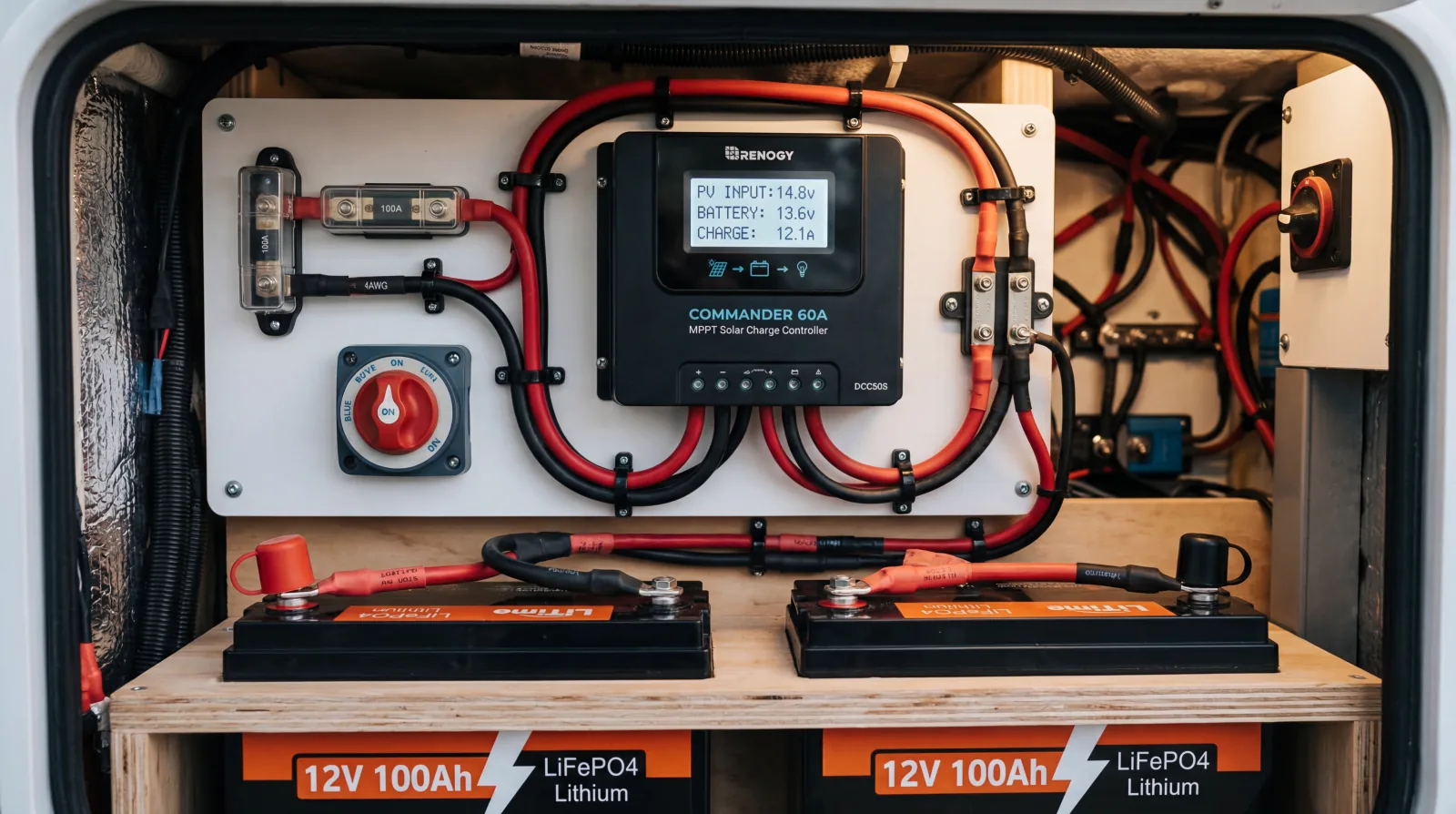
RV Solar Battery Guide: Why LiFePO4 Wins (vs AGM and Gel)
Based on published specs and verified user reviews, LiFePO4 leads RV solar batteries in 2026 with the longest cycle life and the most usable capacity per amp hour.
AGM remains the budget pick for occasional weekend campers.
Affiliate Disclosure
Smart RV Hub may earn a commission if you purchase from A1 SolarStore through these links, at no additional cost to you; see our full disclosure.
What you'll discover
- Side by side comparison of every major RV battery type
- Understand depth of discharge and why it changes everything
- Size your battery bank with a simple daily usage calculation
- Find the right battery for your budget and travel style
- Avoid common upgrade mistakes that cost hundreds of dollars
Affiliate link. We may earn a commission at no extra cost to you.
Already know your battery chemistry?
Once you know your battery size, price it at A1 SolarStore, which ships from multiple US warehouses and takes sizing questions by phone.
Your battery bank is the heart of your RV solar system.
Panels capture the sun, but batteries determine how long that power actually lasts.
Choose the wrong chemistry and you could end up with half the usable capacity you paid for, or a bank that fails in three years instead of ten.
This guide breaks down every option available in 2026, with real numbers so you can make a decision that fits your budget and your lifestyle.
Why Your Battery Choice Defines Your Solar System
Solar panels are commoditized: a 200W panel from any major brand will perform within a few percentage points of another.
Batteries are not that simple.
Two batteries with identical amp hour ratings can deliver radically different usable power depending on their chemistry.
Depth of discharge (DoD), charge efficiency, weight, and lifespan all vary dramatically between types.
Getting this right means your system powers your lifestyle.
Getting it wrong means running out of power on day two of a five day trip, or replacing a bank you thought would last a decade.
How Do RV Battery Types Compare?
All figures below are based on manufacturer specifications and represent typical midrange products in each category.
Prices reflect 2026 retail.
| Spec | LiFePO4 | AGM | Gel | Flooded LA |
|---|---|---|---|---|
| Usable DoD | 80 to 100% | 50% | 50 to 60% | 30 to 50% |
| Cycle Life (to 80%) | 2,000 to 5,000 | 300 to 500 | 500 to 1,000 | 150 to 300 |
| Weight (100Ah) | ~26 lbs | ~60 lbs | ~65 lbs | ~55 lbs |
| Charging Speed | Fast (1C) | Moderate (0.2C) | Slow (0.1C) | Moderate |
| Temp Range | -4°F to 140°F | 5°F to 120°F | -4°F to 120°F | Below freezing if kept charged |
| Maintenance | None | None | None | Monthly top up |
| Typical Cost (100Ah) | $300 to $600 | $120 to $200 | $150 to $250 | $80 to $150 |
Ships fast to get you camping sooner
Rated 4.5 of 5 on Trustpilot, checked October 2026 (opens in a new tab)Fast US shipping. Other trust signals verified October 2026.
Shop 12V Lithium RV BatteriesAffiliate link. We may earn a commission at no extra cost to you.
LiFePO4: The Gold Standard for RV Solar
Lithium iron phosphate batteries have become the dominant choice for serious RV solar setups, and the reasons are compelling.
Over a 10 year ownership window, LiFePO4 typically costs less per usable amp hour than AGM when you factor in replacement cycles.
For full timers and boondockers, the math almost always favors lithium.
AGM: The Smart Budget Option
Absorbed glass mat batteries remain an excellent choice for weekend warriors and budget conscious RVers who aren't ready for the lithium price premium.
AGM is sealed, maintenance free, and works with standard solar charge controllers with no special settings needed.
They're forgiving of partial state of charge use, making them well suited to casual solar setups.
The key limitation is depth of discharge.
Regularly draining an AGM below 50% dramatically shortens cycle life.
A 200Ah AGM bank delivers only 100Ah of reliable usable power.
Best for: RVers who camp 1 to 2 weekends per month, are not planning full time use, and want a proven technology without the lithium upfront cost.
When a Gel Battery Still Makes Sense
Gel batteries use a silica thickened electrolyte that makes them highly resistant to vibration and temperature extremes, more so than standard AGM.
They perform better than AGM in very hot climates and can withstand rougher terrain without damage.
Cycle life is also moderately better at 500 to 1,000 cycles versus 300 to 500 for AGM.
The tradeoff is slow charging.
Gel batteries must be charged at low current, typically 0.1C, to avoid permanent damage.
In a solar system with ample sun this is manageable, but on overcast days you may not fully recharge before sundown.
Best for: RVers in extreme heat or on very rough roads, who don't mind the slow charge rate and want better durability than standard AGM without lithium pricing.
How to Size Your RV Battery Bank
Sizing starts with your daily power consumption.
Follow these four steps.
List your appliances and daily runtime
Add up watt hours for everything you run: lights, refrigerator, phone charging, fans, CPAP, laptop.
Total your daily watt hours
Add every appliance together.
A typical full time setup lands between 1,500 to 3,000Wh per day.
Convert to amp hours at 12V
Divide total watt hours by 12 to get amp hours. 1,500Wh ÷ 12 = 125Ah of daily consumption.
Adjust for your battery chemistry's DoD
Divide by your usable DoD.
LiFePO4 at 100% DoD: 125Ah minimum.
AGM at 50% DoD: 250Ah minimum.
Add 20 to 30% buffer for cloudy days.
For a deeper breakdown of solar system sizing, see our RV solar panels guide and solar installation guide.
For a full comparison of the top LiFePO4 options by capacity and cold weather performance, see our best lithium batteries for RV guide.
Buying soon? Check the latest RV solar and battery deals before you order.
Where the Bank Goes: Battery Box, Venting and Access
Sizing the bank is only half the job, because a battery still has to sit somewhere it can be secured, vented and reached.
A battery box is the enclosure that holds it, and on a flooded or gel setup it is doing real safety work rather than tidying wires.
Venting
Flooded batteries give off hydrogen while charging, so their box vents outside the living space.
Sealed AGM and lithium do not need that, which is why lithium builds can move indoors.
Securing
A bank that shifts on a corner is a short circuit waiting to happen.
The box needs to be strapped or bolted to structure, not to a floor panel.
Access
You will need to reach the terminals to check connections and read a monitor.
A box buried behind a fixed panel turns a ten minute check into an afternoon.
Weight is the other constraint, and a large bank sitting far from the axle changes how the rig tows or drives.
Which RV Battery Is Best for Your Travel Style?
Weekend campers do well with a 200Ah AGM bank, part time travelers fit a 200 to 300Ah LiFePO4 bank, and full time boondockers need 400Ah or more of lithium.
Weekend Warrior
AGM: 200Ah bank
Camping 1 to 2 weekends per month with regular shore power recharges. AGM's DoD limitation matters less here.
Typical budget: $240 to $400
Part Time Full Timer
LiFePO4: 200 to 300Ah bank
On the road 30+ nights per year with regular boondocking. LiFePO4 pays off within 3 to 4 years.
Typical budget: $600 to $1,800
Full Time Boondocker
LiFePO4: 400Ah+ bank
Full timers need maximum usable capacity and minimum maintenance. Size for 2+ days of autonomy.
Typical budget: $1,200 to $2,400
If you boondock regularly, also read our guide on camping with no hookups at all for tips on managing power consumption in off grid campsites.
Wondering if the investment pencils out? Our look at when the investment pays for itself breaks down the real numbers for different camping frequencies.
A solar and battery setup is what makes no hookup nights comfortable, so put it to work staying overnight at wineries and farms with the membership that opens up those parking spots.
Recommended Batteries for RV Solar Systems
A1 SolarStore carries 12V lithium batteries, including six DEKA Duration LiFePO4 models, along with AGM options. Check each listing's warranty term against the lifespan this guide describes.
Their team can help you match the right battery chemistry and capacity to your solar panel setup and daily power consumption.
To match your battery bank to the right solar panel system, use our step by step panel and controller sizing. Then check our MPPT vs PWM charge controller guide to ensure your charger is set up for lithium.
See our full RV solar equipment buying guide for pricing comparisons across battery types and brands.
Smart RV Hub Editorial Team
RV Technology Research and Reviews
Our writers research smart RV technology full time, covering solar power, connectivity, security, and power management.
Every guide draws on published manufacturer specifications and verified owner reviews, so you can compare options with confidence.
Meet the editorial team and our review standardsReady to Upgrade Your RV Battery Bank?
A1 SolarStore carries lithium and AGM batteries from trusted brands, with tech support to help you match the right battery to your solar system.
Ready to buy your solar panels too? Compare retailers and kit prices to round out your complete system.
Shop RV Batteries at A1 SolarStore →(opens in new tab)Affiliate link. We may earn a commission at no extra cost to you.
- Over 60 Fulfillment Centers
- Free Shipping on Qualifying Orders
- Rated Excellent on Trustpilot, checked October 2026 (opens in a new tab)
Trust signals verified October 2026. Check a1solarstore.com for current details.
Why RVers trust A1 SolarStore for their battery upgrade.
Ships fast to get you camping sooner
Rated 4.5 of 5 on Trustpilot, checked October 2026 (opens in a new tab)Fast US shipping. Other trust signals verified October 2026.
Shop 12V Lithium RV BatteriesAffiliate link. We may earn a commission at no extra cost to you.
Get RV Battery and Solar Tips by Email
Battery care, sizing and solar guides, sent as we publish them.
Free by email. Unsubscribe anytime.
Frequently Asked Questions
How long do LiFePO4 batteries last in an RV?
LiFePO4 (lithium iron phosphate) batteries typically last 2,000 to 5,000 charge cycles, which, as a rough guide, translates to 10 to 15 years of regular use in an RV.
That is 4 to 6 times longer than AGM batteries at the same depth of discharge.
Can I mix LiFePO4 and AGM batteries in my RV?
Mixing battery chemistries is strongly discouraged. Different charge profiles mean one bank will always be undercharged or overcharged, shortening the life of both.
If you are upgrading from AGM to LiFePO4, replace the entire bank at once and update your charge controller settings.
What is depth of discharge (DoD) and why does it matter?
Depth of discharge is the percentage of a battery's capacity you can safely use before recharging. LiFePO4 allows 80 to 100% DoD, while AGM is limited to 50% and flooded lead acid to 30 to 50%.
A 100Ah AGM battery only delivers 50Ah of usable power, while a 100Ah LiFePO4 delivers 80 to 100Ah.
Do I need a special charger for LiFePO4 batteries?
Yes. LiFePO4 batteries require a lithium compatible charger or a charge controller with a dedicated lithium profile.
Standard AGM or lead acid chargers will not charge lithium batteries to full capacity and can damage them over time. Most modern MPPT solar charge controllers include a lithium setting.
How many batteries do I need for RV boondocking?
A typical boondocking setup uses 200 to 400Ah of usable capacity. With LiFePO4 at 100% DoD, two 100Ah batteries (200Ah total) covers most weekend stays.
Full timers often run 400 to 600Ah.
Is LiFePO4 worth the higher cost over AGM?
For full timers and frequent boondockers, LiFePO4 usually costs less per usable amp hour once you factor in cycle life. It lasts 2,000 to 5,000 cycles versus 300 to 500 for AGM, so a single lithium bank can outlive four or more AGM banks.
For weekend campers with regular shore power, AGM remains the cheaper upfront pick.
Can LiFePO4 batteries charge in freezing temperatures?
No. Standard LiFePO4 batteries should not be charged below freezing, since charging at low temperatures damages the cells.
Many RV batteries now include a low temperature cutoff or an internal heater that lets them charge safely in cold weather. If you camp in winter, choose a heated lithium battery or keep the bank in a warm compartment.
How do I size my battery bank for daily power use?
Total your daily watt hours, divide by 12 volts to get amp hours, then divide by your usable depth of discharge. For example, a 1,500 Wh per day load needs about 125Ah of lithium at 100% DoD or roughly 250Ah of AGM at 50% DoD.
Add a 20 to 30% buffer for cloudy days so you do not run flat.
Related Guides
Best RV Solar Panels 2026
Compare top rated panels by wattage, efficiency, and price.
Wiring And Mounting, Step By Step
How a DIY solar build goes together.
Top LiFePO4 Banks Compared
Capacity, cycle life, and true cost per usable amp hour.
Camping With No Hookups
How off grid RV camping works and what power it takes to do it.
Renogy or Battle Born for Your Bank?
Head to head look at two leading LiFePO4 battery brands.
Wiring Your Solar and Battery Bank
Correct wire gauge and fusing between panels, controller, and batteries.
Solar Panel Care and Upkeep
Cleaning schedules and inspection habits that extend system life.
See our complete hub for panels, batteries and off grid power, where all the solar guides live.