RV Solar Wiring: Series vs Parallel
Same panels, same watts, very different behavior on a shady roof.
The Arithmetic, Drawn
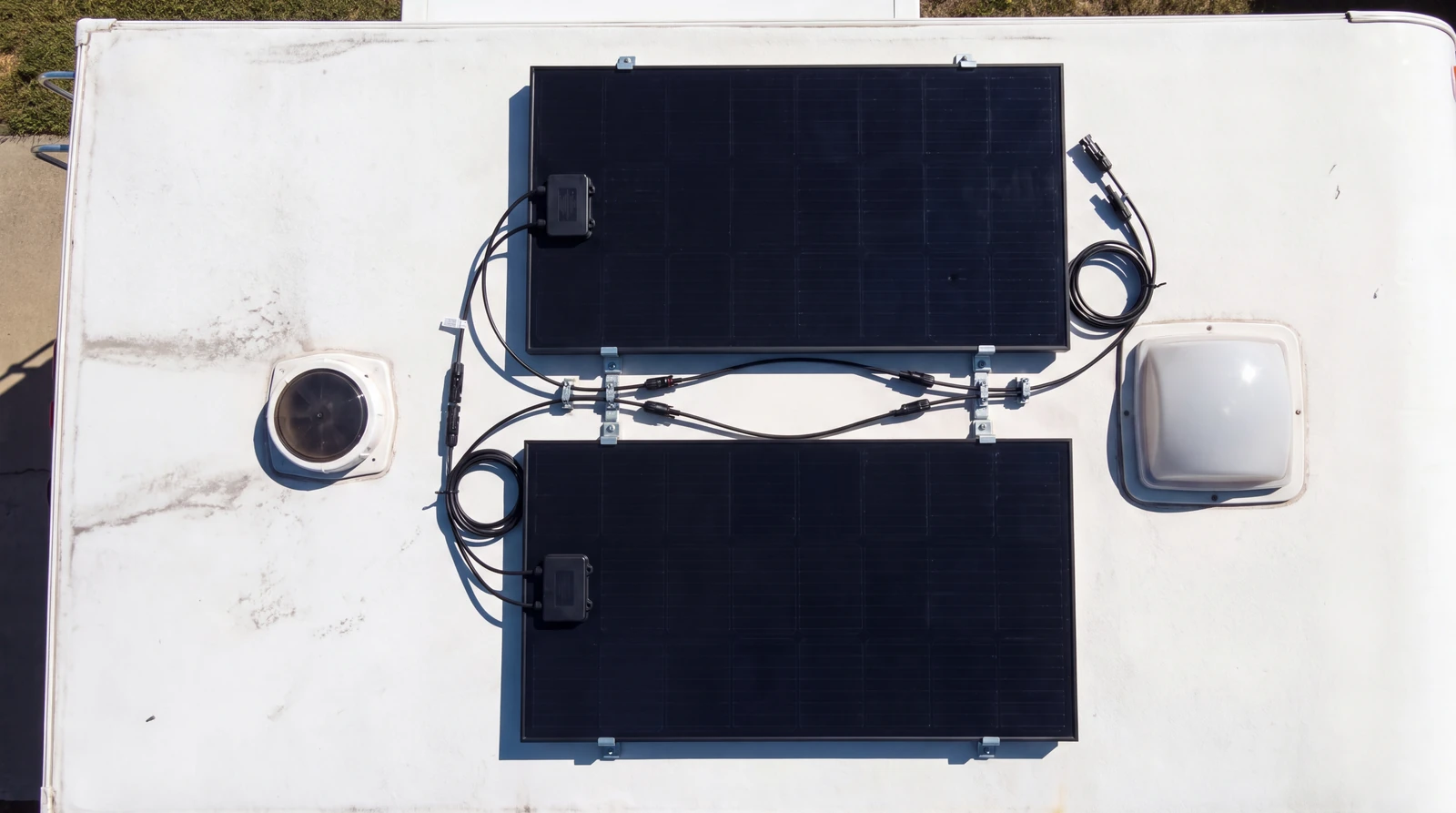
Three identical 20 volt, 5 amp panels: in series they make 60 volts at 5 amps, in parallel 20 volts at 15 amps, and 300 watts either way.
If the terms are new, our plain English introduction to solar power on an RV covers the basics first.
What Actually Differs
Everything below follows panel and controller manufacturer documentation, last verified August 2026.
Voltage and current
- Series
- Voltages add, current stays at one panel’s rating.
- Parallel
- Voltage stays, currents add across panels.
Partial shade
- Series
- One shaded panel drags the whole string.
- Parallel
- Each panel produces on its own.
Wire gauge
- Series
- Thinner wire carries the same power at higher voltage.
- Parallel
- Thicker wire and branch connectors for the summed current.
Controller fit
- Series
- Wants MPPT input voltage room, with cold margin.
- Parallel
- Works closer to battery voltage, PWM included.
Fusing
- Series
- String level, per the full wiring guide.
- Parallel
- Branch fuses commonly required at 3 plus strings.
Morning and evening
- Series
- Higher voltage clears the charging threshold earlier.
- Parallel
- Low light output starts later at low voltage.
| Criterion | Series | Parallel |
|---|---|---|
| Voltage and current | Voltages add, current stays at one panel’s rating. | Voltage stays, currents add across panels. |
| Partial shade | One shaded panel drags the whole string. | Each panel produces on its own. |
| Wire gauge | Thinner wire carries the same power at higher voltage. | Thicker wire and branch connectors for the summed current. |
| Controller fit | Wants MPPT input voltage room, with cold margin. | Works closer to battery voltage, PWM included. |
| Fusing | String level, per the full wiring guide. | Branch fuses commonly required at 3 plus strings. |
| Morning and evening | Higher voltage clears the charging threshold earlier. | Low light output starts later at low voltage. |
The Controller Draws the Boundary
Every charge controller publishes a maximum input voltage and current, and the wiring pattern must land inside both.
Series strings need cold weather margin, because panel voltage rises below freezing per manufacturer spec sheets, and exceeding the input limit damages hardware.
Which controller type handles which voltages is the subject of our close look at the two charge controller designs, and the fusing that goes with each pattern is in the full wiring guide.
Affiliate Disclosure
This page contains affiliate links to A1 SolarStore.
When you purchase from A1 SolarStore through these links, we may earn a commission at no additional cost to you.
This helps support our free calculators, guides, and research tools. Read our full disclosure
Identical panels are what make either pattern's arithmetic hold, so match before you buy.
Built to last your RV adventures
Rated 4.4 of 5 on Trustpilot, checked August 2026 (opens in a new tab)Fast US shipping. Other trust signals verified August 2026.
Shop RV Solar Panels for Off Grid CampingAffiliate link. We may earn a commission at no extra cost to you.
Solar sizing tips by email
Wiring patterns, controller limits, and the cold weather margins spec sheets bury.
Free by email. Unsubscribe anytime.
Where This Comes From
The worked figures on this page are electrical arithmetic, and the shade, fusing, and voltage margin behavior follows panel and controller manufacturer documentation.
No array of ours was wired or metered in the making of it.
Verified August 2026, and the input limits in your controller's manual outrank every general rule on this page.
Smart RV Hub Editorial Team
RV Technology Research and Reviews
Our writers research smart RV technology full time, covering solar power, connectivity, security, and power management.
Every guide draws on published manufacturer specifications and verified owner reviews, so you can compare options with confidence.
Meet the editorial team and our review standardsSeries vs Parallel Questions
Should I wire my RV solar panels in series or parallel?
Series when your controller is an MPPT with input room and your roof is shade free, parallel when partial shade is your daily reality.
Many RV arrays land on a mix, and the controller's published input limits are the hard boundary either way.
What does series wiring do?
Voltages add and current stays the same: three 20 volt, 5 amp panels become a 60 volt, 5 amp string.
Higher voltage means thinner wire for the same power and an earlier start to the charging day, per MPPT manufacturer documentation.
What does parallel wiring do?
Currents add and voltage stays the same: the same three panels become a 20 volt, 15 amp array.
Each panel works alone, so shade on one leaves the others producing, at the cost of thicker wire and branch fusing.
Does series or parallel produce more power?
Neither: the same panels make the same watts either way, and the diagram on this page shows both at 300 watts.
What changes is how the array behaves in shade and what the wiring run costs.
Why does shade hurt a series string so much?
Current in a series string is limited by its weakest panel, so one shaded panel drags every panel toward its output.
Bypass diodes soften this per panel manufacturer documentation, and parallel wiring avoids the mechanism entirely.
What are the limits on how many panels I can chain?
The charge controller's published maximum input voltage and current, with cold weather margin: panel voltage rises below freezing per manufacturer spec sheets.
Exceeding the voltage limit is a hardware damaging error, which is why the margin is not optional.
Do parallel panels need their own fuses?
At three or more parallel strings, panel manufacturers commonly require branch fusing, per the series fuse rating printed on the panel label.
Our full wiring guide covers where those fuses sit in the chain.
Can I mix series and parallel?
Yes: series pairs wired in parallel is a common RV pattern that splits the difference on voltage and shade behavior.
Both halves of the mix must be identical panels for the arithmetic to hold.
The chain, the controller, and the panels around this decision.
The Full Wiring Chain
The full chain this decision sits inside, with fusing.
Controller Types Compared
The controller choice that shapes the wiring choice.
Panels To Apply This To
The panels this arithmetic gets applied to.
How Many Panels You Need
How many panels the roof needs in the first place.
Flexible vs Rigid Solar Panels
The panel format question beside the wiring one.
Sizing The Inverter
The load side of the same electrical system.
Where to Buy Matched Solar Gear
A closer look at the A1 SolarStore catalog and support.
The Variable Only Your Roof Knows
Where the shade falls on your roof at your usual camps decides this, and no spec sheet can see it.
Watch the roof over a couple of trips before committing the wiring, because an air conditioner shadow at 3pm is worth more than any diagram, this one included.
Fast US shipping. Other trust signals verified August 2026.
Shop RV Solar Panels for Off Grid CampingAffiliate link. We may earn a commission at no extra cost to you.