Portable Solar Panel for RV Owners: Suitcase Kit or Roof System?
Written for owners who already have a rig. It covers which setup fits your camping, and how much daily effort each one asks for.
By Smart RV Hub Editorial Team · 7 min read · Methodology: published manufacturer specifications and user reviews
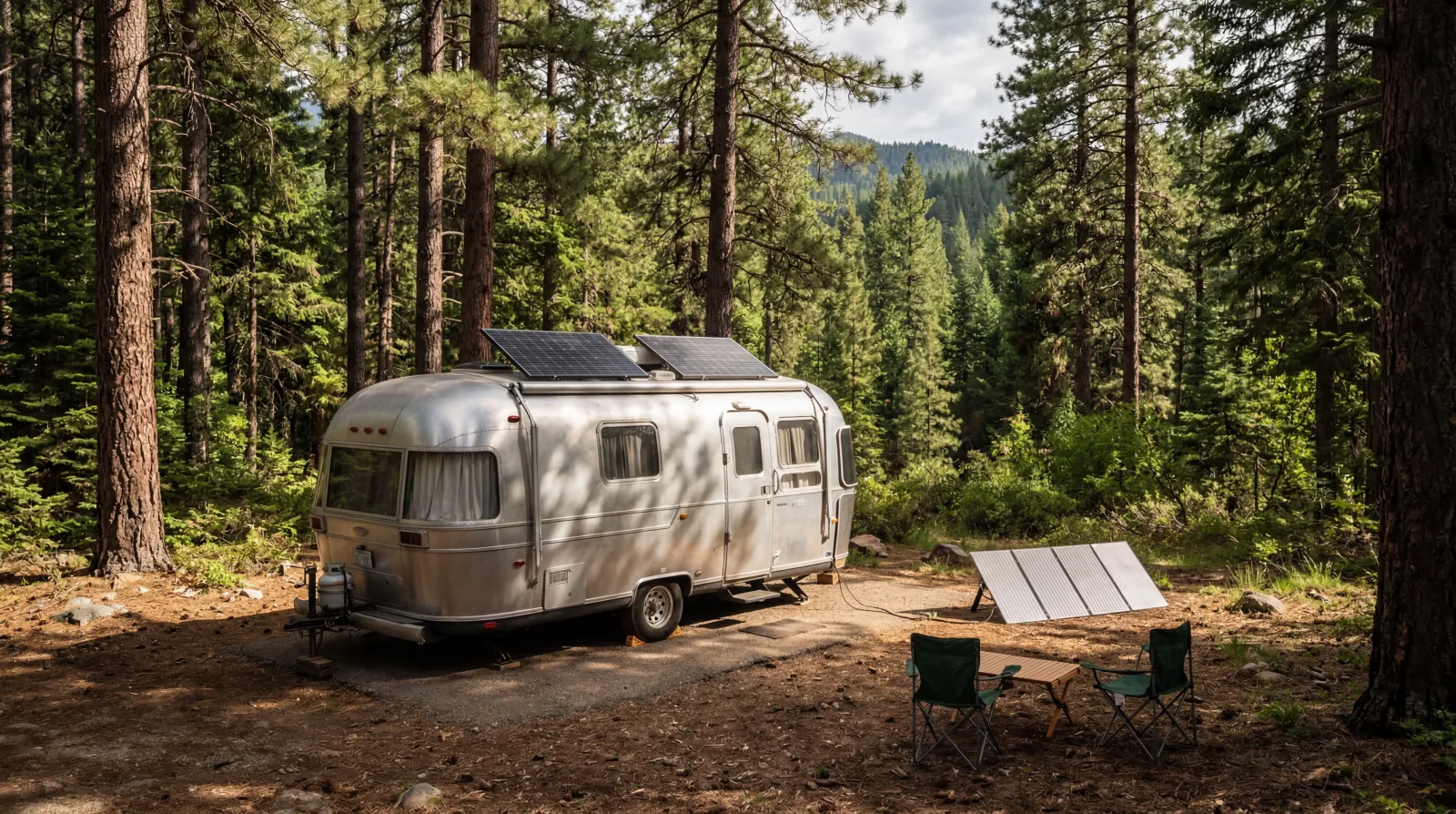
Portable solar suits short stays in one site, where you can angle the panel by hand.
Roof mounted solar suits owners who drive most days and want power with no daily routine.
How you camp decides this, not how many watts you want.
Affiliate Disclosure
Smart RV Hub may earn a commission if you purchase from A1 SolarStore through these links, at no additional cost to you; see our full disclosure.
Both setups below sell as complete kits, which keeps the panel, controller, and wiring matched to each other.
Ships fast to get you camping sooner
Rated 4.5 of 5 on Trustpilot, checked October 2026 (opens in a new tab)Fast US shipping. Other trust signals verified October 2026.
Shop RV Solar Panels and BatteriesAffiliate link. We may earn a commission at no extra cost to you.
What you'll discover
- When portable beats a roof system, and when it does not
- What is actually inside a solar suitcase kit
- How to size a portable setup for your loads
- The four drawbacks owners raise most often
Who Should Use Portable Solar Panels?
Portable solar panels appeal to owners who want extra power without committing to a permanent install.
A portable solar panel is often called a solar suitcase or a portable RV solar kit. It makes power at your campsite without cutting into your roof.
Your camping pattern settles this first. Wattage comes later.
Full timers who move often lean toward roof mounted systems, while weekend campers and seasonal users usually do better with a kit they can pack away.
If you already know you want a roof kit, our wattage guides cover installation and sizing. Each is a starting point, broken down at 200 watts, 400 watts, 600 watts, and 800 watts.
When Does Portable Solar Beat a Roof Mounted System?
Portable solar earns its keep when the rig stays put and someone is willing to walk the panel into better light.
It also suits renters and borrowed rigs. Anyone unwilling to put holes in a roof can try it just as easily, and nothing is permanent if your camping style shifts.
A roof array earns its place once travel days outnumber settled ones. It keeps charging while the wheels turn, and full timers value waking to a charged bank, with no cables to run and no panels to carry.
Portable Kits
- No drilling and no roof work
- Angle it by hand to follow the sun
- Packs away, and resells if plans change
- Left outside, so theft and setup are real costs
Roof Mounted Systems
- Charges while you drive in daylight
- No daily setup and no cable through a window
- Nothing to stow away at all
- Fixed angle, and there is no undoing it
If you move sites nightly, a roof mounted system saves the daily setup and takedown a portable kit needs. Our RV solar system sizing guide matches panel wattage to your real power use, whichever setup you land on.
Portable vs Roof Mounted RV Solar Compared
| Feature | Portable | Roof mounted |
|---|---|---|
| Setup time | Set up and packed away each use | Fitted once, then left alone |
| Sun tracking | Tilted and turned by the owner | Whatever angle the roof gives you |
| Security | Sits on the ground, easy to lift | Mounted on the roof, harder to remove |
| Storage space | Takes up space when folded | No storage needed once installed |
| Power while driving | Cannot charge while driving | Tops up the bank while underway |
| Best camping style | Short stays, parked in one place | Frequent moving, daily driving |
| Wattage in published listings | About 90 to 400 watts | About 200 to 800 watts and up |
| Installation | No holes in the roof | Roof drilling or a professional install |
What Is Inside an RV Solar Suitcase Kit?
Based on published specs from portable kit makers, a solar suitcase folds two rigid panels into a case, and retailer listings describe a carry handle, while several models add a kickstand.
Kits commonly include a charge controller built into the case. That part controls what reaches your battery, so you do not buy it separately.
A cable runs from the kit to your battery bank through a port or a window. Cable length varies by kit, so check the listing before you plan where the panel will sit.
Some kits use alligator clips for a direct battery connection. Others use a plug and socket, listed as SAE or Anderson, for a tidier setup.
According to published portable kit listings, output runs from about 90 watts to about 400 watts per unit, and makers also sell expansion kits for owners who want to add a second panel.
The panels inside are almost always rigid rather than flexible. See the comparison of flexible and rigid panels for the reasoning behind that.
What Should You Look for When Comparing Portable Solar Panels?
Compare portable panels on seven things: watts, folded size and weight, the controller, the kickstand, weather rating, the connector and cable, and the warranty.
- Watts against your daily use: a 200W panel suits a 12V fridge and device charging, while 100W is a top up for phones, lights and a laptop
- Folded size and weight: you carry it out and back most days, so check it fits the bay you will stow it in
- Controller type: check whether a controller is built in, and whether it is PWM or MPPT
- Kickstand angle: an adjustable stand lets you tilt the panel toward the sun as it moves
- Weather rating: look for a published water resistance rating if the panel stays out overnight
- Connector and cable length: match the plug to your battery or side wall port, and make sure the cable reaches the sun from the shade
- Warranty: portable kits often carry shorter warranties than rigid roof panels, so read the term before you buy
As an example, Renogy lists its 200W 12V portable suitcase kit at $322.99 with a 20A PWM controller built in, checked October 2026. Renogy's limited warranty gives its suitcase kits 2 to 5 years of material and workmanship cover depending on the model, against 10 years on its rigid N type panels.
Our pre order checklist for each portable size adds what 100W to 400W panels recover on a clear day.
Sizing a Portable Solar Setup for Your RV
Work from your daily power use, not the wattage printed on the box.
A phone charger, a few LED lights, and a fan draw very little. A CPAP breathing machine or a small refrigerator draws far more.
As a rough starting point, light use sits in the 100 to 200 watt range. Heavier daily use often lands in the 200 to 400 watt range.
Sun position matters more for portable panels than for roof panels. You angle a suitcase kit by hand rather than leaving it fixed, which is why retailer guidance describes shifting it through the day to keep it in direct sun.
For more precision than a range like this can offer, the full sizing guide includes a load calculator.
For what each wattage tier actually returns in a day, see portable RV solar panel sizes.
One panel does not make a working setup.
A complete kit ships the panel, the charge controller, and the cable already matched, which takes the component guesswork off your plate.
Ships fast to get you camping sooner
Rated 4.5 of 5 on Trustpilot, checked October 2026 (opens in a new tab)Fast US shipping. Other trust signals verified October 2026.
Shop RV Solar Panels and BatteriesAffiliate link. We may earn a commission at no extra cost to you.
What Are the Real Drawbacks of Portable Solar Panels?
Four things push owners back toward a roof array, and none of them show up on a product page.
Theft
A portable panel sits outside the rig where anyone can pick it up.
That is the usual sticking point.
Many add a cable lock or bring the panel inside overnight at unfamiliar campsites.
Cable runs
The cable has to run somewhere.
It reaches from wherever you place the panel to your battery bank, usually through a window or door left slightly open, and that gap also lets in bugs, dust, and cold air.
Chasing the sun
Portable panels only earn their angle advantage if you move them as the sun crosses the sky.
Skip that and output drops.
A stationary panel drifts out of direct sun within a few hours.
Storage space
A folded suitcase kit still needs somewhere dry to live, which means a spot inside the rig or in a basement bay whenever it is not in use.
Owners short on storage often find this the point that decides it.
How Do You Choose Between Portable and Roof Mounted Solar?
Begin with your travel rhythm, not with a wattage target.
A portable kit is a reasonable starting point if the rig sits still for a few nights. It only works if a short daily routine does not bother you.
A roof mounted system is worth the installation effort for frequent travel days. See what that install actually involves in the installation guide before you decide.
A folding panel you can carry is a straightforward answer to cloudy stretches and unexpected demand. Once you are ready to shortlist, the guide to buying RV solar panels compares retailers and complete kits on whole system price.
Goal Zero, Jackery and Bluetti: The Power Station Route
A portable panel needs somewhere to put the power, and for many owners that is a power station rather than the rig's own bank.
A power station is a battery, an inverter and a charge controller in one carryable case. No install, no holes in the roof.
Goal Zero
The Yeti range is the one most often sold alongside its own folding panels as a matched kit.
Convenient, and usually the most expensive way to buy a given number of watt hours.
Jackery
Widely stocked and simple to use, which makes it a common first power station.
Check whether the model you are looking at uses lithium iron phosphate, because the older cells have a shorter service life.
Bluetti
Tends to lead on capacity and on how much solar input the unit will accept at once.
Check that input ceiling. It caps how fast any panel can refill it.
The trade is cost per watt hour, and a power station sits well above a wired bank there. You pay for the convenience.
What you buy instead is no installation, and the option of carrying the whole thing away from the rig.
If you would rather put the power into the rig itself, the storage side of a fitted system covers the chemistries and what each one costs to run.
If a Roof Kit Is the Answer
Each wattage guide covers what that size runs and which battery suits it. Use them as a starting point, then size against your own daily use.
See both setups side by side before you commit to either one.
A1 SolarStore sells full size roof panels from 355W up and publishes specs alongside every listing. It does not sell folding portable panels, so buy those elsewhere if you need one.
Ships fast to get you camping sooner
Rated 4.5 of 5 on Trustpilot, checked October 2026 (opens in a new tab)Fast US shipping. Other trust signals verified October 2026.
Shop RV Solar Panels and BatteriesAffiliate link. We may earn a commission at no extra cost to you.
Still Weighing Portable Against Roof?
Get our RV solar guides by email, covering sizing, wiring, and kit comparisons.
Free by email. Unsubscribe anytime.
Build the Right Setup
Pick up whichever decision comes next for you, from sizing and panel type to mounting and where to buy.
Match Panels To Your Daily Loads
Match wattage, battery, and controller to what you actually run.
Flexible Against Rigid Panels
Why almost every suitcase kit uses rigid panels.
Mounting And Wiring A Roof Array
What a permanent install involves before you commit.
Where To Buy RV Solar
Retailers and complete kits compared on whole system price.
Frequently Asked Questions
What is a solar suitcase for an RV?
A solar suitcase is a portable solar panel kit that folds in half like a case.
It usually has a built in charge controller and a carry handle.
You set it up outside your RV and run a cable to your battery bank.
How many watts do I need for a portable RV solar kit?
It follows your daily watt hours, which have little to do with how big the rig is.
Small electronics need far less than anything with a motor or a compressor.
Add up your own loads before you shortlist a kit. Size your system properly.
Can a portable solar panel run my RV air conditioner?
A standard portable solar kit is not sized for air conditioning.
Air conditioning needs a large battery bank and usually a generator or a campground power hookup as well.
Portable solar works best for lights, device charging, water pumps, and small electronics.
Is a portable solar panel safe from theft at a campsite?
Anything left on the ground is easier to walk off with than a panel bolted to a roof.
Owners manage that with a lock, a site they can see from the door, or by stowing the kit at night.
Can I use a portable solar panel with a roof mounted system at the same time?
Yes, pairing the two is common, with the fixed array carrying the everyday load and the folding kit covering peaks.
Check your charge controller specs before combining panel types, since combined wattage needs to stay within its rated input.
Do portable solar panels work in the shade?
Output falls sharply in shade for portable and roof panels alike, since both rely on direct sun.
The one advantage a portable kit has is that you can park the rig in shade and then carry the panel out to a sunny patch nearby.
How far can a portable solar panel sit from the RV?
That depends on the cable supplied, which the product listing spells out.
Longer runs are possible with thicker cable, though more power is lost over distance so the gain shrinks.
Are portable panels rigid or flexible?
Almost every solar suitcase uses two rigid framed panels hinged together.
The frame is what lets the kit stand on its own kickstand.
Flexible panels are a separate category aimed at curved roofs rather than portable use. Flexible panels against rigid.
Smart RV Hub Editorial Team
RV Technology Research and Reviews
Our writers research smart RV technology full time, covering solar power, connectivity, security, and power management.
Every guide draws on published manufacturer specifications and verified owner reviews, so you can compare options with confidence.
Meet the editorial team and our review standards