
Full Time RV Living Guide: Read This Before You Sell Everything
The honest full time RV living guide for Americans ready to trade their mortgage for a mountain view.
📋 What you'll discover
- Calculate true costs of full time RV living
- Set up mail, domicile, and healthcare as a nomad
- Find reliable income sources for life on the road
- Avoid common mistakes first year full timers make
Affiliate Disclosure
This page contains affiliate links.
When you purchase through these links, we may earn a commission at no additional cost to you.
This helps support our free calculators, guides, and research tools. Read our full disclosure
RV LIFE Pro pricing, campground count, trial terms, and app ratings verified August 2026. Check rvlife.com for current details.
Live the Freedom You've Been Dreaming About
Plan routes and find extended stays across more than 30,000 campgrounds with RV Life Pro.
Rated 4.6 on the App Store, checked August 2026 (opens in a new tab), and available on Google Play. Start with a 7 day free trial.
Try RV Life Pro Free for 7 Days →Affiliate link. We may earn a commission at no extra cost to you.
What Is the Reality of Full Time RV Living?
What may have once seemed unconventional is now a well established lifestyle.
A growing number of Americans have made the same choice.
Many full timers find RV living more affordable than traditional housing.
Costs vary widely based on lifestyle and location.
But this lifestyle will test you.
Successful full time RV living requires mastering five pillars: domicile, mail, healthcare, connectivity, and campground strategy.
Skip one and trouble follows.
Before you commit, take the RV readiness assessment to see how prepared you really are for life on the road.
Sleeping well night after night matters too, so review mattress upgrade options built for full time RV use and our wider guide to upgrading comfort systems for year round living.
Here is each one in turn.
Full Time Essentials:
- • Legal domicile and mail forwarding
- • Reliable internet and connectivity
- • Healthcare and insurance planning
- • Budget and financial management
- • Campground network and planning: use the member campground map and reviews to discover long term stay options
Domicile & Mail
Establish legal domicile in RV friendly states and set up mail forwarding for important documents.
Work & Income
Remote work, freelancing, and location independent income sources pay for a full time travel routine.
Campground Strategy
Balance between free camping, membership parks, and paid campgrounds to optimize costs and amenities.
Start Your Full Time RV Journey
Plan your nomadic lifestyle with RV Life Pro. Find extended stay campgrounds in a database of more than 30,000 sites and plan RV safe routes between them.
Rated 4.6 on the App Store, checked August 2026, and backed by a 30 day money back guarantee, according to RV LIFE.
Start Your 7 Day Free Trial →Affiliate link. We may earn a commission at no extra cost to you.
How Much Does Full Time RV Living Cost?
Full time RV living runs roughly $1,800 to $3,100 per month for most travelers, with campground fees and insurance the two largest line items and free camping the biggest lever for cutting costs.
Average Monthly Expenses
Cost Saving Strategies
- • Use Harvest Hosts and free camping (BLM, National Forests). how many Harvest Hosts nights it takes to cover the membership
- • Join camping membership programs for discounts
- • Work camp for free sites and small income
- • Cook in RV instead of restaurants
- • Solar power reduces campground dependency. See all in one solar installation kits for full time setups
- • Stay longer to reduce fuel costs
Is Full Time RV Living Right for You?
The full time RV lifestyle suits some households better than others. Any savings over traditional housing vary widely by lifestyle and travel style.
Full Time RV Living Essentials Checklist
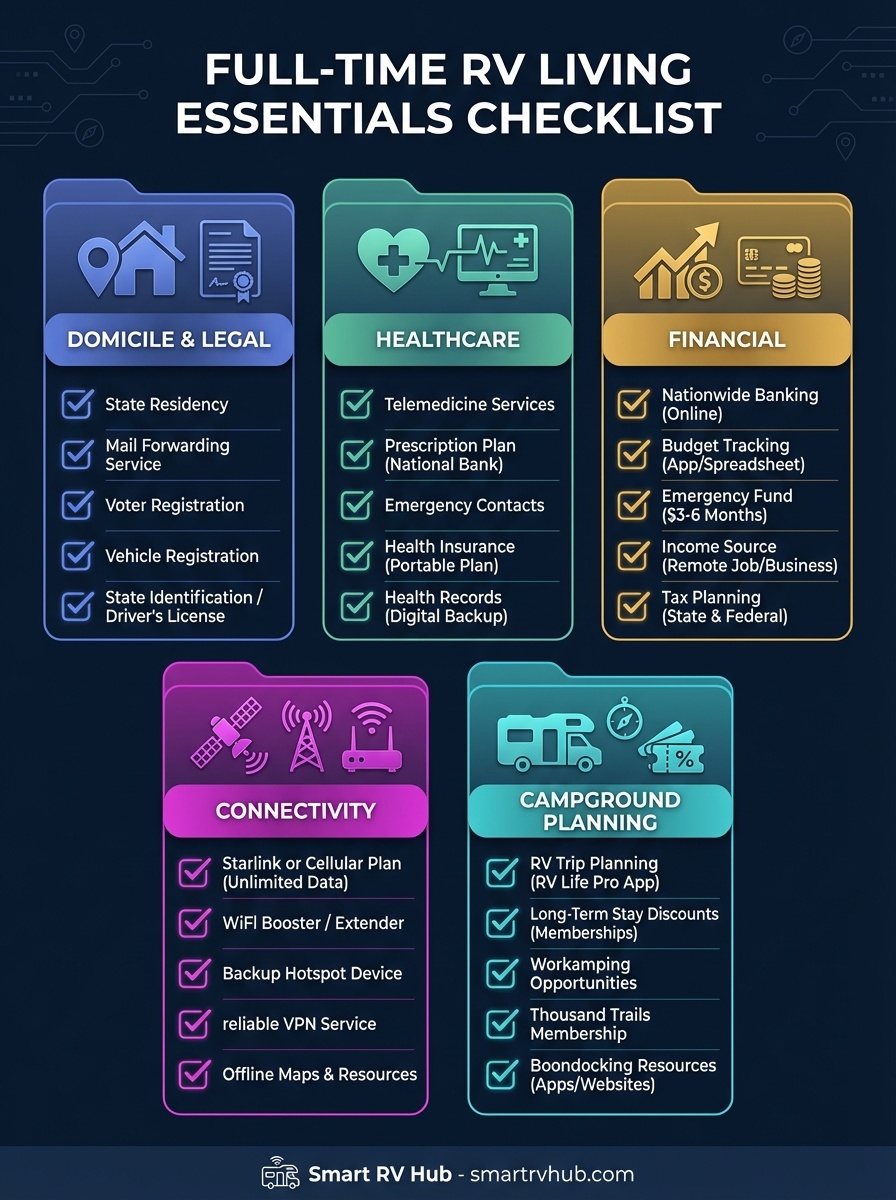
Essential categories to master before going full time on the road
Essential Tools for Full Time RV Living
Plan your routes, find campgrounds, and manage your nomadic lifestyle
RV Life Pro for Full Timers
Trip planning, RV safe routing and campground reviews for full time RVers, plus a maintenance tracker for the rig.
- • 30,000+ campground database
- • Trip planning for continuous travel
- • Maintenance tracker for service records
- • RV safe routing between locations
- • Campground reviews from other full timers
- • Community forums and Masterclass courses
Affiliate link. We may earn a commission at no extra cost to you.
Related RV Lifestyle Resources
Full Time RV Living Frequently Asked Questions
How much does it cost to live in an RV full time?
Full time RV living typically costs between $1,800 to $3,100 per month, including campground fees, fuel, insurance, food, and connectivity.
Many full timers find RV living more affordable than traditional housing, though costs vary widely based on lifestyle and location.
The biggest expenses are campground fees ($600 to $1,200 per month) and insurance ($400 to $600 per month, varies significantly by coverage level, RV value, and location).
Using free camping on BLM land, a Harvest Hosts membership, and work camping programs can significantly reduce monthly expenses.
Is full time RV living cheaper than renting an apartment?
For most people, yes.
Full time RV living averages $1,800 to 3,100 per month compared to typical apartment rent plus utilities averaging $1,500 to 2,500 for just housing alone.
The savings come from lower utility costs and the option of free camping, though RV owners still pay registration and, in some states, personal property tax on the rig.
Upfront RV purchase costs and insurance can run higher, so the total picture depends on your own situation and travel style.
What are the downsides of living in an RV full time?
The biggest challenges include limited living space, constant maintenance and repairs, difficulty establishing permanent healthcare providers, and managing legal domicile and mail forwarding.
A structured maintenance schedule helps, and our RV maintenance checklist ebook is in the works, with a waitlist open now.
Many full timers also struggle with inconsistent internet connectivity for remote work and finding long term parking in desirable locations.
The lifestyle asks for adaptability, mechanical skills, and comfort with minimalism.
It is not for everyone.
How do full time RVers get mail?
Most full timers use mail forwarding services like Escapees, St. Brendan's Isle, or America's Mailbox that provide a permanent address in an RV friendly state.
These services scan and forward mail to wherever you are traveling, typically on a weekly or biweekly schedule.
You can also receive packages at Amazon Lockers, UPS stores, or campground offices along your route for more immediate delivery needs.
What state residency is best for full time RVers?
The three most popular domicile states for full timers are South Dakota, Texas, and Florida due to no state income tax and RV friendly residency laws.
South Dakota is often considered the easiest with a simple one night stay requirement and mail forwarding services that streamline the process.
The best choice depends on your specific tax situation, voting preferences, and whether you need to return periodically for driver's license renewal or vehicle registration.
How do full time RVers earn an income on the road?
Common income sources include remote work, freelancing, running an online business, seasonal work camping, and content creation.
Work camping programs often trade labor for a free campsite plus a small wage, which lowers expenses while adding income.
Many full timers combine several streams so a slow month in one area does not threaten the whole budget.
How do full time RVers handle healthcare?
Most full timers combine a nationwide insurance plan, telemedicine services for routine issues, and mail order prescriptions filled to their forwarding address.
Choosing a domicile state with strong plan networks makes finding in network providers easier while traveling.
Keeping digital copies of medical records and a list of medications helps when visiting a new provider on the road.
What is the best internet setup for full time RV living?
A reliable setup pairs a primary connection such as Starlink or a cellular hotspot with a backup on a second carrier for redundancy.
Internet and connectivity typically run $100 to $200 per month for full timers who depend on staying online for work.
Researching campground signal strength before booking helps avoid sites that cannot support video calls or large uploads.
How do I find long term campgrounds for full time RV living?
Look for parks offering weekly and monthly rates, which are usually far cheaper per night than daily bookings.
RV Life Pro lets you search more than 30,000 campgrounds, read reviews that mention extended stays, and plan RV safe routes between them.
Mixing paid parks with free camping on BLM and National Forest land and memberships like Harvest Hosts keeps monthly costs down.
Smart RV Hub Editorial Team
RV Technology Research and Reviews
Our writers research smart RV technology full time, covering solar power, connectivity, security, and power management.
Every guide draws on published manufacturer specifications and verified owner reviews, so you can compare options with confidence.
Meet the editorial team and our review standardsFull time living is a decision most people make once, and it usually involves selling a house to fund it.
A few weeks in a rented rig of the class you are considering answers the layout and size questions before any of that becomes hard to undo.
Affiliate link. We may earn a commission at no extra cost to you.
Unique Camping Experiences
Pair your RV Life Pro routes with a Harvest Hosts membership for overnight stays at wineries, farms, and breweries along the way, with no nightly fee once you join.
Affiliate link. We may earn a commission at no extra cost to you.