Is RV Solar Worth It? Honest Cost and Payback Analysis (2026)
14 min read
Affiliate Disclosure
This page contains affiliate links to A1 SolarStore.
When you purchase from A1 SolarStore through these links, we may earn a commission at no additional cost to you.
This helps support our free calculators, guides, and research tools. Read our full disclosure
- Over 60 Fulfillment Centers
- Free Shipping on Qualifying Orders
- Rated Excellent on Trustpilot, checked August 2026 (opens in a new tab)
Trust signals verified August 2026. Check a1solarstore.com for current details.
Affiliate link. We may earn a commission at no extra cost to you.
📋 What you'll discover
- Who actually benefits from RV solar and who probably does not
- Real cost breakdowns at three budget levels
- Payback timelines based on your camping frequency
- The honest objections and straightforward answers
- How to start small and expand without wasting money
- What solar does beyond saving money
Affiliate link. We may earn a commission at no extra cost to you.
Who Benefits Most from RV Solar?
Solar does not deliver the same return for every camper. Where you park and how often you dry camp is the single most important variable.
The Weekend Warrior
Camps 20 to 30 nights per year, mostly at established campgrounds with hookups. Dry camps occasionally at free dispersed sites.
Verdict: Worth it if you dry camp 10 or more nights per year. A starter kit at $600 to $1,200 pays back in two seasons and adds resale value.
The Part Time Boondocker
Camps 40 to 80 nights per year with a strong preference for free or low cost dispersed sites. Hates generator noise.
Verdict: Clear yes. A midrange 400W system pays for itself in roughly 14 months at 50 dry camping nights a year, and it eliminates generator dependency entirely.
The Full Timer
Lives in the RV full time, spends most nights off grid or at low cost sites, often works remotely and runs high draw appliances.
Verdict: Absolutely worth it.
Solar is not optional at this level.
The payback is fast and the alternative (daily generator fuel plus campground hookup fees) adds up to thousands per year.
True Cost Breakdown: Three Budget Levels
These ranges cover equipment plus basic installation labor. DIY installs run toward the low end; professional installs run toward the high end.
For the tier most part timers land on, our 600 watt kit breakdown itemizes what the money buys.
Solar has also become far more affordable. The average price of a completed solar system has fallen 59 percent over the past decade. Solar Energy Industries Association
Starter System
$600 to $1,200
- Panels: 200W monocrystalline
- Battery: 100Ah lithium (LiFePO4)
- Controller: 20A PWM or MPPT
- Best for: Lights, phone charging, fan, small 12V fridge
Covers roughly 600 to 800Wh of daily use. A solid entry point that you can expand later without replacing components.
Midrange System
$2,000 to $3,500
- Panels: 400W (two 200W panels)
- Battery: 200Ah lithium
- Controller: 40A MPPT
- Best for: 12V fridge, laptop, Starlink, overnight comforts
The most popular tier for part time boondockers. Covers 1,500 to 2,500Wh per day comfortably.
Premium System
$4,500 to $7,000+
- Panels: 800W or more
- Battery: 400Ah or more lithium
- Controller: 60A MPPT
- Best for: Full timers, AC use, remote work office, high draw appliances
Includes a 2,000 to 3,000W pure sine inverter and complete wiring. Designed to replace shore power indefinitely.
Payback Analysis: When Does Solar Pay for Itself?
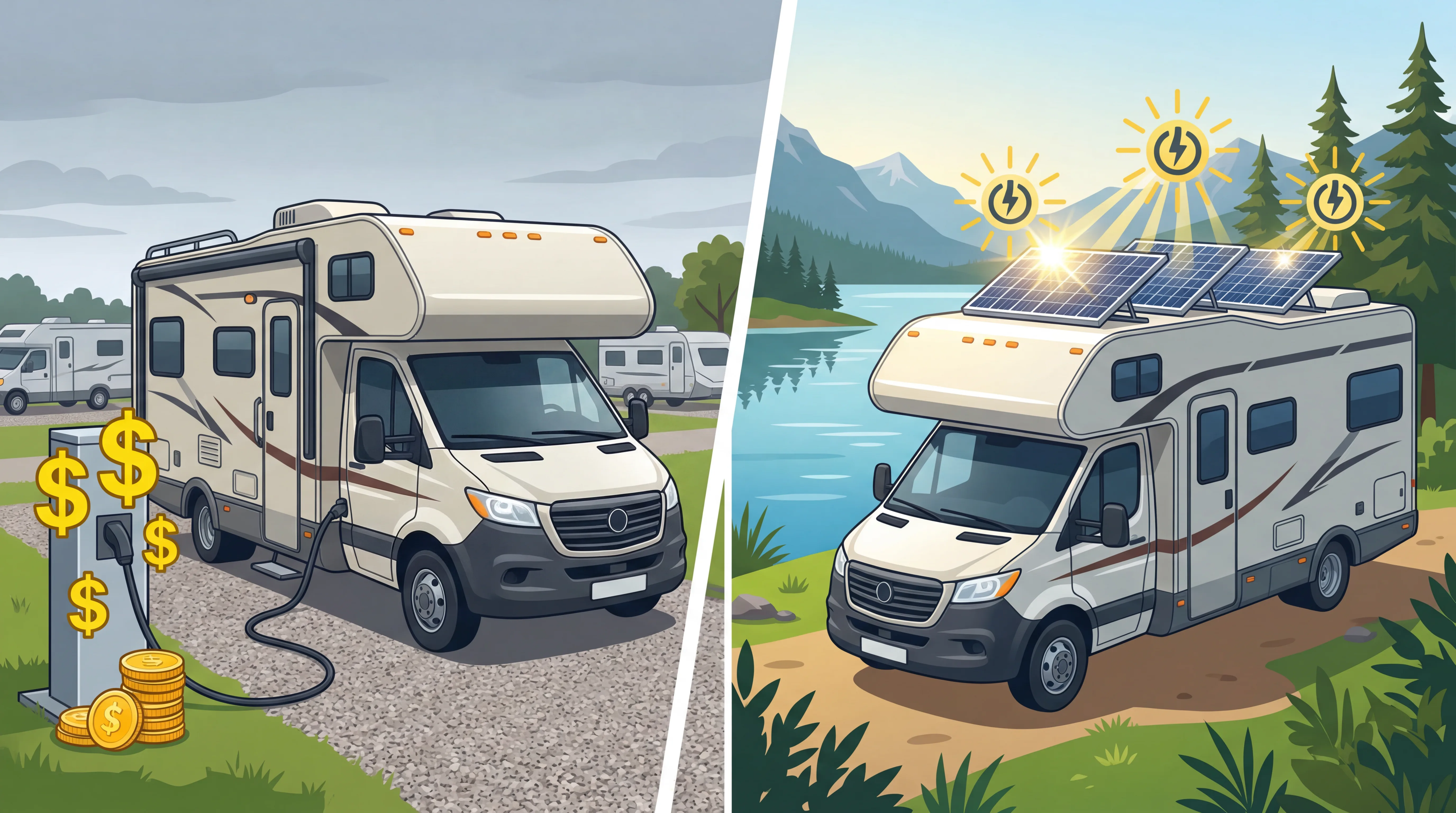
There are three costs solar directly replaces. Add up what you currently spend on each and you have your personal payback timeline.
Full timers replace the most, and the 800 watt kit walkthrough shows the build that usually gets them there.
Campground Hookup Fees
Full hookup sites typically run $25 to $50 per night in the US, with popular national park adjacent spots exceeding $60.
At 50 boondocking nights per year instead of paid hookups, you save $1,250 to $2,500 annually.
Generator Fuel
A typical RV generator burns 0.3 to 0.5 gallons per hour and requires 4 to 6 hours of daily runtime to keep batteries charged.
At $3 to $5 per gallon, daily fuel cost runs $3.60 to $15. Over 90 boondocking days per year that is $324 to $1,350 in fuel alone.
Generator Maintenance
Annual generator maintenance (oil, air filter, spark plugs, carb service) runs $200 to $500 per year for a regularly used unit.
Generators also depreciate and eventually need replacement. A solar system has no moving parts and no recurring fuel cost.
Upkeep for panels amounts to occasional cleaning and inspections, as covered in our RV solar maintenance routine.
Break Even Example: Midrange System
System cost: $2,750 (midpoint of $2,000 to $3,500 range).
Annual savings: 50 boondocking nights replacing $35/night hookups = $1,750 saved.
Add generator fuel eliminated: $600 saved per year.
Total annual savings: approximately $2,350.
Break even: roughly 14 months.
From month 15 onward, every boondocking night is money in your pocket.
When does RV solar pay for itself?
Drag your dry camping nights per year. We use the $2,750 midrange system, $35 hookup nights, and $600 a year of generator fuel from this page.
Estimated savings per year
$2,350
50 nights at $35 plus $600 generator fuel
Pays back the $2,750 system in
about 14 months
A simple estimate from the figures on this page. Your real payback depends on your actual system cost and how often you dry camp.
Shop RV solar kits at A1 SolarStoreAffiliate link. We may earn a commission if you buy, at no extra cost to you.
Trust signals verified August 2026.
Want These Figures in Writing?
Your estimate: about 14 months at 50 nights a year.
Send yourself this payback estimate along with RV solar sizing and install guidance.
No spam, and you can unsubscribe anytime. See our Privacy Policy.
Fast US shipping. Other trust signals verified August 2026.
Compare RV Solar Kits and PricesAffiliate link. We may earn a commission at no extra cost to you.
Benefits Beyond the Financial Math
The payback analysis only captures what you can count in dollars.
Several strong reasons to go solar never show up on a spreadsheet.
- •
Complete campsite freedom
Solar unlocks Bureau of Land Management land, national forests, and dispersed camping zones that have no hookups at all. The best spots in the American West are almost entirely accessible only to self sufficient rigs.
- •
Silence where it counts
A generator running at 6am to charge batteries is a fast way to make enemies at any campsite. Solar produces power silently from first light.
No engine noise, no exhaust smell, no apologizing to neighbors.
- •
Increased resale value
A professionally installed solar system with documentation can make an RV more attractive to buyers who want off grid capability. A finished system removes a project the next owner would otherwise have to tackle themselves.
- •
Energy independence during emergencies
When grid power fails, campgrounds with hookups go dark. A solar equipped RV becomes a self sufficient shelter.
A battery bank charged by panels keeps lights, a fridge and devices running for as long as the sun keeps recharging it, with no fuel run and no hookup.
- •
Lower environmental impact
Eliminating generator runtime removes a meaningful source of carbon emissions and noise pollution from natural areas. Many national park dispersed camping areas are increasingly discouraging generator use.
Honest Objections (and Honest Answers)
These are the real reasons people hesitate. Each one deserves a straight answer rather than dismissal.
"I do not boondock enough to justify it"
Even 10 to 15 dry camping nights per year saves $250 to $750 in hookup fees and delivers a quiet, hassle free camping experience. A starter kit at $600 to $800 breaks even in two seasons.
If you ever want to spend a night somewhere without hookups, solar removes the barrier entirely.
"My roof is too small for solar panels"
Portable folding panels and ground mounted systems exist for exactly this situation. A 200W portable panel kit deploys from a storage bay in minutes and costs $300 to $500.
You lose some convenience but gain full flexibility in panel placement regardless of roof space or shading.
"I camp in a cloudy region"
Solar still works in overcast conditions, producing 10 to 25% of rated output on gray days. The fix is oversizing your panel array by 30 to 50%.
A 600W array producing 20% output still delivers 120W, which keeps a modest battery bank healthy through multi day overcast stretches.
"I am selling my RV within two years"
A professionally installed solar system can return part of its cost in resale value, and a documented install appeals to buyers who want off grid capability. Two years of camping savings on top of that can put you ahead financially even with a short ownership window.
Document everything and market to solar seeking buyers.
"The upfront cost is too high"
Start with a $600 to $800 starter system. It handles basic needs, teaches you how solar works in your specific rig, and expands cleanly later.
You do not have to buy the whole system at once. Most experienced solar RVers started small and added capacity over two or three seasons.
Start Small, Expand Later
Solar scales incrementally, so you do not have to buy the full system on day one.
Here is a sensible upgrade pathway that lets you learn and grow without wasting money on prematurely large components.
Still on the fence about the whole lifestyle? Renting a solar equipped RV through Outdoorsy lets you test the technology before you build a system of your own.
Phase 1: The Starter (200W)
One 200W panel, a 30A MPPT controller with expansion headroom, and 100Ah of lithium. Covers lights, phone charging, a 12V fan, and basic loads.
Key: Choose an MPPT controller rated for 40A even if your panels only need 20A. That headroom means Phase 2 is plug and play.
Phase 2: The Upgrade (400W)
Add a second 200W panel and upgrade to 200Ah lithium. Now your system runs a 12V fridge, laptop, and overnight loads without generator backup.
This upgrade typically costs $800 to $1,200 added to your Phase 1 investment.
Phase 3: Full Timer Ready (800W or more)
Double the panels to 800W, expand to 400Ah of lithium, and add a 2,000W pure sine inverter for AC appliances. At this tier, shore power becomes truly optional.
Use our step by step load and panel sizing to calculate your exact requirements before committing to this tier.
The single most important Phase 1 decision is choosing the right charge controller.
Read our MPPT vs PWM controller comparison before buying. The $50 difference between a PWM and MPPT unit at 200W is the difference between a system that expands cleanly and one that requires a full swap at Phase 2.
Where to Buy RV Solar Equipment
Compare A1 SolarStore before you buy anywhere else, since every part in its kits is sized to work together.
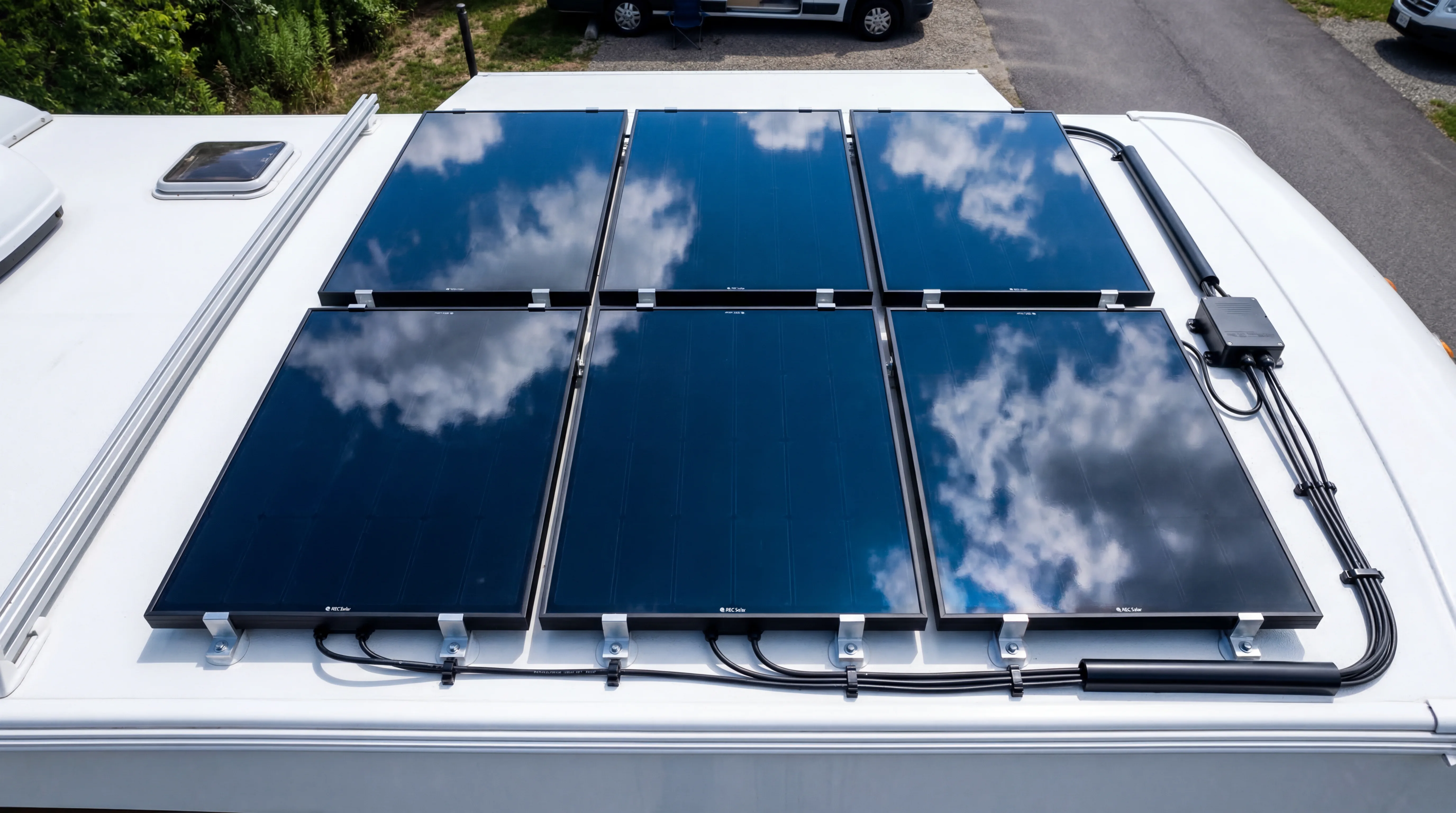
A1 SolarStore specializes in RV solar systems and carries complete kits, individual panels, LiFePO4 batteries, and charge controllers. Its panel range includes Trina, Canadian Solar, and REC, with lithium batteries from brands like Victron and SimpliPhi (stock verified August 2026).
If you would rather not assemble parts yourself, our all in one solar kit options for RV owners bundle everything that works together out of the box.
The tech support staff can match components to the system size you worked out above.
Browse their full RV solar catalog in our RV solar panels buying guide.
Equipment pricing moves throughout the year, so review the current discounts on RV solar gear before ordering to improve your payback math.
Planning to upgrade your battery bank alongside a solar install? Our top LiFePO4 battery picks for RV use break down the best options by capacity and value for the money.
Try Before You Invest
Not sure about solar? Rent an RV with solar already installed and test your real power needs before making the investment.
Affiliate link. We may earn a commission at no extra cost to you.
Go Deeper on the Details
Once you have decided solar makes sense for your camping style, these guides cover the specifics of building a great system.
- →Sizing Panels and Batteries to Your Loads
Calculate your exact panel, battery, and controller size based on your real daily loads.
- →Which Panels To Put On Top
Compare the top monocrystalline panels for efficiency, durability, and value.
- →Complete Kits Worth Buying
Prematched complete kits that include panels, controller, wiring, and hardware.
- →Choosing And Protecting Your Bank
Lithium vs AGM, capacity sizing, and how to protect your battery bank long term.
- →Picking Your Charge Controller
Which controller type is right for your system size and budget.
- →Mounting And Wiring It Yourself
Step by step panel mounting, wiring, and safe connection of every component.
- →Renogy vs Battle Born Batteries
How the two popular lithium battery brands compare on price, capacity, and warranty.
- →Flexible vs Rigid Panels for Your Roof
Weight, output, and durability tradeoffs between the two panel styles.
- →Your total RV solar cost
Work out a realistic budget for panels, batteries, and wiring before you commit.
Frequently Asked Questions
How long do RV solar panels last?
Quality monocrystalline panels carry 25 year power output warranties and typically retain 80% or more of rated output after 25 years. Degradation averages 0.3 to 0.5% per year.
Physical damage and failed junction boxes are more common failure points than gradual cell degradation.
Does RV solar work in winter?
Yes. Solar panels actually produce slightly more power in cold temperatures because efficiency improves as cells cool.
The challenge in winter is shorter daylight hours and lower sun angles. Size your system with 30 to 50% extra panel capacity if you camp primarily in winter months.
Can I sell my RV with solar panels installed?
Yes, and it typically helps your sale. Buyers searching for solar equipped RVs are a specific, motivated audience.
A professionally installed system with documentation appeals to that audience and can support a faster sale because the work is already done.
Do I need permits for RV solar?
Generally no for rooftop installs on a recreational vehicle. RVs are not subject to residential building codes.
Some states and campgrounds have rules about portable ground mounted panels, so check local regulations if you plan to deploy panels outside the vehicle.
Should I install RV solar myself or hire a professional?
A 200W starter kit is DIY friendly if you are comfortable with basic 12V wiring. A system above 400W with lithium batteries, an inverter, and AC circuits warrants professional installation.
Mistakes in DC wiring can cause fires. Our installation guide covers safe DIY practices for each tier.
How much maintenance does RV solar require?
Very little. Rinse panels with water a few times per year to remove dust and bird droppings.
Inspect terminal connections and wiring annually for corrosion or chafing. Check battery state of health every 12 months.
A well installed system can run for years with no intervention.
Can I finance an RV solar system?
Yes. Many solar retailers offer payment plans, and some RV lenders allow adding solar to an existing RV loan as an improvement.
A $2,500 midrange system financed at 12% over 24 months costs about $118 per month. If it replaces $30 to $50 per night in hookup fees, the math can work in your favor from month one.
What is the best starter solar kit for an RV?
Look for a kit that includes a 200W monocrystalline panel, a 20A or 30A MPPT charge controller, mounting hardware, and wiring. Pair it with a 100Ah lithium battery for the best value.
Avoid cheap PWM controllers bundled with budget kits, the efficiency loss adds up fast.
Is solar worth it if I mostly stay at campgrounds?
Probably not as a financial investment. If you spend 90% of nights at sites with full hookups, you will never recoup the installation cost against hookup savings.
The case for solar then rests on convenience (no cord management), resale value, and the occasional dry camping trip where it pays immediate dividends.
What happens on cloudy days?
Panels still produce 10 to 25% of rated wattage under heavy cloud cover. A 400W array might deliver 40 to 100W on a gray day.
Monocrystalline panels produce more usable power than polycrystalline in diffuse light. Sizing your battery bank for two days of autonomy provides buffer through multi day overcast stretches.
Smart RV Hub Editorial Team
RV Technology Research and Reviews
Our writers research smart RV technology full time, covering solar power, connectivity, security, and power management.
Every guide draws on published manufacturer specifications and verified owner reviews, so you can compare options with confidence.
Meet the editorial team and our review standardsReady to Get Off the Grid?
A1 SolarStore carries panels, complete kits, lithium batteries, and MPPT charge controllers for every RV solar build size.
Rated Excellent on Trustpilot (verified August 2026) with free shipping on qualifying orders and expert pre sale support to help you pick the right components.
Shop RV Solar Kits at A1 SolarStoreAffiliate link. We may earn a commission at no extra cost to you.
Everything else lives in the main solar section.
Solar pays off fastest the more you camp off the grid, so read how Harvest Hosts stays work at wineries and farms, and plan the route with a planner built for RV safe routes.
Still Weighing the Payback?
Get RV solar guides, sizing tips, and payback math in your inbox.