
Best Lithium RV Batteries 2026: Half the Weight, Double the Usable Energy
Top pick: the DEKA Duration DD100-12H, a heated 100Ah LiFePO4 in a Group 27 drop in case rated for 6,000 cycles at 80 percent depth of discharge. Five LiFePO4 picks compared below, based on published maker specs.
A1 SolarStore does not carry LiTime. They stock batteries from DEKA, Trojan, MidNite, Discover, Rubix, SimpliPhi, Fullriver and Victron, verified August 2026.
Affiliate Disclosure
This page contains affiliate links to A1 SolarStore.
When you purchase from A1 SolarStore through these links, we may earn a commission at no additional cost to you.
This helps support our free calculators, guides, and research tools. Read our full disclosure
📋 What you'll discover
- Compare top LiFePO4 batteries by capacity, cycle life, and cold weather performance
- See the true cost per usable amp hour over the life of the battery
- Find the right group size for your existing battery bay
- Understand which batteries include built in heaters for cold climate camping
- Get sizing guidance matched to how you actually camp
What Is the Best Lithium Battery for an RV?
Based on published specs and user reviews, the best lithium battery for an RV in 2026 is the DEKA Duration DD100-12H by MK Battery: a heated 100Ah LiFePO4 in a Group 27 drop in case, rated for 6,000 cycles at 80 percent depth of discharge.
Full timers should step up to the heated 300Ah DD300-12H, and budget buyers can consider the LiTime 12V 100Ah with its 5 year warranty.
Our lithium RV battery selections are based on published manufacturer specifications and user reviews. Confirm current availability at A1 SolarStore before you order, because stocked brands change.
The comparison table and detailed reviews below cover capacity, cycle life, cold weather performance, and what you actually pay per usable amp hour over the life of the battery.
Quick Picks: Best Lithium Battery for RV Use by Need
The best lithium battery for RV use depends on where and how often you camp, so here is one pick per need from the five batteries reviewed below.
- General use and cold weather camping: DEKA Duration DD100-12H, a heated 100Ah Group 27 drop in rated for 6,000 cycles at 80% DoD.
- Warm climate campers: DEKA Duration DD100-12, the same 100Ah Group 27 battery without the heater, so charging stops below 32°F.
- Full timers: DEKA Duration DD300-12H, a heated 300Ah unit that replaces three 100Ah batteries wired in parallel.
- Class A and big rig banks: DEKA Duration DD460-12H, a heated 460Ah unit with the same 6,000 cycle rating.
- Tight budgets: LiTime 12V 100Ah, rated for 4,000 plus cycles at 100% DoD with a 5 year warranty, sold by the manufacturer rather than A1 SolarStore.
Picks are based on published specs and user reviews. The A1 SolarStore button below opens its 12V LiFePO4 range, which lists the DEKA Duration line in 100Ah, 300Ah and 460Ah sizes on A1's lithium page, read October 2026.
Affiliate link. We may earn a commission at no extra cost to you.
How Do We Evaluate Lithium Batteries for RVs?
No brand paid to be here. Every spec on this list comes from published manufacturer documentation and retailer listings.
To rank each lithium RV battery we looked at capacity, depth of discharge, cycle life at different discharge depths, cold weather cutoffs, BMS features, and warranty length.
But the number that matters most? Price per usable amp hour.
Capacity and usable depth: Rated amp hours compared against realistic depth of discharge limits
Cycle life at real world discharge depths: published ratings run up to 6,000 cycles at 80% DOD, against roughly 300 to 500 for lead acid at 50% DOD
Cold weather performance: Charge cutoff temperatures and whether a heating element is included
BMS protection features: Over discharge, over charge, short circuit, and low temperature cutoff
Physical fitment: Group size compatibility with standard RV battery bays
True cost per cycle: Price divided by usable amp hours and expected cycle life
Best Lithium Batteries for RV 2026
These are the best lithium RV batteries for 2026, stacked side by side on the specs that decide the buy.
Every LiFePO4 pick here is based on published manufacturer specifications and user reviews.
| Feature | Top Pick: DEKA Duration DD100-12H | Value: DEKA Duration DD100-12 | Full Timers: DEKA Duration DD300-12H | Largest Banks: DEKA Duration DD460-12H | Budget: LiTime 12V 100Ah |
|---|---|---|---|---|---|
| Capacity | 100 Ah | 100 Ah | 300 Ah | 460 Ah | 100 Ah |
| Voltage | 12V | 12V | 12V | 12V | 12V |
| Cycle Life | 6,000 at 80% DoD | 6,000 at 80% DoD | 6,000 at 80% DoD | 6,000 at 80% DoD | 4,000+ at 100% DoD |
| Form Factor | Group 27 | Group 27 | Large format case | Not published | Group 24 SKU available |
| Built In Heater | |||||
| Cold Weather Charging | Self heats below 32°F | 32°F charge floor | Self heats below 32°F | Built in heater | No heater |
| IP67 Rated | Not published | ||||
| Warranty | 10 years or 6,000 cycles* | 10 years or 6,000 cycles* | 10 years or 6,000 cycles* | 10 years or 6,000 cycles* | 5 years |
| Sold at A1 SolarStore | Manufacturer direct |
*The manufacturer's published warranty documentation lists 10 years or 6,000 cycles for the DEKA Duration line.
Affiliate link. We may earn a commission at no extra cost to you.

Best LiFePO4 Battery for RV: Detailed Reviews
Each lithium RV battery below is ranked by how well it fits a specific RV owner, from the heated 100 amp hour top pick for most campers to the 460 amp hour option for the largest banks.
Every spec below is based on published manufacturer documentation, not on paid placement.
Top Pick: DEKA Duration DD100-12H (Heated 100Ah)
DEKA Duration DD100-12H Heated 100Ah LiFePO4 RV Battery
This is the lithium RV battery most owners consider first. According to MK Battery, the DD100-12H packs 100 amp hours and 1.2kWh into a Group 27 drop in case.
The integrated smart BMS supports battery to inverter and battery to battery communications, and the case carries an IP67 rating against dust and water.
What separates this one from the unheated version: a built in heating system. The heater sounds like a nice to have until you learn that LFP cells suffer permanent damage when charged below freezing.
Per the manufacturer's published specs, the heater activates automatically below 32 degrees Fahrenheit and warms the battery to 50 degrees before charging begins. MK Battery
Street price typically runs around $800 to $850 at major solar retailers, roughly $50 more than the unheated version. Prices change often, so check current pricing at A1 SolarStore below.
Pros
- Built in heating system: Per the manufacturer's published specs, it self heats below 32 degrees Fahrenheit and warms to 50 degrees before charging begins
- Smart BMS communications: Battery to inverter and battery to battery communications built in
- 6,000 cycle rating: At 80 percent depth of discharge, that is well over a decade of real world cycling
- True drop in replacement: Group 27 form factor with an IP67 rated case
- Long warranty: The manufacturer's published warranty documentation lists 10 years or 6,000 cycles
Cons
- Premium price: Higher upfront cost than budget options, though the per cycle math favors it
- Heated model premium: The heater only earns its keep if you camp or store below freezing; warm climate campers can save with the unheated DD100-12
Best For:
Most RV owners, especially those camping in cold climates or wanting a set it and forget it solution that works year round.
Affiliate link. We may earn a commission at no extra cost to you.
Value Pick: DEKA Duration DD100-12 (100Ah)
Same battery. No heater.
The DD100-12 gives you the same 100 amp hours and 1.2kWh in the same Group 27 drop in case, with the same IP67 rating and the same smart BMS communications as the top pick.
That means charging below 32 degrees Fahrenheit is off limits.
For campers who winter in the low desert, the Gulf Coast or South Florida, this restriction rarely matters.
Low desert towns such as Yuma and Phoenix rarely freeze in December, but Arizona's high country around Flagstaff does.
South Florida and coastal Southern California rarely freeze either, though the Texas Panhandle and inland California do.
Street price typically runs around $750 to $800 at major solar retailers.
Pros
- Lower entry cost: All the performance benefits without paying for cold weather features you may not need
- Same cycle life and warranty: Matches the top pick's 6,000 cycle rating and 10 year published warranty
- True drop in fit: Group 27 form factor with an IP67 rated case
Cons
- No built in heater: Charging below 32 degrees Fahrenheit is off limits and will damage cells
- Not for four season camping: Cold climate campers should look at the best overall pick instead
Best For:
Upgrading from lead acid if you camp in warm climates and do not need cold weather charging protection.
Affiliate link. We may earn a commission at no extra cost to you.
Full Timer Pick: DEKA Duration DD300-12H (Heated 300Ah)
Living in your RV full time changes what "enough battery" means.
The heated DD300-12H delivers 300 amp hours from a single unit, replacing three 100 amp hour batteries wired in parallel with fewer connections and fewer failure points.
One honest note: A1 SolarStore's Duration lineup steps from 100Ah straight to 300Ah, so there is no 200Ah middle option.
MK Battery states discharge is rated down to minus 4 degrees Fahrenheit, with 150 amps recommended and 300 amps maximum continuous discharge. The built in heater handles charging below 32 degrees.
The 300Ah class weighs about 82 pounds based on the published spec for the unheated version. Getting that capacity from lead acid would take several hundred pounds of batteries.
Street price typically runs around $2,000 to $2,200 at major solar retailers.
Pros
- 300 amp hours in one unit: Run a residential fridge, lighting, water pump and devices for roughly a day or two without solar, depending on draw
- Strong discharge ratings: 150 amps recommended, 300 amps maximum continuous, and discharge rated down to minus 4 degrees Fahrenheit
- 6,000 cycles at 80 percent depth of discharge: The manufacturer's published warranty documentation lists 10 years or 6,000 cycles
- Built in heater and IP67 rating: Cold weather charging handled automatically in a sealed case
Cons
- Large format case: Not a standard group size, so verify bay fitment before purchase
- Higher upfront cost: 300Ah pricing reflects the capacity, though cost per amp hour is competitive
Best For:
Full time RV residents, serious boondockers, and anyone who wants to stop worrying about what to turn off.
Affiliate link. We may earn a commission at no extra cost to you.
Largest Banks: DEKA Duration DD460-12H (Heated 460Ah)
460 amp hours in a single heated unit. Serious power for serious rigs.
Big rigs, Class A motorhomes, fifth wheels running residential appliances, and setups where you want maximum capacity with the fewest connections.
It carries the same DEKA Duration ratings as the rest of the line: 6,000 cycles at 80 percent depth of discharge, a built in heater, and an IP67 rated case.
A verified street price for the heated 460Ah was not available at review time.
The unheated version typically retails around $2,200 to $2,400 at major solar retailers, and heated models in this line have run slightly higher.
Check A1 SolarStore for current pricing.
Pros
- 460Ah in one unit: Massively reduces connection complexity versus multiple smaller batteries
- Built in heater: Cold weather charging handled by the heating system
- Line wide warranty: Carries the same 10 year or 6,000 cycle published warranty as the rest of the Duration line
- IP67 rated case: Sealed against dust and water for exterior compartments
Cons
- Big battery, big footprint: Confirm dimensions, weight, and bay fitment with the retailer before buying
- Overkill for weekenders: Most campers will never use this much capacity
Best For:
Class A motorhomes, fifth wheels with residential appliances, and, as a rough guide, any setup that has outgrown 300 amp hours.
Affiliate link. We may earn a commission at no extra cost to you.
Budget Alternative: LiTime 12V 100Ah
One honest note up front: A1 SolarStore listed no LiTime battery when we read its lithium page in October 2026, so this one is bought from the manufacturer.
We include it anyway because it is a credible budget path into lithium based on the manufacturer's published specs.
LiTime rates the 12V 100Ah at 4,000 plus cycles at 100 percent depth of discharge and backs it with a 5 year warranty. LiTime
It weighs about 24.25 pounds. The base model has no Bluetooth and no heater, and LiTime offers a Group 24 SKU for tight battery bays.
LiTime's 12V 100Ah lineup typically ranges roughly $280 to $400 new on the manufacturer's site, depending on variant. The brand runs frequent sales, so listed prices change often.
Pros
- Budget friendly entry into lithium: Proves LFP does not have to be a premium only upgrade
- 4,000 plus cycles at 100 percent depth of discharge: Per the manufacturer's published rating
- Light at about 24.25 pounds: Easy single person install, and a Group 24 SKU is available
Cons
- No Bluetooth on the base model: No remote visibility into state of charge from your phone
- No built in heater: Charging below freezing is off limits, so this is a warm climate battery
- 5 year warranty: Half the published coverage of the DEKA Duration line
Best For:
First time LFP buyers, anyone needing a basic drop in swap, and campers who do not need cold weather charging or remote monitoring.
Not sure how much capacity you need before you buy? Our guide to matching storage capacity to your daily draw walks through sizing for any brand.
Why Are Lithium Batteries Worth the Upgrade for RVs?
A LiFePO4 lithium RV battery lasts 10 to 15 years based on published ratings of 3,000 to 6,000 cycles, against 2 to 5 years for lead acid. As a rough guide, it also gives you 80 to 100 percent of its capacity rather than 50 percent, at about 60 percent less weight for the same rated amp hours.
Lithium vs Lead Acid: Side by Side Comparison
Running flooded lead acid or AGM batteries? You are hauling around twice the energy you can actually use.
Lead acid is commonly published as half usable, with deeper discharge shortening its life, and your own battery maker states the depth that applies to your pack.
A 200 amp hour lead acid bank gives you roughly 100 usable amp hours before you start killing it.
Lithium iron phosphate rated at the same 200 amp hours gives you 180 to 200 usable amp hours.
Eighty to 100 percent depth of discharge without damage, as LFP makers state on their spec sheets. Nearly double the energy you can actually pull from the same number printed on the label.
Weight is the other thing that hits you.
As a rough guide, a typical group 31 lead acid battery runs 65 to 75 pounds.
The LFP equivalent? Twenty five to 30 pounds.
Stack four of those and you just freed up 150 pounds for gear, water, and food instead of dead battery weight.
Charging speed is where the gap gets absurd. Lead acid from 50% to full takes six to eight hours.
A comparable lithium battery? Two to three hours with decent solar or shore power.
You wake up, plug in, and by lunch you are full.
Self discharge barely registers with LFP. Based on published self discharge rates of about 2 to 3 percent a month, a rig parked for four months should come back near 90 percent, provided parasitic loads are disconnected.
True Cost Per Cycle Breakdown
Sticker shock kills lithium sales. As a rough estimate across the industry, a 100 amp hour LFP battery runs about $280 to $1,000, from budget brands to heated premium models.
Lead acid? Typically $150 to $250.
Up to several times the price, and hard to swallow.
But look at what happens over time.
Lead acid carries published ratings of roughly 300 to 500 cycles at half depth of discharge.
LFP carries published ratings of 3,000 to 6,000 cycles at 80% depth of discharge. Ten times the usable lifetime, give or take.
Run the per cycle math on those industry estimates and lithium works out cheaper per usable amp hour over the life of the pack, because it delivers many times more cycles for a similar usable capacity.
The expensive battery is actually cheaper.
No water levels to check, no corrosion eating your terminals, and no replacing the whole bank every two to three years because one cell decided to quit.
How Do You Choose the Right Lithium Battery for Your RV?
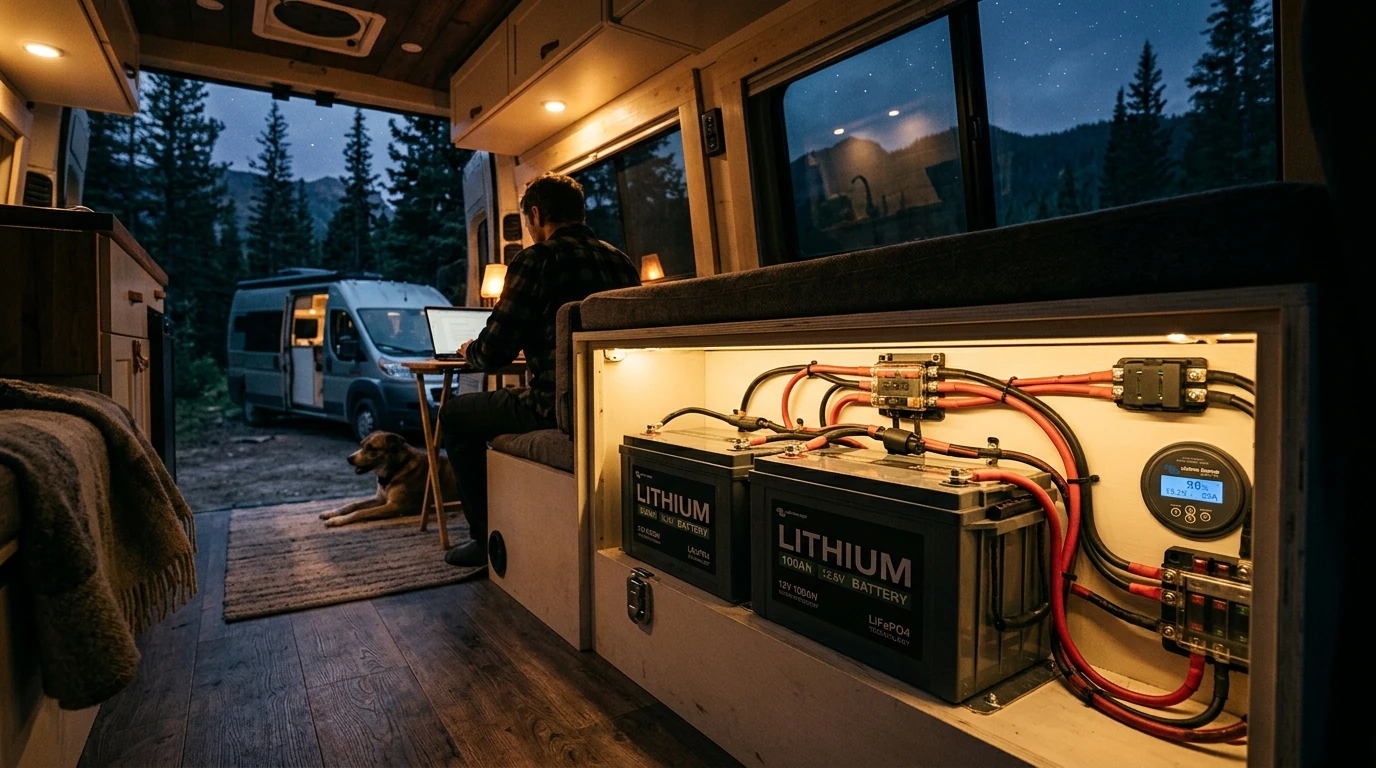
Choosing the best lithium battery for your RV comes down to three things: how much power you use in a day, whether the battery physically fits your group size bay, and whether you camp where charging can drop below freezing.
Size your bank to at least 1.5 times your daily amp hour use, confirm fitment with a tape measure, and pick a heated model if you camp or store in the cold.
The box that turns that bank into household power matters too, and what modified sine power does to sensitive electronics explains which appliances demand the cleaner output.
Calculate Your Power Needs
Do not guess. Calculate.
List every device you run on battery power and its wattage. Divide each by your system voltage (usually 12 volts) for the amp draw, then multiply by hours used per day.
Add everything up. That total is what you burn on a normal day.
Rough benchmarks: weekend campers running lights, a water pump, phone chargers, and a small fan land around 50 to 80 amp hours per day.
Full timers pulling a residential fridge, entertainment, and multiple devices need 150 to 250 amp hours daily.
Buy at least 1.5 times your daily number. Cloudy days happen, surprise power draws happen, and having that buffer means you stop obsessing over the battery monitor every 20 minutes.
For a deeper look at matching your battery bank to a solar charging system, check out our guide to how many panels your bank actually needs.
Battery Size and Fitment
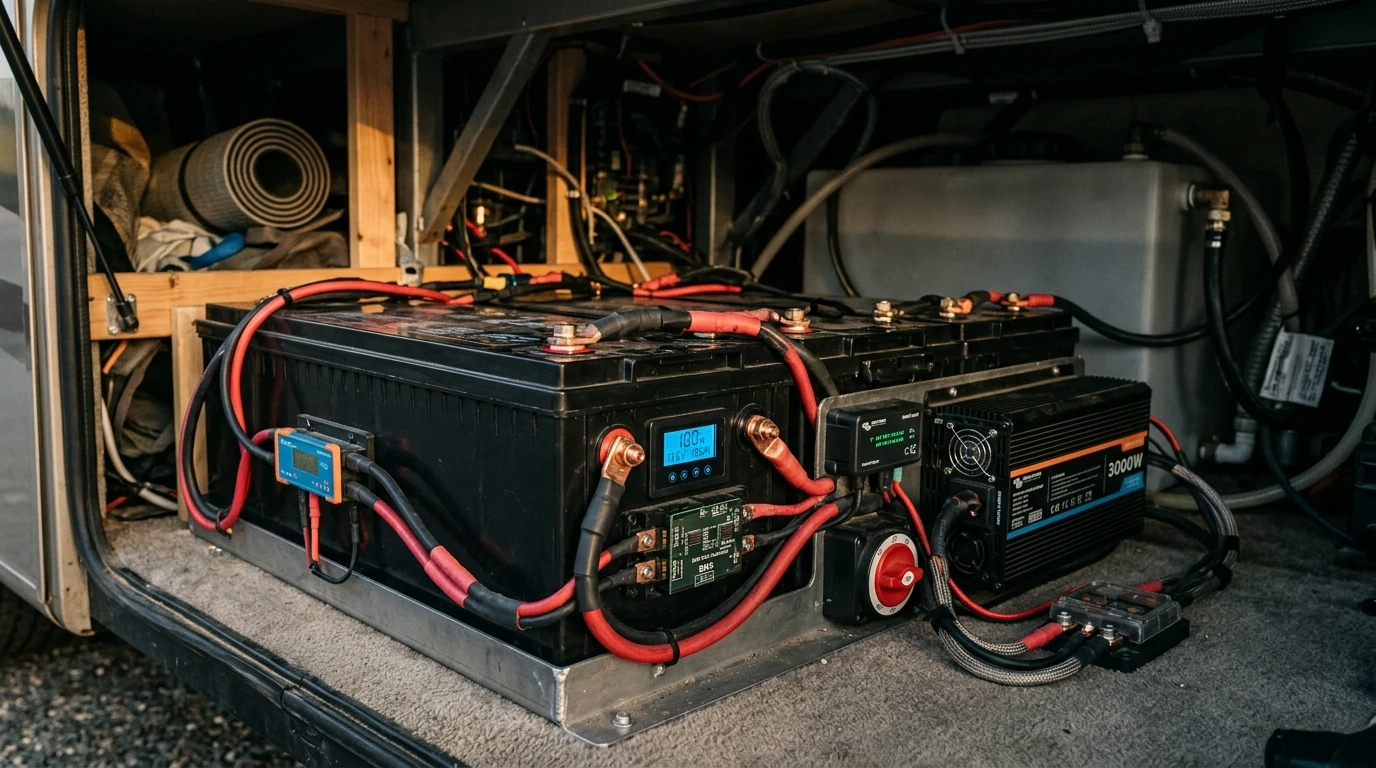
Amp hours mean nothing if the battery does not physically fit your compartment.
Every RV battery bay was built for a specific group size. Force something larger in and you create safety risks, not to mention voiding the warranty.
Tape measure first. Credit card second.
Group 24, group 27, and group 31 cover the vast majority of RVs. Most 100 amp hour LFP batteries match group 24 or 27 dimensions for a true drop in swap.
Higher capacity units (200 amp hours and up) often use group 31 or custom dimensions.
Verify fitment before you buy.
Check our full rundown on choosing a house battery for detailed group size specifications and compatibility charts.
Budget Considerations
Match your budget to how you actually camp, not to whatever ranks cheapest today.
If you boondock often, a premium battery with built in heating and a long warranty saves real money over five to ten years.
Camp mostly at campgrounds with hookups? A budget LFP still gives you the weight savings and zero maintenance without paying for cold weather features that never leave the box.
One move that works regardless: start with a single 100 amp hour battery and expand later.
LFP batteries parallel more forgivingly than lead acid, though matching brand, capacity and age still gives the best results.
Size your battery bank with our free calculator to work out your exact power needs and find the right capacity for your setup. Open the free calculator.
What Do You Need to Install Lithium Batteries in an RV?
Fitting a lithium RV battery rarely means new panels, because in most cases your existing solar array and wiring work fine. The charging side is what needs attention.
Set your charge controller or converter to a lithium iron phosphate profile, and add a DC to DC charger if you charge from the alternator while driving.
For parallel banks, use the same brand, capacity, and ideally the same purchase date so the BMS keeps cells balanced.
Sourcing matched cells from one place makes that easier, and our look at how A1 SolarStore handles battery orders and shipping covers what to expect.
Charger and Converter Requirements
This is where people get burned after spending $800 on a new battery.
Your existing converter was designed for lead acid. Lead acid battery makers state a three stage profile with absorption at 14.4 to 14.8 volts and float at 13.2 to 13.6 volts.
Most LFP makers state a lower absorption of 14.2 to 14.6 volts and either no float charge at all or a very low float around 13.4 volts.
Mismatch the profile and the BMS trips its over voltage protection. Charging stops, your converter throws error codes, and nothing is charging even though nothing is damaged.
Two solutions: swap the converter for a lithium compatible model, or add a standalone lithium charger.
If you are running solar, check your MPPT charge controller. Most modern units already include an LFP profile buried in the settings menu.
Check our guide on which charge controller type suits lithium to make sure your solar charging setup is optimized for lithium batteries.
The clean way around all of this is to order the battery bank, converter, and charge controller as one matched set.
One order means one compatible system and far fewer surprises on launch day.
Wiring Configurations
Most RV setups run 12 volts.
Parallel wiring (positive to positive, negative to negative) adds capacity while keeping voltage the same. Straightforward.
Series wiring does the opposite: positive to negative, stepping voltage up while capacity stays flat.
Want a 24 or 48 volt system for a bigger inverter? Series is how you get there.
One rule for parallel LFP wiring: same brand, same capacity, and ideally same purchase date.
The BMS in each unit manages cell balance, but matched batteries give it less work to do and deliver more consistent performance over time.
For solar panel sizing and wiring configurations that pair with your new lithium battery bank, visit our walkthrough of a full rooftop solar install.
Frequently Asked Questions
How long do lithium batteries last in an RV?
Quality LFP batteries carry published ratings of 3,000 to 6,000 charge cycles at 80% depth of discharge depending on the model.
As a rough guide, that works out to ten to fifteen years depending on how hard you push them and how often you cycle.
Can I use lithium batteries with my existing RV solar setup?
Usually, yes.
Your existing panels work fine.
The charge controller is the part that needs attention.
Switch it to a lithium iron phosphate profile.
Most MPPT (maximum power point tracking) controllers support this natively.
Do lithium batteries work in cold weather?
Discharging in cold weather is fine down to the maker's published limit, for example minus 4 degrees Fahrenheit on the DEKA Duration DD300-12H.
Charging below freezing (32 degrees Fahrenheit) causes permanent cell damage.
Premium batteries solve this with a built in heater that warms the cells before accepting a charge.
See batteries with built in heaters at A1 SolarStore.
Affiliate link. We may earn a commission at no extra cost to you.
Is it safe to charge lithium batteries while driving?
Yes.
Your alternator can charge lithium while you drive.
You will likely need a DC to DC charger (battery to battery charger) between the alternator and your lithium bank to regulate voltage and protect both sides.
Can I mix lithium and lead acid batteries?
Do not do this.
Different charging profiles, different voltage curves, and different internal resistance mean one type ends up undercharged while the other gets overcharged.
Replace the entire bank at once when you switch.
How many lithium batteries do I need for my RV?
Weekend campers usually land at one or two 100 amp hour batteries.
Full timers and serious boondockers need 200 to 400 amp hours.
Calculate your exact needs based on daily power consumption.
How much usable capacity do lithium RV batteries actually give you?
LiFePO4 batteries deliver roughly 80 to 100 percent of their rated capacity without damage, while lead acid is limited to about 50 percent.
That means a 100 amp hour LFP battery gives you 80 to 100 usable amp hours, where a 100 amp hour lead acid battery safely gives you only about 50.
You get nearly double the energy from the same number printed on the label.
Do I need a special charge controller for lithium RV batteries?
Most modern MPPT charge controllers already include a lithium iron phosphate charging profile in the settings menu, so you often just switch the profile.
Most LFP makers state a lower absorption voltage of about 14.2 to 14.6 volts and either no float charge or a very low float around 13.4 volts.
If your converter was built for lead acid only, you may need a lithium compatible converter or a standalone lithium charger.

Related Guides
Renogy vs Battle Born
Value versus premium: warranty, weight, and price on 100Ah LiFePO4 batteries.
Is RV Solar Worth It?
Find out if a solar setup makes sense for your camping style.
Best RV Solar Panels 2026
Compare the top solar panels to pair with your lithium batteries.
Best RV Solar Installation Kits
Complete matched systems that include a correctly sized charge controller for lithium batteries.
What Is Boondocking?
How to camp off the grid without running the batteries flat.
Renogy vs Victron Comparison
Two popular brands compared for RV electrical systems.
Running RV Air Conditioning on Solar
The battery bank size and panel wattage it takes to power an air conditioner.
Deals on Lithium Batteries and Solar Gear
Current sale prices on the batteries, panels, and kits covered in this guide.
Smart RV Hub Editorial Team
RV Technology Research and Reviews
Our writers research smart RV technology full time, covering solar power, connectivity, security, and power management.
Every guide draws on published manufacturer specifications and verified owner reviews, so you can compare options with confidence.
Meet the editorial team and our review standardsOur Recommendation
The best lithium battery for most RV owners is the DEKA Duration DD100-12H.
MK Battery states it is a heated 100 amp hour LiFePO4 in a Group 27 drop in case. Done.
It drops into your existing battery bay, charges in a fraction of the time of lead acid, and the per cycle math works out in its favor over the life of the battery.
Full timers who need more capacity should look at the DD300-12H, which MK Battery states is a heated 300 amp hour battery. That triples the power without the complexity of parallel wiring.
Switching from lead acid to LFP is one of those rare upgrades where the math, the convenience, and the actual day to day experience all line up.
The tradeoff is the upfront price, and the cost per cycle more than covers it.
Affiliate link. We may earn a commission at no extra cost to you.
Fast US shipping. Other trust signals verified August 2026.
Shop RV Solar Panels and BatteriesAffiliate link. We may earn a commission at no extra cost to you.
See our complete guide to powering an RV from the sun for all solar and battery guides.
Sources
- DEKA Duration Drop in Smart LFP Batteries brochure, MK Battery
- Energy Storage Product Line, MK Battery
- LiTime 12V 100Ah LiFePO4 Lithium Batteries, LiTime
- Lithium Batteries for Solar, Marine, RV & Golf Carts, A1 SolarStore