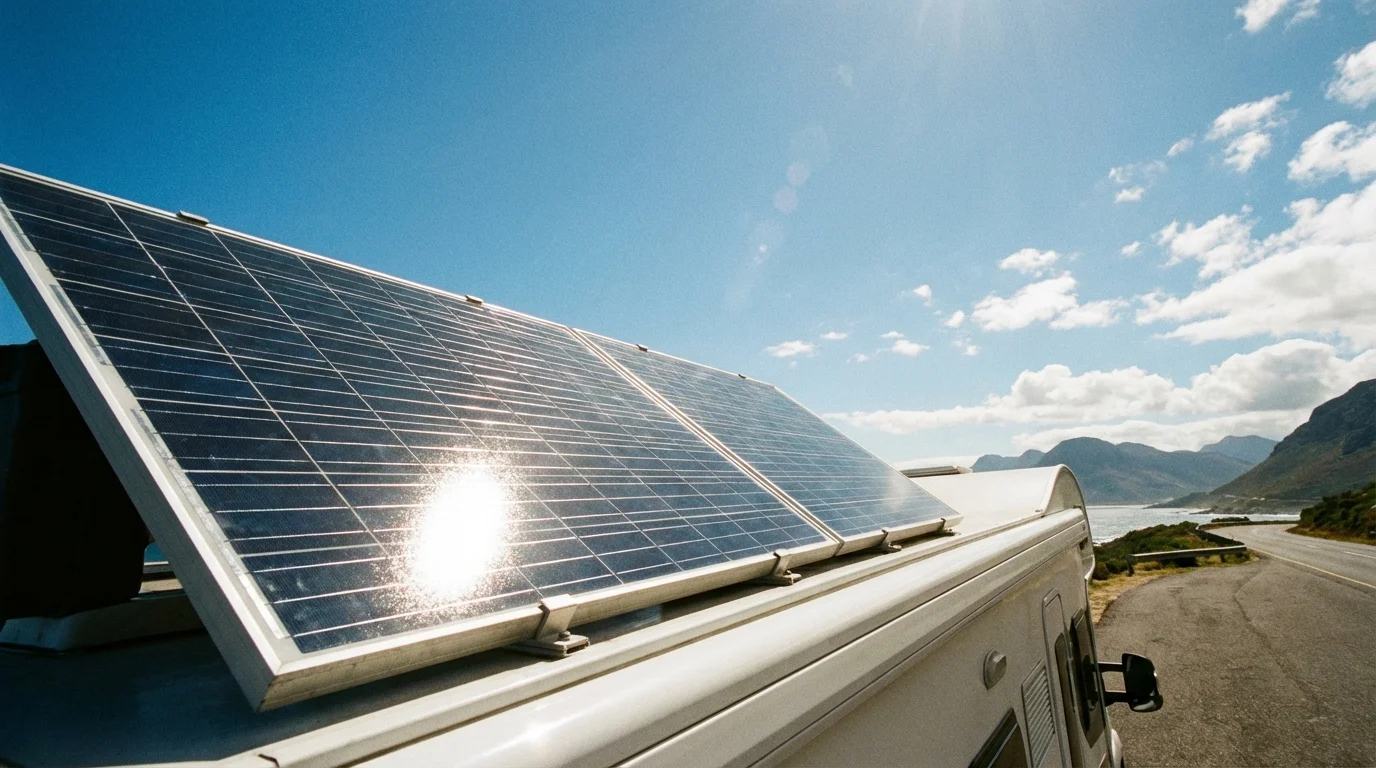
200 Watt RV Solar Kit: What It Powers and What to Buy
200 watts is the minimum viable weekend setup, a real category, not a cut down version of a bigger one.
How this guide was put together
Based on published specs and user reviews, never first person testing.
The watt hour figures are rough planning numbers, not a promise for your roof.
Affiliate Disclosure Smart RV Hub may earn a commission if you purchase from A1 SolarStore and RV Life Pro through these links, at no additional cost to you; see our full disclosure.
Where the ceiling sits
A 12V compressor refrigerator, the kind that runs straight off the battery, is the load that pushes it past comfortable.
If 200 watts fits the way you camp, the part worth pricing first is the 100 amp hour (100Ah) lithium battery it pairs with.
Free shipping options on qualifying orders
Rated 4.4 of 5 on Trustpilot, checked November 2026 (opens in a new tab)Ships from over 60 US fulfillment centers, checked October 2026.
Shop 12V Lithium RV BatteriesAffiliate link. We may earn a commission at no extra cost to you.
Who Is a 200 Watt RV Solar Kit For?
A 200 watt kit suits weekend campers and van lifers who want to charge devices and run lights without paying for hookups.
It handles the modest loads of a short trip well, and it fits the limited roof space of a smaller rig or camper van.
Weekend loads and when to step up
That makes it a good off grid solar setup for weekend trips and short camping trips, where power consumption stays low.
If you run a refrigerator daily or want more headroom, step up to a 400 watt kit instead.

What Does a Complete 200 Watt Kit Include?
A complete 200 watt kit arrives as a matched set, which makes the install straightforward for a first time builder.
- The panels
- One 200 watt panel, or a pair of 100 watt panels when vents and hatches break up the roof.
- A charge controller
- A maximum power point tracking (MPPT) unit sized past 200 watts, so a later panel does not mean a second controller.
- Wiring and connectors
- Cable of the right gauge, a fuse, and connectors cut to length so nothing is guessed on the roof.
- The battery
- Around 100Ah of lithium, the bank that carries an evening without running the cells flat.
Which Kit to Buy
A1 SolarStore sells RV solar parts rather than boxed kits. According to its own catalog, Trina, Canadian Solar, and REC are among its panel brands (stock verified November 2026).
Its camper panels are full size, such as a 355 watt Canadian Solar panel, so one of them already passes 200 watts.
For this build, A1 covers the battery and the controller, and you choose and size each part yourself.
Free shipping options on qualifying orders
Rated 4.4 of 5 on Trustpilot, checked November 2026 (opens in a new tab)Ships from over 60 US fulfillment centers, checked October 2026.
Shop MPPT Charge ControllersAffiliate link. We may earn a commission at no extra cost to you.
What to look for and where to compare
Based on published specs and user reviews, look for monocrystalline panels (the common black, single crystal type), an MPPT charge controller with headroom for a later upgrade, and clear wiring instructions.
According to A1's shipping page, delivery is free on qualifying orders. According to its about page, orders leave from over 60 fulfillment centers (checked October 2026).
See the panels in our ranking of the leading panel models and the controllers in our head to head on the two brands.
For a full comparison of retailers and price tiers, start with our where to buy RV solar panels guide.
Battery Pairing and Output
Match 200 watts of panels with around 100Ah of lithium for roughly 1,200 watt hours (the energy figure on a battery label) of usable storage. That covers lights, charging, and a fan overnight.
As a rough guide, in good sun the array commonly produces around 600 to 800 watt hours a day.
The battery holds about a day and a half to two days of good sun, so one gray day does not leave you dark. Top bar: 600 to 800 watt hours in. Bottom bar: about 1,200 watt hours stored.

Daily output and the inverter question
The math: 200 watts times four to five peak sun hours (hours of full strength sun) is 800 to 1,000 watt hours. Heat, wiring and charging losses bring that down to roughly 600 to 800.
According to one maker's listing, a 12V 100Ah lithium battery is rated 12.8 volts and 1,280 watt hours. Roughly 1,200 is a fair working figure.
Expect it to swing with sun hours, panel tilt, shade and heat, so budget from the low end when clouds are forecast.
Most skip the inverter, the box that turns battery power into household outlet power. They charge from 12V and USB, which keeps solar charging simple and efficient.
200 watt planning figures
Panels
One 200 watt panel, or a matched pair of 100s
Harvest on a clear day
Around 600 to 800 watt hours
Battery
A 100Ah lithium battery bank, roughly 1,200 watt hours usable
Charge controller
MPPT solar charge controller, with headroom above 200 watts
Inverter
Usually none, charge from 12V and USB
| Part | Planning figure |
|---|---|
| Panels | One 200 watt panel, or a matched pair of 100s |
| Harvest on a clear day | Around 600 to 800 watt hours |
| Battery | A 100Ah lithium battery bank, roughly 1,200 watt hours usable |
| Charge controller | MPPT solar charge controller, with headroom above 200 watts |
| Inverter | Usually none, charge from 12V and USB |
When Should You Step Up From 200 Watts?
Your loads may be growing. The best guide to wattage is your daily watt hours.
- Does a compressor fridge run every day?
- Do two people work from the rig?
- Do you often camp under trees?
A yes to any one points to 400 watts. No to all three means 200 watts fits.
Run the numbers in our full sizing math for panels, battery and inverter. If the total pushes past what 200 watts covers, take the step up to a 400 watt array.
Rather not drill the roof yet? Weigh a portable solar suitcase kit that you set out in the sun at camp.
Find Off Grid Camping Spots
Now that you know your solar setup, look through more than 30,000 campgrounds with RV Life Pro (checked October 2026).
Listings carry camper reviews, and many show connectivity reports from other RVers.
Affiliate link. We may earn a commission at no extra cost to you.
Smart RV Hub Editorial Team
RV Technology Research and Reviews
Our writers research smart RV technology full time, covering solar power, connectivity, security, and power management.
Every guide draws on published manufacturer specifications and owner reviews, so you can compare options with confidence.
Meet the editorial team and our review standardsFrequently Asked Questions
Is 200 watts the smallest solar array worth fitting?
For camping off hookups it is the practical floor rather than a token panel.
In good sun a 200 watt array commonly produces around 600 to 800 watt hours a day.
That keeps lights, devices, and a fan going on a short trip.
What load breaks a 200 watt kit?
A 12V compressor refrigerator.
It keeps cycling on day and night, so its draw adds up around the clock.
That leaves little margin in a 600 to 800 watt hour day for other loads or cloudy weather.
Should I skip 200 watts and buy 400 watts instead?
Buy 400 watts now if a compressor refrigerator runs every day, two people work from the rig, or you camp under trees.
Stay at 200 watts if your trips are two or three nights and your loads are lights, charging, and a fan.
What battery matches a 200 watt array?
Around 100Ah of lithium, which is roughly 1,200 watt hours of usable storage if you assume a 12V bank.
That carries lights, charging, and a fan overnight, and the panels put back the next day what a light day took out.
Do I need an inverter with a 200 watt kit?
Only if you want household outlets, and most 200 watt setups do without one.
Charging from 12V and USB avoids the standby draw of an inverter, which matters more on a small array than on a large one.
Can I add panels to a 200 watt kit later?
Only if the charge controller was bought for the system you will end up with.
Choose an MPPT controller with headroom above 200 watts and leave clear roof space.
A third panel is then a bolt on rather than a rebuild.
Is a 200 watt kit enough for a camper van?
For a van used at weekends it usually is, because the loads are as small as the roof.
Put a compressor refrigerator in that same van and you are back at the decision between 200 watts and 400 watts.
Free shipping options on qualifying orders
Rated 4.4 of 5 on Trustpilot, checked November 2026 (opens in a new tab)Ships from over 60 US fulfillment centers, checked October 2026.
Shop 12V Lithium RV BatteriesAffiliate link. We may earn a commission at no extra cost to you.