How to Size an RV Inverter
Add up the watts that run at once, add 20 percent headroom, then round up to the next inverter size.
Size it from your own appliances
Check everything you would run at the same moment, not everything you own.
Recommended inverter size
2,000W
1300W at once, plus 20% headroom, points at a 2,000W inverter
Wattages are typical published running figures, not measurements of your appliances, and motor driven loads surge above them at startup, which published inverter specs cover at about twice continuous.
Email yourself this size
Plus the wiring and fusing notes that go with the class you landed on.
No spam, and you can unsubscribe anytime. See our Privacy Policy.
The Method, Step by Step
Wattages and margins below follow published appliance labels and inverter manufacturer guidance, last verified August 2026.
List what runs at the same moment
Not everything you own: the microwave and the hair dryer only matter together if they really run together.
Sum the published running watts
Use the label or published spec for each appliance. The calculator above carries typical category figures.
Add 20 percent headroom and round up
Manufacturer guidance keeps continuous load under about 80 percent of the rating, which the headroom builds in.
Check surge against motor loads
Published surge ratings run about twice continuous. Compressors and pumps are the loads to verify.
Size the battery side to match
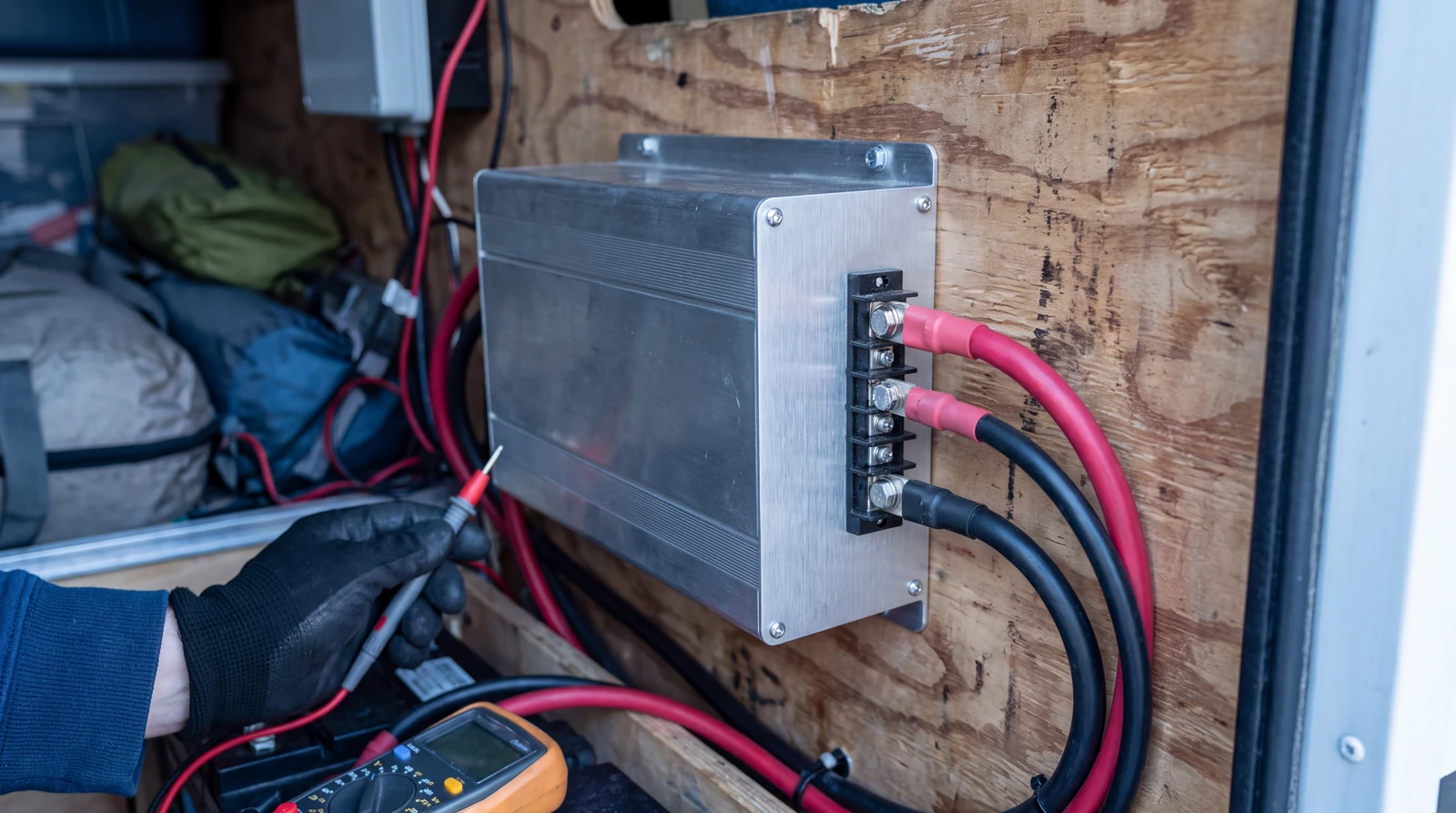
A 2,000 watt inverter can pull roughly 170 amps at 12 volts, so the bank and cabling have to be planned with it.
Two Decisions Ride Along With Size
Waveform: electronics, CPAP machines, and motor loads are the ones manufacturers direct to pure sine, settled in our pure sine comparison.
Wiring: a large inverter connects to the battery with heavy cable and a fuse from the manufacturer's table, walked through in our solar wiring guide.
One Box or Two: The Inverter Charger and the Transfer Switch
A plain inverter turns battery power into household power and does nothing else.
An inverter charger does that job and also charges the bank whenever shore power or a generator is connected, which is why it is the common choice on a full time build.
When the combined unit wins
One box, one set of cables and one thing to configure, which saves space in a bay that is already full.
It suits rigs that move between shore power and battery often, because the handover is automatic.
When separate units win
A failure takes out one function rather than both, and you replace the failed part on its own.
It also lets you size the charger and the inverter independently, which matters if your loads and your charging needs are mismatched.
Either way something has to decide whether the rig runs on shore power or on the inverter, and that is the transfer switch.
Most inverter chargers have one built in, so a separate transfer switch is usually only a line item when you are pairing standalone units.
Size the transfer switch to the shore power service the rig is wired for rather than to the inverter, because it carries whichever source is live.
Affiliate Disclosure
This page contains affiliate links to A1 SolarStore.
When you purchase from A1 SolarStore through these links, we may earn a commission at no additional cost to you.
This helps support our free calculators, guides, and research tools. Read our full disclosure
With a class settled by the calculator, shopping becomes a filter exercise rather than a guess.
Fast US shipping. Other trust signals verified August 2026.
Shop RV Solar Panels for Off Grid CampingAffiliate link. We may earn a commission at no extra cost to you.
Solar sizing tips by email
Inverter classes, battery pairings, and the draw figures other guides skip.
Free by email. Unsubscribe anytime.
Where These Figures Come From
Your appliance labels are the authority this page defers to: the category wattages are typical published running figures, not meter readings of ours.
Headroom and surge margins follow inverter manufacturer guidance, and no inverter crossed our bench for this guide.
Verified August 2026. When a label on your own appliance disagrees with a category figure here, the label wins.
Smart RV Hub Editorial Team
RV Technology Research and Reviews
Our writers research smart RV technology full time, covering solar power, connectivity, security, and power management.
Every guide draws on published manufacturer specifications and verified owner reviews, so you can compare options with confidence.
Meet the editorial team and our review standardsInverter Sizing Questions
What size inverter do I need for my RV?
Add the published running watts of everything you would run at the same moment, then add about 20 percent headroom and round up to the next class.
A microwave and laptop day lands at 2,000 watts, while a full residential kitchen pushes 3,000.
Is a 2,000 watt inverter enough for an RV?
For one high draw appliance at a time plus the small stuff, usually yes: a 1,200 watt microwave with 20 percent headroom fits inside 2,000 watts.
Running two heat producing appliances at once is what pushes rigs into the 3,000 watt class.
What is inverter surge capacity?
Motor driven loads draw a spike at startup, and published inverter specs commonly rate surge at about twice the continuous figure for a few seconds.
Compressor fridges and power tools are the loads to check surge ratings against.
Can an inverter be too big?
Oversizing wastes money twice: bigger inverters cost more and draw more idle power just being on, per published no load specs.
Size to your simultaneous loads with headroom, not to the biggest number on the shelf.
What battery bank does a 2,000 watt inverter need?
At full output a 2,000 watt inverter draws roughly 170 amps from a 12 volt bank before losses, which manufacturer guidance pairs with 200Ah of lithium or more.
The inverter and the bank have to be sized together, not separately.
Do I need pure sine or modified sine?
Modern electronics, CPAP machines, and anything with a motor or charger are the loads manufacturers direct to pure sine.
Our pure sine vs modified sine guide settles that question in full.
What wire and fusing does an inverter need?
Large inverters connect straight to the battery with heavy gauge cable and a fuse sized to the manufacturer's table.
Our solar wiring guide covers the fusing chain, and the inverter manual's table wins over any rule of thumb.
Does an inverter drain the battery when idle?
Yes: published no load draws commonly run from a few watts to over 20 for large units.
Switching the inverter off when unused is the free habit that protects a boondocker's battery budget.
The waveform, wiring, and battery decisions around the size.
Pure Sine vs Modified Sine
The waveform question that comes right after size.
Wiring And Fusing The Chain
Where the inverter sits in the chain, with fusing.
Batteries To Feed That Inverter
The bank that has to feed the size you picked.
Sizing Panels, Battery, And Inverter
Panels, battery, and inverter sized as one system.
Lithium Battery Upgrade, Explained
Why the battery chemistry changes what the inverter can do.
Solar Panels to Run RV AC
The heaviest load question, answered separately.
Inside the 800 Watt Solar Kit
The array most full time inverter loads lean on.
If Your Loads Grow Later
An inverter class is cheap to get right and annoying to outgrow, because the cabling and fusing are sized to it.
If a residential fridge or induction cooking is on next year's list, size for that rig now and the wiring never needs touching twice.
Built to last your RV adventures
Rated 4.4 of 5 on Trustpilot, checked August 2026 (opens in a new tab)Fast US shipping. Other trust signals verified August 2026.
Shop RV Solar Panels for Off Grid CampingAffiliate link. We may earn a commission at no extra cost to you.