
RV Solar Power Guide: Size It, Price It, and Camp Anywhere
Most RVs run on 400 to 800 watts of panels, and the free calculator below sizes yours.
By Smart RV Hub Editorial Team · Methodology: published manufacturer specs and user reviews
Affiliate Disclosure Smart RV Hub may earn a commission if you purchase from A1 SolarStore and RV LIFE Pro through these links, at no additional cost to you; see our full disclosure.
The daily use and prices behind these figures
On a day with 5 peak sun hours, a 400W array yields about 1,700 watt hours and an 800W array about 3,400.
Those sums use Renogy's $639.99 400W kit and LiTime's $335.99 100Ah battery, both checked October 2026.
That range covers most rigs, and working out your own number takes a load audit rather than an average.
The full method, step by step, is in our walkthrough for sizing a system to your own power use.
Browse RV Solar Panels at A1 SolarStore(opens in new tab)Affiliate link. We may earn a commission at no extra cost to you.
Most RVs need 400 to 800W of solar panels and 200 to 400Ah of lithium battery capacity.
Parts for a 400W weekend setup come to about $1,312, and an 800W full time build to about $2,624, on Renogy kit and LiTime battery prices checked October 2026.
What this guide covers
This guide covers panel selection (Renogy vs Victron vs Rich Solar), battery sizing, charge controller types (MPPT vs PWM), and step by step installation.
Use the free calculator below to size your exact system.
Where to Compare RV Solar Parts: A1 SolarStore
Strong price to warranty ratio based on published spec sheets and verified buyer reviews.
Full size panels, MPPT controllers, RV inverters and six DEKA Duration lithium models, with free shipping on qualifying orders.
See RV Solar Panels at A1 SolarStore(opens in new tab)Affiliate link. We may earn a commission at no extra cost to you.
- Over 60 Fulfillment Centers
- Free Shipping on Qualifying Orders
- Rated Excellent on Trustpilot, checked November 2026 (opens in a new tab)
Trust signals verified October 2026. Check a1solarstore.com for current details.
A1 SolarStore does not carry Renogy or Rich Solar. They stock panels from JA Solar, Canadian Solar, Mission, Trina, REC, LONGi, Hyundai, Jinko and Qcells, verified November 2026.
How an RV solar system fits together
Tap any part of the power chain to see what it does and what to look for when you buy it.
Solar panels
Panels sit on the roof and turn sunlight into DC power. More watts, more energy on a sunny day.
Match the wattage to your daily power use and the roof space you have to work with.
Affiliate link. We may earn a commission if you buy, at no extra cost to you.
What this guide covers
- Calculate your exact RV solar power needs with free solar calculator
- Compare the highest rated RV solar panels and complete solar systems
- Side by side comparisons of RV solar panels and lithium batteries
- Save money with solar energy independence and boondocking
Quick Navigation
Same formulas as the RV solar sizing guide.
Run Your Own Numbers in the Solar Calculator
Divide your daily watt hour use by your peak sun hours, then by 0.85 for wiring and heat losses. A 3,000 Wh day with 5 sun hours needs about 706W, so you buy 800W.
Once you have the wattage, decide on how to string the panels together, because the layout changes shade behavior.
Typical range: 1,200 to 5,500 Wh
4 to 6 hours across most of the US
Your Solar Recommendations
Priced from Renogy's $179.99 200W panel and LiTime's $335.99 12V 100Ah battery, checked October 2026.
That cost covers panels and battery only, so add the controller, wiring and mounts on top.
Ready to Go Off Grid?
Your result points to 800W of panels with about 350Ah of battery. Shop panels and batteries matched to those numbers at A1 SolarStore.
See Panels for 800W of Solar at A1 SolarStore(opens in new tab)Affiliate link. We may earn a commission at no extra cost to you.
Want to compare panels first? See our side by side comparison of RV solar panels.
What Size Solar Panel Do I Need for My RV Battery?
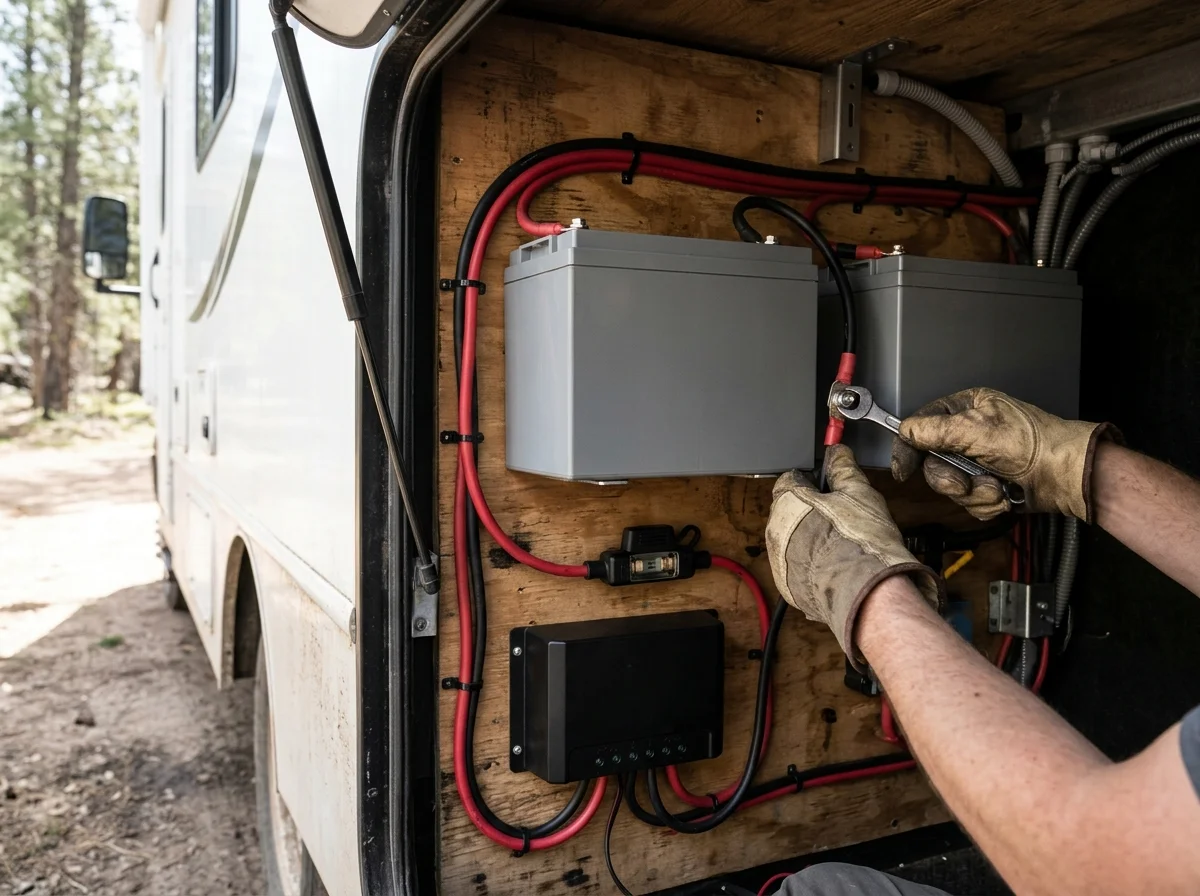
About 300 watts of solar panel refills one 100Ah 12V lithium battery from empty in a sunny day.
The rule is battery watt hours, divided by peak sun hours, divided by 0.85 for wiring and heat losses.
- One 100Ah AGM: about 150W of panel.
- One 100Ah lithium: about 300W of panel.
- Two 100Ah lithium: about 600W of panel.
- Three 100Ah lithium: about 900W of panel.
A 100Ah LiFePO4 battery stores about 1,280 watt hours at its 12.8 volt nominal rating. With 5 peak sun hours, 1,280 divided by 5 and then by 0.85 comes to about 300 watts.
- One 100Ah lithium: about 300W, or 150W if you only use half of it each day
- Two 100Ah lithium (200Ah): about 600W
- Three 100Ah lithium (300Ah): about 900W
- One 100Ah AGM: about 150W, since only about half of it is usable
Peak sun hours average 4 to 6 across most of the US, so plan on the low end if you camp in the Northwest or in winter.
Most owners size panels to the power they use each day rather than to a full refill, which our daily use sizing walkthrough works through load by load.
Save Money
Reduce or eliminate campground fees by boondocking with solar power
Eco Friendly
Clean, renewable energy reduces your carbon footprint
Energy Independence
Power your RV anywhere the sun shines, no hookups needed
What Size RV Solar System Do You Need?
Match your daily watt hour use to a tier.
- 200 to 400W suits weekend trips
- 400 to 600W fits part time travel
- 600 to 800W or more supports full time living
Use this visual guide to choose the right solar setup for your RV lifestyle.
Not sure which tier suits you? Spending a week in a solar equipped rig first is easy to arrange, and our full guide to renting an RV walks through how.
Complete RV Power System Overview
See how all power sources work together in your RV
Get Free Solar Tips by Email
Join our newsletter for solar tips, product reviews, and solar equipment deal alerts.
Free by email. Unsubscribe anytime.
RV solar system size by usage type, 2026
Which RV Solar System Fits Your Travel Style?
Panels and battery alone run from about $1,030 for a 400W weekend build to about $2,060 for an 800W full time build, on the October 2026 prices in the calculator.
The inverter is the other half of that spend, and our guide to which inverter waveform your appliances need keeps you from buying the wrong one.
Want detailed panel comparisons?
Visit our side by side look at the panels worth buying.
Weekend Camper
2 to 4 trips a month
- Panels
- 400W (2 x 200W)
- Battery
- 200Ah LiFePO4
- Panels and battery
- About $1,030
- Runs
- Lights, phones, small fridge
Part Time RVer
1 to 2 weeks a month
- Panels
- 600W (3 x 200W)
- Battery
- 300Ah LiFePO4
- Panels and battery
- About $1,550
- Runs
- Full fridge, TV, laptop, coffee maker
Full Timer
Living in the RV
- Panels
- 800W+ (4 x 200W)
- Battery
- 400Ah+ LiFePO4
- Panels and battery
- About $2,060
- Runs
- All appliances, remote work, microwave
Off Grid Pro
Extended boondocking
- Panels
- 1,200W+ (6 x 200W)
- Battery
- 600Ah+ LiFePO4
- Panels and battery
- About $3,100
- Runs
- Everything, plus AC within limits
| Usage Type | Solar Panels | Battery | Panels and Battery | Best For |
|---|---|---|---|---|
Weekend Camper 2 to 4 trips/month | 400W (2× 200W) | 200Ah LiFePO4 | About $1,030 | Lights, phone charging, small fridge |
Part Time RVer 1 to 2 weeks/month | 600W (3× 200W) | 300Ah LiFePO4 | About $1,550 | Full fridge, TV, laptop, coffee maker |
Full Timer Living in RV | 800W+ (4× 200W) | 400Ah+ LiFePO4 | About $2,060 | All appliances, work from RV, microwave |
Off Grid Pro Extended boondocking | 1,200W+ (6× 200W) | 600Ah+ LiFePO4 | About $3,100 | Everything + A/C (with limits) |
Panels at $179.99 per 200W and lithium at $335.99 per 100Ah, checked October 2026. A controller, wiring, mounts and an inverter come on top.
Pro Tip: Start with what you need now.
Planning for expansion and deals
It's easier to add panels later than to remove them.
Most systems can be expanded by 50 to 100% with proper planning.
When you are ready to purchase, our guide to judging an RV solar kit price covers what to compare before you buy, shipping included.
Before you order, see when to buy RV solar and when to wait.
See how one retailer stacks up in our look at what A1 SolarStore sells for RV solar, including shipping and support.
How Do Electric Camping Trailers Compare on Battery and Solar?
The Lightship AE.1 carries the bigger battery at 77 kWh, while the Pebble Flow takes the most solar at up to 4 kW.
Both batteries are far larger than any roof array can refill in one day, so on these trailers solar tops up daily use rather than recharging from empty.
Lightship AE.1
77 kWh battery, 670W of solar standard or 1.8 kW with Solar+.
About 2.8 kWh a sunny day, or 7.7 kWh with Solar+.
Pebble Flow
45 kWh battery, 1.1 kW of roof solar plus a port for 3 kW more.
About 4.7 kWh a sunny day, or 17 kWh at the full 4 kW.
Typical 400W RV system
2.6 kWh battery (200Ah lithium) and 400W of solar.
About 1.7 kWh a sunny day.
| Trailer | Battery | Published solar | Solar per sunny day |
|---|---|---|---|
| Lightship AE.1 | 77 kWh | 670W standard, 1.8 kW with Solar+ | About 2.8 kWh, or 7.7 kWh with Solar+ |
| Pebble Flow | 45 kWh | 1.1 kW on the roof, plus a port for 3 kW more | About 4.7 kWh, or 17 kWh at the full 4 kW |
| Typical 400W RV system | 2.6 kWh (200Ah lithium) | 400W | About 1.7 kWh |
- Typical 400W RV: about 1.5 days.
- Pebble Flow, 4 kW: about 2.6 days.
- Pebble Flow, roof only: about 9.6 days.
- Lightship AE.1, Solar+: about 10 days.
- Lightship AE.1 on its standard 670W: about 27 days.
How the trailer figures were worked out
Daily solar figures assume 5 peak sun hours and a 0.85 loss factor. Battery and solar figures come from each maker's spec page, checked October 2026.
To compare any electric trailer yourself, divide the battery kWh by the daily solar kWh to see how many sunny days a full refill would take.
By that measure the Pebble Flow at 4 kW refills in under three sunny days, while the AE.1 with Solar+ needs about ten, so both makers also list fast charging from public EV chargers.
RV Battery Type Comparison Guide
Compare Lead Acid, AGM, and LiFePO4 batteries for your RV solar system. For more detail on the top LiFePO4 options, see our lithium battery comparison guide.
Ready to Shop for Equipment?
Our dedicated buying guides compare kits, panels, and batteries at every price point.
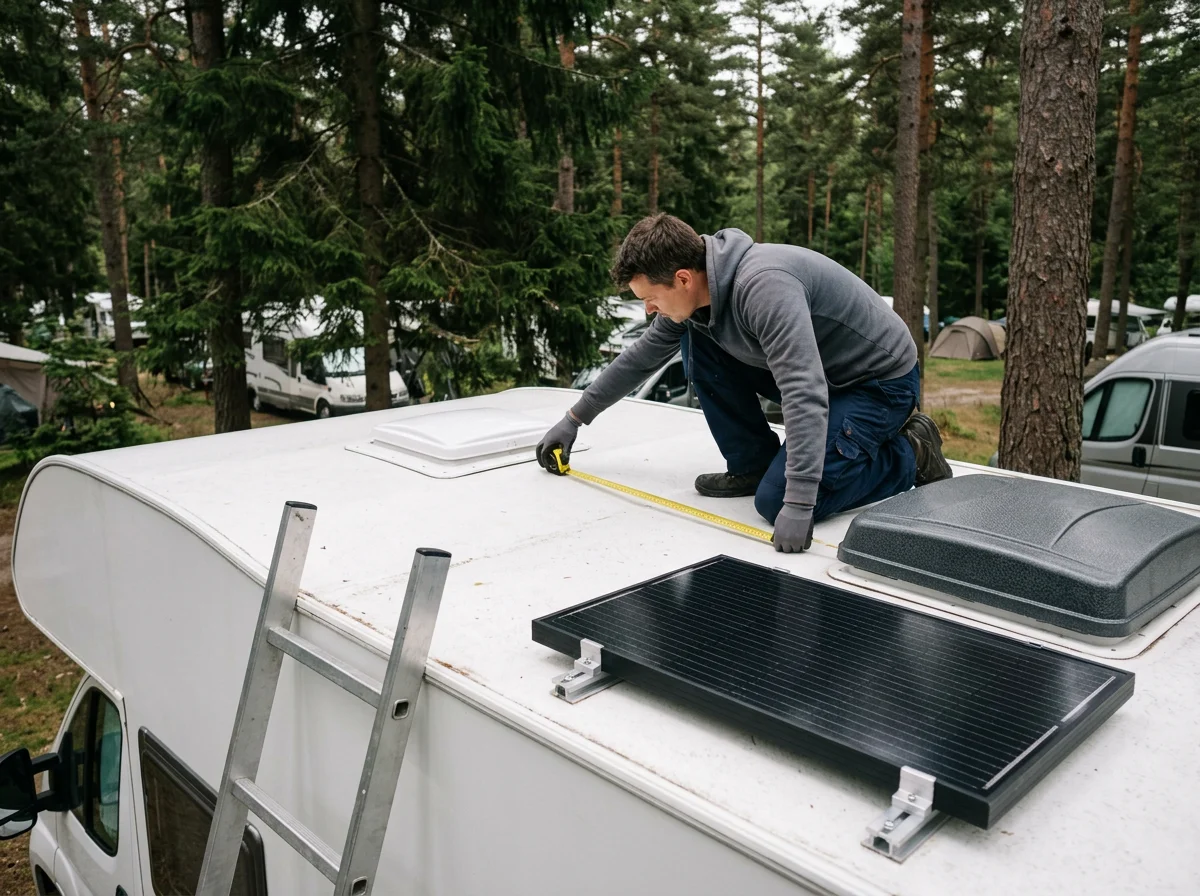
Can You Get RV Solar Installed by a Pro?
Not ready to DIY? A1 SolarStore connects you with home service pros for solar installation work.
Request offers and compare quotes.
Affiliate link. We may earn a commission at no extra cost to you.
Related Resources & Next Steps
Guides for the next decision after sizing, from brand choice to wiring.
Solar Equipment & Reviews
- Ready to buy? Compare the highest rated RV solar panels for 2026 based on published manufacturer specifications and user reviews.
- Torn between brands? Discover which solar brand delivers better performance for your needs.
- Rigid or flexible? Compare flexible vs rigid RV solar panels for your roof.
- Starting small? See what a 200 watt RV solar kit can realistically power for weekend trips.
- Need more capacity? Find out whether a 400 watt RV solar kit covers your daily usage.
- Want to run the AC? See how many solar panels it takes to run an RV air conditioner.
- Wiring it yourself? Follow the RV solar wiring guide for fuses and wire sizing.
- Budgeting the build? Estimate your system size and cost with the solar cost calculator.
- Need precise numbers? Calculate your exact battery and solar requirements with our free tools.
- Want to optimize? Master your RV power management system for maximum efficiency.
- Still on the fence? See whether RV solar pays back for your travel pattern before you spend a dollar.
- Already installed? Keep panels clean and the system healthy with our maintenance routine.
Planning & Lifestyle
- Going full time? Explore what full time RV life really requires for solar and beyond.
- Working remotely? Set up the ultimate remote work RV office with reliable power.
- Planning adventures? Plan your solar powered RV trips safely with RV specific routing.
- Camping off grid? Stay overnight at wineries and farms with Harvest Hosts to stretch your solar powered nights.
- Not ready to buy? Try RVing with a rental first before investing in solar equipment.
Not sure where to start? Our free tools that size a solar system tell you exactly how many panels and batteries you need.
Then browse our detailed panel reviews based on published specs to find equipment for your budget.
Considering the RV lifestyle? Estimate rental costs to test RV living before making the solar investment.
Explore More Solar Resources
How to Size and Install RV Solar Power Systems
Follow these five steps to calculate your power needs and select the right panels, batteries, and equipment for your RV, from daily watt hours through to the final purchase.
- 1
Calculate Your Daily Power Usage
List every appliance and device you run, then add up the watt hours each one uses in a day. A moderate build with a compressor fridge, laptop and lights uses about 1,240 Wh, and a full timer who runs air conditioning about 5,500 Wh.
- 2
Determine Sun Hours for Your Location
Check average daily sun hours for your typical travel locations. Most of the US gets 4 to 6 peak sun hours a day, according to NREL solar resource data.
- 3
Calculate Required Solar Panels
Divide your daily watt hours by your peak sun hours, then divide by 0.85 for wiring and heat losses. Round up to the next 100 watts.
- 4
Select Battery Capacity
Divide your daily watt hours by 0.8, then by 12 volts, to get the lithium amp hours for one day of use. Add more if you want to ride out cloudy days.
- 5
Choose Complete System or Components
Buy a complete kit for the simplest install, or buy the parts separately. A1 SolarStore sells the parts: full size panels, MPPT controllers, RV inverters and 12V lithium batteries.
RV Solar Frequently Asked Questions
Straight answers to common RV solar questions
How many solar panels does an RV need?
As a general guideline, most RVs need 400 to 800W of solar capacity.
Weekend campers usually need 200 to 400W, which is one or two 200W panels.
Full timers usually need 600 to 800W, which is three or four panels.
At 5 peak sun hours, 400W makes about 1,700 watt hours a day and 800W about 3,400.
Your own needs depend on your appliances and habits.
What size solar system for weekend vs full time RVing?
Weekend RVers need 200 to 400W of solar and up to 200Ah of lithium.
Full time RVers need 600 to 800W and 300 to 400Ah.
On prices Renogy and LiTime listed in October 2026, parts for the 400W build with 200Ah come to about $1,312 and the 800W build with 400Ah to about $2,624, before an inverter.
How much does RV solar installation cost in 2026?
Parts for a basic 400W system with 200Ah of lithium come to about $1,312, and an 800W system with 400Ah to about $2,624, before an inverter.
Those sums use Renogy's listed $639.99 for its 400W 12V kit with a Rover 40A MPPT controller and LiTime's listed $335.99 for its 12V 100Ah battery, both checked October 2026.
The inverter price varies widely by seller, and professional installation adds labor on top, so get written quotes before you commit.
Can I run my RV AC on solar power?
Yes, but running AC on solar takes 1,200 to 2,400W of panels and 600 to 1,000Ah of lithium.
Dometic rates its 13,500 BTU Brisk II at 12.4 amps for the compressor and 2.5 amps for the fan at 115 volts, about 1,700 watts at full load.
A 600Ah bank used to 80 percent covers about three hours of that, and 1,000Ah about five, once the inverter takes its share.
With five peak sun hours, 1,200W of panels refills about three hours of cooling a day and 2,400W about six.
Many RVers use solar for everything except AC for that reason, and a soft start eases the startup surge but not the running draw.
Renogy vs Victron solar panels: Which is better for RVs?
On published specs, Renogy is the value pick for 200W panels and Victron the premium pick with slightly higher rated efficiency.
Both deliver high real world efficiency relative to their rated output.
Choose Renogy for budget conscious installations or Victron for maximum performance.
What battery size do I need with my RV solar panels?
Size the battery to hold at least one day of use: daily watt hours divided by 0.8, then by 12 volts.
A 400W system makes about 1,700Wh on a 5 sun hour day, which calls for about 200Ah of lithium.
An 800W system makes about 3,400Wh, which calls for about 400Ah.
Lithium is preferred over lead acid because you can use more of it and it lasts longer.
What size solar panel do I need for my RV battery?
About 300 watts of panel refills one 100Ah 12V lithium battery from empty in a sunny day.
That battery holds about 1,280 watt hours at its 12.8 volt nominal rating.
Divide that by 5 peak sun hours and a 0.85 loss factor and you get about 300 watts.
If you only use half the battery each day, about 150 watts keeps up.
A 100Ah AGM battery gives about 600 usable watt hours, so about 150 watts refills it too.
Should I get monocrystalline or polycrystalline solar panels?
Monocrystalline panels lead for RV installations on published specs.
They run at 19 to 22% efficiency against 15 to 17% for polycrystalline, so you get more power from less roof space.
They cost 10 to 20% more up front.
That efficiency pays back through better performance in partial shade and in cooler weather.
Where roof space is limited, monocrystalline is worth the extra cost.
How long do RV solar panels last?
Based on typical manufacturer warranties, quality RV solar panels last 25 to 30 years with minimal degradation.
Most manufacturers guarantee 80 to 85% power output after 25 years.
As a rough guide, the charge controller needs replacement after 10 to 15 years, and lithium batteries last 10 to 15 years (3,000 to 5,000 cycles).
Budget for the battery.
It is your main long term solar cost.
Can I install RV solar panels myself or do I need professional installation?
Many RVers successfully install their own solar systems with basic tools and electrical knowledge.
A typical DIY installation takes 1 to 2 days for a 400 to 800W system.
Doing it yourself saves the installer's labor charge.
Professional installation makes sense for complex systems (1,200W+), integrated battery upgrades, or guaranteed warranty coverage.
What is the difference between PWM and MPPT charge controllers?
MPPT controllers, short for Maximum Power Point Tracking, are 20 to 30% more efficient than PWM controllers.
They are worth the extra cost for RV solar.
MPPT pulls the most power from your panels by adjusting voltage and current, which matters most in cold weather and partial shade.
For systems of 400W or larger, always choose MPPT.
PWM only makes sense on very small systems of 100 to 200W, where its lower price outweighs the lost output.
Top brands include Victron, Renogy, and Morningstar.
A1 SolarStore does not carry Renogy or Morningstar. They stock charge controllers from MidNite Solar, verified November 2026.
How much roof space do I need for RV solar panels?
Plan for about 11 square feet of clear roof per 200W rigid panel, so a 400W system needs about 22 square feet and an 800W system about 44.
Renogy lists its 200W N type panel at 49.7 by 30.1 inches, about 10.4 square feet, and the extra allows for gaps.
A 435W residential panel such as the Qcells Q.TRON 435W measures 67.8 by 44.6 inches, about 21 square feet, per its datasheet.
Measure around vents, AC units and the ladder before you buy, since layout usually decides the answer.
Flexible panels can follow curved surfaces where rigid frames cannot.
Will solar panels charge my RV battery while driving?
Yes, solar panels charge your battery bank continuously whenever there is sunlight, including while driving.
Your alternator provides the primary charging while the engine runs, and solar charging during travel is supplemental but valuable for maintaining your house battery when parked between destinations.
Drive often in the sunny part of the day and you can size the array slightly smaller.
What happens to my solar panels in winter or cloudy weather?
Solar panels work in winter and cloudy conditions but produce significantly less power than peak summer sun.
Cold temperatures can actually improve panel efficiency, but shorter days and lower sun angles reduce total output.
On overcast days, expect reduced capacity.
Snow blocks production until it melts.
Four things help through winter.
- More battery capacity, so you can store what you do collect
- Panels angled steeper, so snow slides off
- Extra panel capacity beyond what your summer sums call for
- A backup charger, meaning a generator or shore power, for long cloudy spells
Solar Guides & Resources
- RV Solar Installation Guide
Step by step guide to installing solar on your RV
- RV Solar by State
Sun hours and sizing compared across the best solar states
- Where to Buy RV Solar Panels
Compare retailer prices, shipping and support
- Best RV Solar Installation Kits
Complete kits for easy DIY solar installation
- RV Solar Battery Guide
LiFePO4 vs AGM vs Gel, compare every battery type
- RV Solar System Sizing Guide
Calculate exactly how much solar you need
- MPPT vs PWM Charge Controllers
Which controller type is right for your setup
- Best RV Solar Panels 2026
Top rated panels compared and reviewed
- Renogy vs Victron Comparison
Head to head comparison of the top two brands
- 600 Watt RV Solar Kit Review
The part timer's sweet spot, reviewed on published specs
- 800 Watt RV Solar Kit Review
The standard full timer build, reviewed on published specs
Sources
- Solar Photovoltaic Technology Basics, US Department of Energy
- National Solar Radiation Database, National Laboratory of the Rockies (formerly NREL)
- N type 200W solar panel listing, checked October 2026, Renogy
- 400W 12V premium solar kit listing, checked October 2026, Renogy
- 12V 100Ah LiFePO4 battery listing, checked October 2026, LiTime
- Brisk II rooftop air conditioner, Dometic
- AE.1 specifications, checked October 2026, Lightship
- Pebble Flow specifications, checked October 2026, Pebble
Every RV Solar Guide on This Site
The full solar library, from panel choice and wiring to what a system delivers in your state.
- RV Solar Panels: Complete Guide for Off Grid Power 2026
- Portable RV Solar Panel Sizes: What 100W, 200W and 400W Recover
- Renogy vs Battle Born: Which RV Lithium Battery Is Better?
- Winter Boondocking on Solar in the Arizona Desert
- California RV Solar: From Coastal Fog to Full Mojave Sun
- Colorado RV Solar: Altitude, Canyon Shade and Snow Load
- Florida RV Solar: Humidity, Oak Shade and Afternoon Storms
- Nevada RV Solar: Clear Skies, Public Land, No Hookups
- New Mexico RV Solar: High Desert Elevation and Intense Sun
- Texas RV Solar: The West Texas and Gulf Coast Split
- Utah RV Solar: Canyon Country Stays on Battery Power
- What Is Boondocking? A Beginner's Guide to Free RV Camping
Smart RV Hub Editorial Team
RV Technology Research and Reviews
Our writers research smart RV technology full time, covering solar power, connectivity, security, and power management.
Every guide draws on published manufacturer specifications and owner reviews, so you can compare options with confidence.
Meet the editorial team and our review standardsReady to Break Free from Hookup Fees?
Your calculator result above gives the panel watts, battery and controller size to shop for.
Affiliate link. We may earn a commission at no extra cost to you.
- Over 60 Fulfillment Centers
- Free Shipping on Qualifying Orders
- Rated Excellent on Trustpilot, checked November 2026 (opens in a new tab)
Trust signals verified October 2026. Check a1solarstore.com for current details.
Free shipping options on qualifying orders
Shop RV Solar Panels and BatteriesAffiliate link. We may earn a commission at no extra cost to you.
Find Off Grid Camping Spots
Now that you know your solar setup, look through more than 30,000 campgrounds with RV Life Pro (checked October 2026).
Listings carry camper reviews, and many show connectivity reports from other RVers.
Affiliate link. We may earn a commission at no extra cost to you.