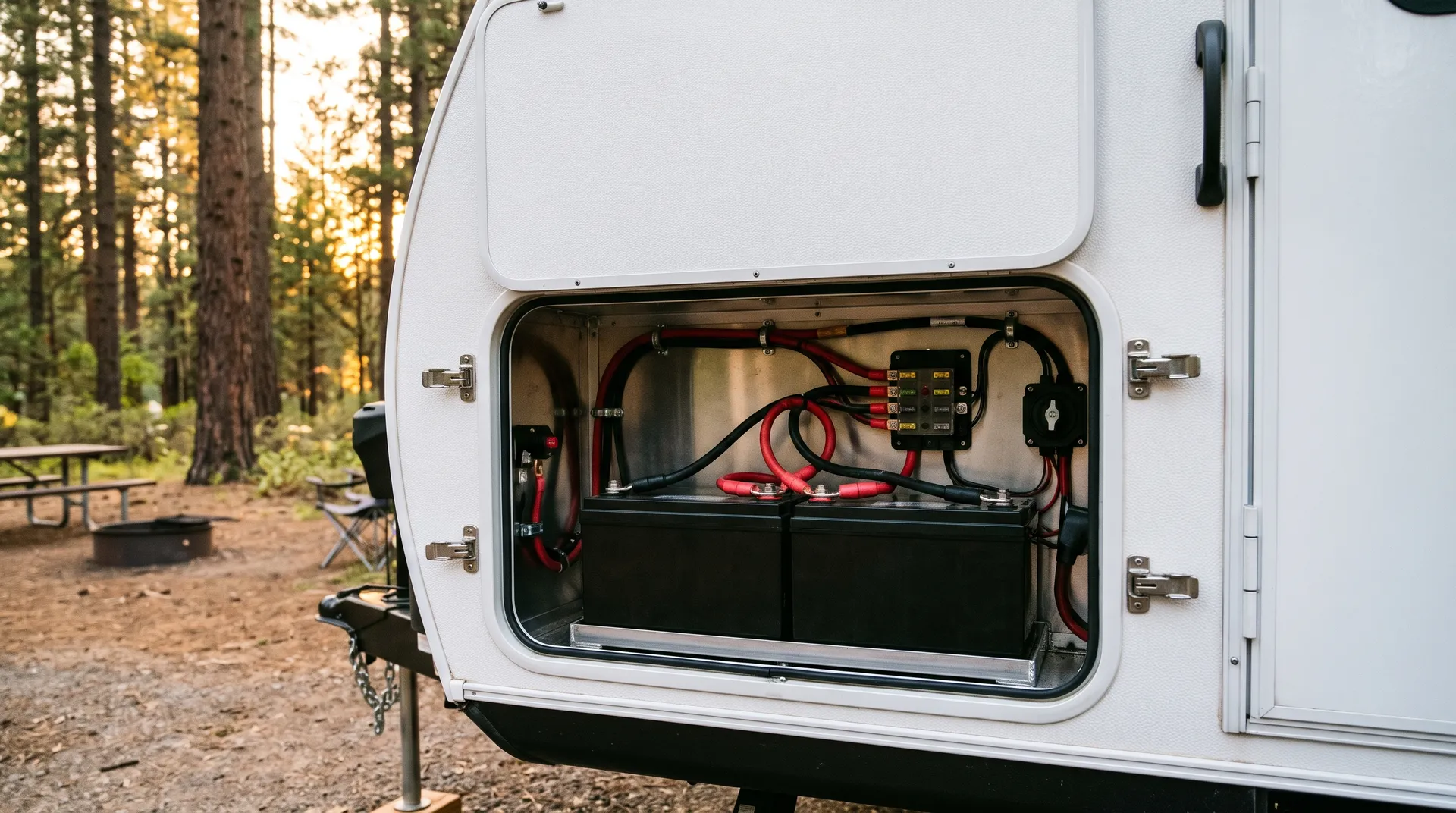
RV Wire Size Calculator for 12 and 24 Volt Circuits
Thin wire wastes power and runs hot, so check the gauge before you cut a cable.
Find my wire sizeAffiliate Disclosure Smart RV Hub may earn a commission if you purchase from A1 SolarStore through these links, at no additional cost to you; see our full disclosure.
Wire Gauge Calculator
Sizes are in AWG, American Wire Gauge, where a smaller number means a thicker wire.
The calculator reads West Marine's published resistance table, and every field updates the answer straight away.
Find your wire gauge
Enter the load and the distance from the battery, measured one way.
Minimum copper wire size
8 AWG
Over 20 feet of round trip wire, 8 AWG loses 0.25 volts, which is 2.1 percent of 12 volts.
Fuse at 25 amps or more, which is 125 percent of the load, and never above what the wire is rated to carry.
- Figures assume a single stranded copper wire rated 105 degrees C, outside a hot engine bay.
- If your cable is bundled or runs somewhere warm, its amp rating drops, so pick a thicker gauge that still clears the load after that cut.
- The device manufacturer's cable and fuse table, and a qualified electrician, have the final say on any high current run.
Get RV wiring tips by email
Your result: 8 AWG, fused at 25 amps or more.
Cable sizing, fusing and battery guidance for RV power builds, with every source named.
No spam, and you can unsubscribe anytime. See our Privacy Policy.
Once the cable is settled, the next decision is the battery, controller or inverter it connects.
Free shipping options on qualifying orders
Rated 4.4 of 5 on Trustpilot, checked November 2026 (opens in a new tab)Ships from over 60 US fulfillment centers, checked October 2026.
Shop 12V Lithium RV BatteriesAffiliate link. We may earn a commission at no extra cost to you.
How Does the Wire Size Calculator Work?
It applies the formula West Marine publishes: voltage drop equals current times length times ohms per foot.
The answer is the thinnest gauge that passes both the drop limit and the maximum amps for that gauge.
Find the current
Read the amps from the device label or manual, or divide watts by system volts, such as 12V or 24V.
Measure one way
Measure the wire length along the cable path from the battery to the device, then let the calculator double it for the round trip.
Pick the drop limit
Use 3 percent for inverters, chargers, feeds and electronics, and 10 percent for lights and simple loads.
Read the gauge and the fuse
Use the gauge shown or thicker, and fuse at 125 percent of the load or more, but never above the wire's rating.
Where each cable sits in a solar build is laid out in our RV solar wiring walkthrough.
- Positive out: 10 feet
- Negative back: 10 feet
- Size the wire for 20 feet, not 10
What Gauge Do Common RV Circuits Need?
These are worked examples at 12 volts, run through the same calculator, not readings from any particular rig.
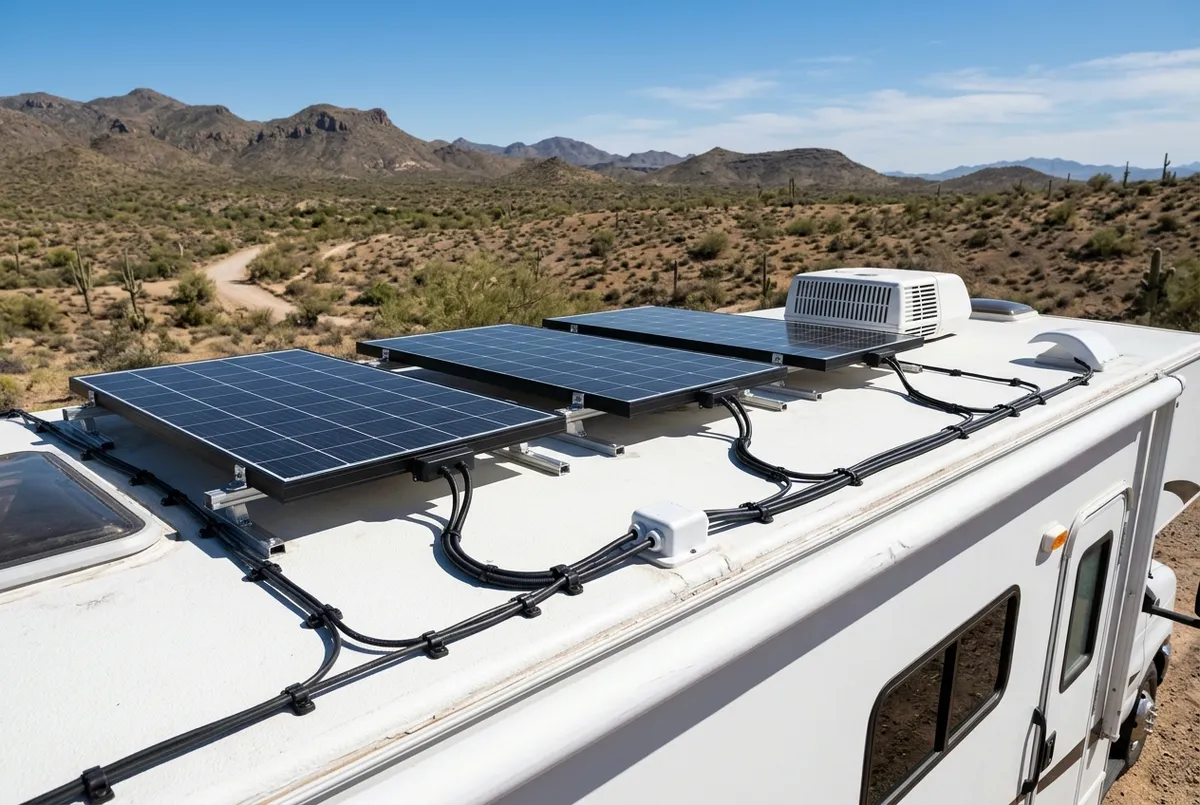
On the roof, series or parallel panel wiring changes the current you need the cable to carry.
Your own amps and distances will differ, so treat the table as a sense check.
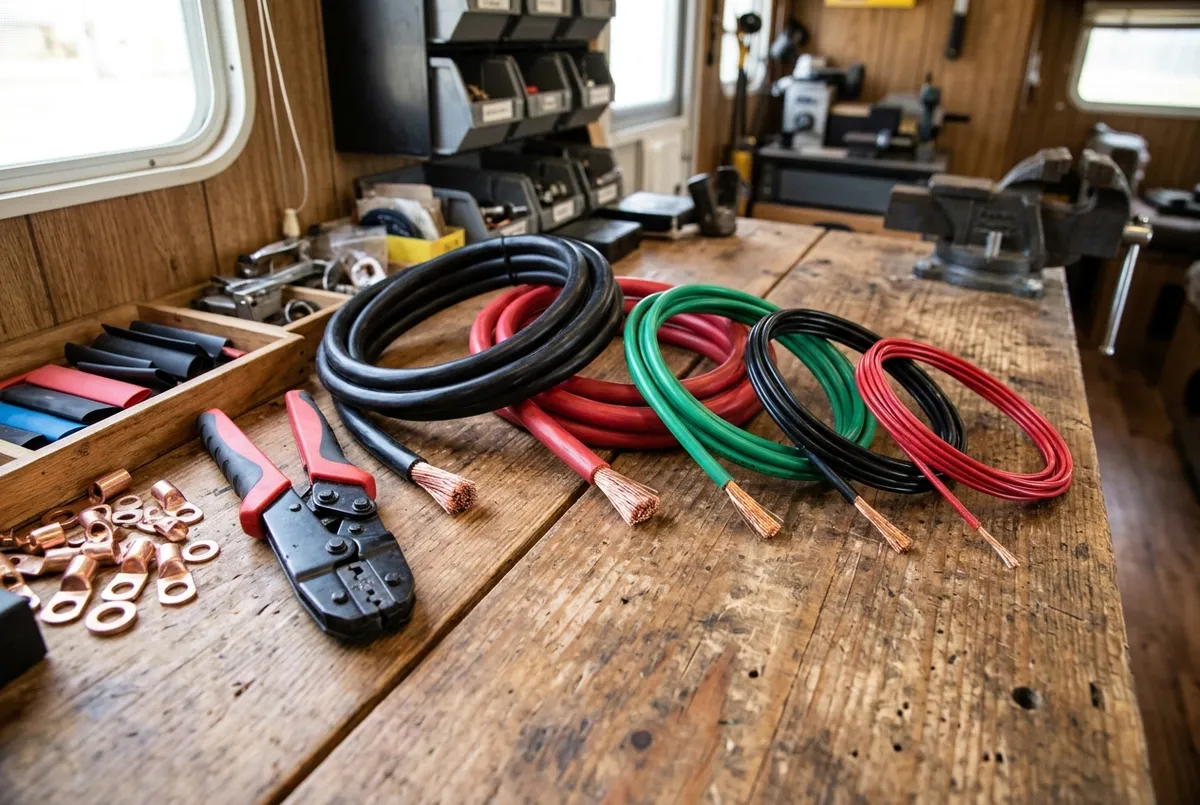
Compressor fridge circuit
10 amps over 15 feet, 3 percent drop
10 AWG
MPPT solar charge controller to battery
30 amps over 5 feet, 3 percent drop
10 AWG
DC to DC charger from the front battery
40 amps over 15 feet, 3 percent drop
4 AWG
2,000 watt inverter to battery
170 amps over 4 feet, 3 percent drop
2 AWG
LED lighting circuit
5 amps over 20 feet, 10 percent drop
16 AWG
| Circuit | Load and one way run | Drop limit | Gauge |
|---|---|---|---|
| Compressor fridge circuit | 10 amps over 15 feet | 3 percent | 10 AWG |
| MPPT solar charge controller to battery | 30 amps over 5 feet | 3 percent | 10 AWG |
| DC to DC charger from the front battery | 40 amps over 15 feet | 3 percent | 4 AWG |
| 2,000 watt inverter to battery | 170 amps over 4 feet | 3 percent | 2 AWG |
| LED lighting circuit | 5 amps over 20 feet | 10 percent | 16 AWG |
The inverter row uses 2,000 watts divided by 12 volts, rounded up for losses to 170 amps.
It is set by heat rather than drop, because 4 AWG carries a published rating of 160 amps in the West Marine table.
Its 213 amp minimum fuse is above the 210 amp rating of 2 AWG, so the fused cable steps up to 1 AWG, rated 245 amps.
Why Does Voltage Drop Matter in an RV?
Every foot of copper in a 12V electrical system has resistance, and current through that resistance loses voltage before it reaches the device.
11.64 volts
According to West Marine's worked figure, a 3 percent limit on a 12 volt system means the device must still see at least 11.64 volts.
The most common mistake, according to West Marine, is reading a round trip chart with the one way distance.
- Use 3 percent for
- Inverter and charger cables, battery to panel feeds, electronics and anything that resets on low voltage.
- Use 10 percent for
- Cabin lights and simple loads that keep working when the voltage sags a little.
Why Thin Wire Is a Fire Risk
Undersized wire also runs hot under load, and West Marine warns that enough heat can melt insulation and start a fire.
That is an avoidable risk, because the fix is a thicker cable chosen before the install.
Victron's lithium battery manual says to size battery cables for the maximum current the system will draw, so check the discharge ratings in our lithium RV battery picks first.
12 Volt Wire Size Chart: Resistance and Maximum Amps
Use this wire gauge chart as a quick reference, with data from West Marine's AWG specifications for 105 degree C marine wire.
The calculator reads the same figures.
Maximum amps, also called ampacity, apply to a single conductor outside a hot engine space.
To read it by hand, find the thinnest gauge whose maximum amps clear your load, then work out its drop: amps times round trip feet times ohms, divided by 1,000.
| Gauge | Ohms per 1,000 feet | Maximum amps |
|---|---|---|
| 18 AWG | 6.48 | 20 |
| 16 AWG | 4 | 25 |
| 14 AWG | 2.5 | 35 |
| 12 AWG | 1.75 | 45 |
| 10 AWG | 0.98 | 60 |
| 8 AWG | 0.62 | 80 |
| 6 AWG | 0.4 | 120 |
| 4 AWG | 0.24 | 160 |
| 2 AWG | 0.157 | 210 |
| 1 AWG | 0.127 | 245 |
| 1/0 AWG | 0.099 | 285 |
| 2/0 AWG | 0.077 | 330 |
| 3/0 AWG | 0.062 | 385 |
| 4/0 AWG | 0.049 | 445 |
How Do You Size the Fuse, and When Do You Size Up?
Fuse at 125 percent of the load, then check the wire
According to Blue Sea Systems, the minimum fuse is 125 percent of the device's amps.
So an 80 amp load gets at least a 100 amp fuse.
The fuse protects the wire, so it must also stay at or below what that wire is rated to carry.
Current is only half the picture, and how long an RV battery can supply it decides how big the battery bank behind the cable must be.
When West Marine says to size up
- Three cables bundled together30 percent fewer amps
- Four to six cables bundled40 percent fewer amps
- Seven to 24 cables bundled50 percent fewer amps
- Run through a hot engine space15 percent fewer amps
- Automotive cable made to SAE sizes6 to 12 percent less copper than the same AWG number
Safety first: battery cables carry enough current to start a fire, so have a qualified electrician or RV technician check high current work.
The device maker's manual and local code win over this calculator whenever they ask for more.
Where These Figures Come From
Resistance, maximum amps, round trip rules and the size up cuts are from West Marine's marine wire advisor.
The fuse rule is from Blue Sea Systems.
We did not install or measure any cable for this guide, and the calculator is plain arithmetic on those published tables.
Last verified November 2026.
Smart RV Hub Editorial Team
RV Technology Research and Reviews
Our writers research smart RV technology full time, covering solar power, connectivity, security, and power management.
Every guide draws on published manufacturer specifications and owner reviews, so you can compare options with confidence.
Meet the editorial team and our review standardsWire Size Questions
What size wire do I need for a 12 volt RV circuit?
The current and the round trip length of the run decide the size.
For example, a 20 amp load 10 feet from the battery needs 8 AWG to stay under a 3 percent drop.
That matches West Marine's published 3 percent chart.
Do I measure the wire one way or round trip?
Voltage drop charts use the round trip, because current travels out on the positive and back on the negative.
This calculator asks for the one way distance and doubles it for you.
What is an acceptable voltage drop on an RV?
ABYC guidance comes from the American Boat and Yacht Council, as summarized by Blue Sea Systems and West Marine.
It allows 3 percent on critical circuits such as panel feeds and electronics.
Simple loads such as cabin lights may drop 10 percent.
This calculator defaults to the stricter 3 percent, which is the safer choice for inverter and charger cables.
What size wire goes from the battery to a 2,000 watt inverter?
2,000 watts divided by 12 volts is about 167 amps before inverter losses, so plan on roughly 170 amps.
By this calculator, a 4 foot run needs 2 AWG for heat, and 1 AWG once it carries the 213 amp minimum fuse.
The inverter manual's own cable and fuse table wins whenever it asks for more.
How do I size the fuse for a wire?
Blue Sea Systems sets the minimum fuse size at 125 percent of the load, and the fuse must still be small enough to protect the wire.
If the device maker's recommended fuse is larger than the wire can take, the fix is a thicker wire, not a bigger fuse.
Does 24 volts need thinner wire than 12 volts?
Yes, for the same current and length, because the allowed drop in volts doubles while the loss in the wire stays the same.
Here, 20 amps over 10 feet needs 8 AWG at 12 volts or 12 AWG at 24 volts, unless the manufacturer asks for more.
That is why a 24 volt system suits rigs with long runs to the back of the coach.
Is automotive wire the same as marine wire?
Not quite: West Marine notes that SAE automotive gauges are 6 to 12 percent smaller in cross section than the same AWG number.
This calculator assumes true AWG stranded copper, so size up if you use SAE cable.
When should I size up from the calculator's answer?
Size up when cables are bundled, run through a hot space, or when the load may grow later.
West Marine cuts the amp rating by 15 percent in hot engine spaces and by 30 to 50 percent for bundles of three or more wires.
The parts these cables connect, and how much power they will move.
Panels to controller to battery to inverter, with fusing.
The watts that set the heaviest cable in the rig.
How much battery the loads on these wires will use.
Banks that can deliver the currents in the table above.
Price the system these cables will connect.
Why panel wiring changes the current on the roof run.
Size the Inverter Before Its Cable
The heaviest cable in most rigs runs from the battery to the inverter, so its size starts with the inverter's watts.
Our guide to choosing an inverter size settles that number first.
Free shipping options on qualifying orders
Rated 4.4 of 5 on Trustpilot, checked November 2026 (opens in a new tab)Ships from over 60 US fulfillment centers, checked October 2026.
Shop RV Solar Panels and BatteriesAffiliate link. We may earn a commission at no extra cost to you.