RV Solar Power Guide: Cut the Hookup Cord and Camp Anywhere
The complete RV solar guide for boondockers, full timers, and weekenders.
Free calculator, panel comparisons, and step by step installation.
Affiliate Disclosure
This page contains affiliate links to A1 SolarStore.
When you purchase A1 SolarStore through these links, we may earn a commission at no additional cost to you.
This helps support our free calculators, guides, and research tools. Read our full disclosure
Affiliate link. We may earn a commission at no extra cost to you.
Most RVs need 400 to 800W of solar panels and 200 to 400Ah of lithium battery capacity.
A basic weekend setup costs around $1,200, while a full time system runs $2,000 to $3,500.
This guide covers panel selection (Renogy vs Victron vs Rich Solar), battery sizing, charge controller types (MPPT vs PWM), and step by step installation.
Use the free calculator below to size your exact system.
By Smart RV Hub Editorial Team · Methodology: published manufacturer specs and verified user reviews
Our Pick · RV Solar Retailer
A1 SolarStore: Editorial Pick for RV Solar Kits
Strong price to warranty ratio based on published spec sheets and verified buyer reviews.
Strong on RV specific kits, fast US shipping, and a curated lithium battery lineup.
See RV Solar Kits at A1 SolarStore →(opens in new tab)Affiliate link. We may earn a commission at no extra cost to you.
- Over 60 Fulfillment Centers
- Free Shipping on Qualifying Orders
- Rated Excellent on Trustpilot
- Smart RV Hub Solar Showdown Pick
Trust signals verified May 2026. Check a1solarstore.com for current details.
A1 SolarStore does not carry Renogy or Rich Solar. They stock panels from JA Solar, Canadian Solar, Mission, Trina, REC, Longi, Hyundai, Jinko, Silfab and Qcells, verified August 2026.
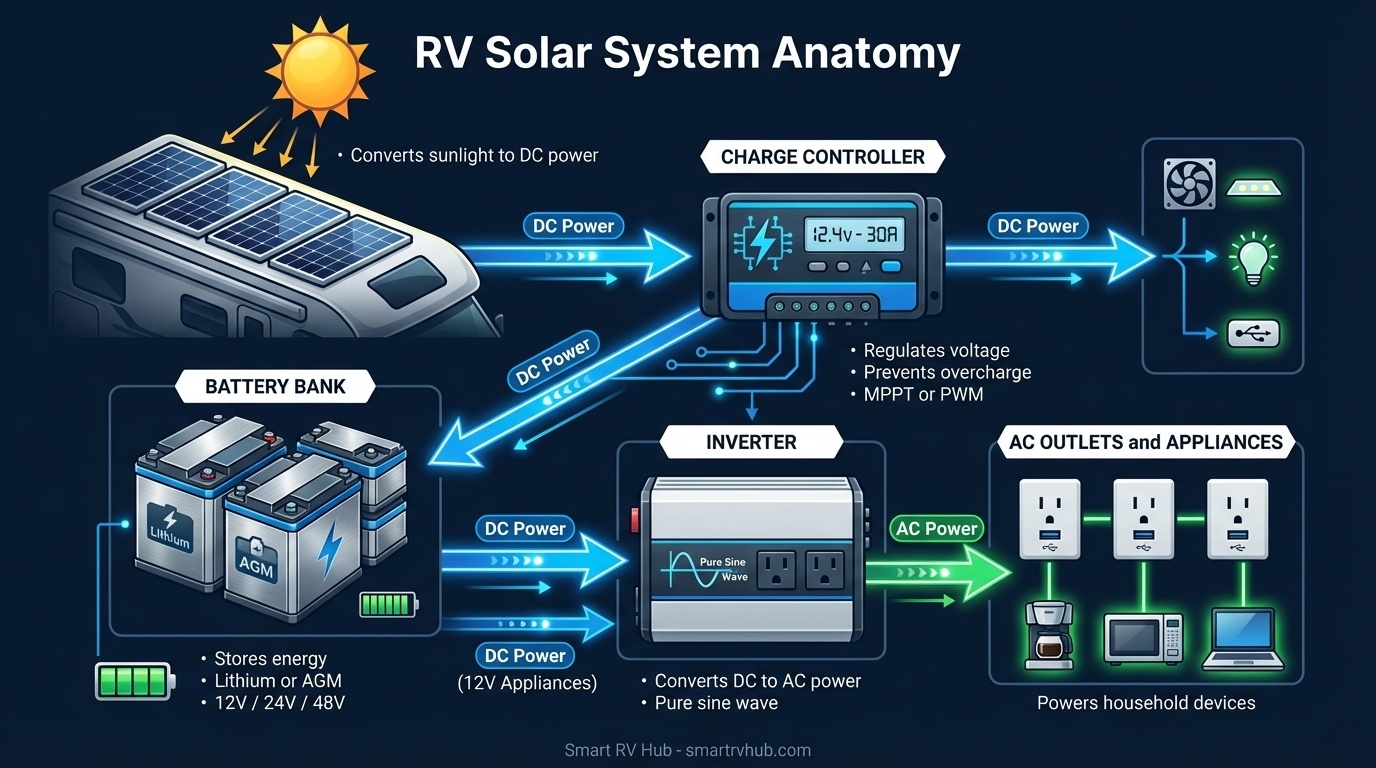
How an RV solar system fits together
Tap any part of the power chain to see what it does and what to look for when you buy it.
Solar panels
Panels sit on the roof and turn sunlight into DC power. More watts means more energy captured on a sunny day.
Match the wattage to your daily power use and the roof space you have to work with.
Affiliate link. We may earn a commission if you buy, at no extra cost to you.
📋 What you'll discover
- Calculate your exact RV solar power needs with free solar calculator
- Compare the highest rated RV solar panels and complete solar systems
- Expert reviews of best solar panels for RVs and lithium batteries
- Save money with solar energy independence and boondocking
Quick Navigation
RV Solar Sizing Calculator
How Do I Calculate My Exact RV Solar Power Needs?
Divide your daily watt hour consumption by available sun hours to size required panel wattage, then add 20 percent buffer. A 3,000 Wh per day load with 5 sun hours needs 600W of panels.
Once you have the wattage, decide on how to string the panels together, because the layout changes shade behavior.
Average RV uses 2000 to 4000 Wh per day
Varies by location: 4 to 7 hours typical
Your Solar Recommendations
Ready to Go Off Grid?
Your result points to a 600W system with about 313Ah of battery. Shop complete kits matched to those numbers at A1 SolarStore.
See 600W Kits at A1 SolarStore →(opens in new tab)Affiliate link. We may earn a commission at no extra cost to you.
Want to compare panels first? See our expert reviews of the best RV solar panels.
Save Money
Reduce or eliminate campground fees by boondocking with solar power
Eco Friendly
Clean, renewable energy reduces your carbon footprint
Energy Independence
Power your RV anywhere the sun shines, no hookups needed
Increase RV Value
Solar installations add value and appeal to your RV
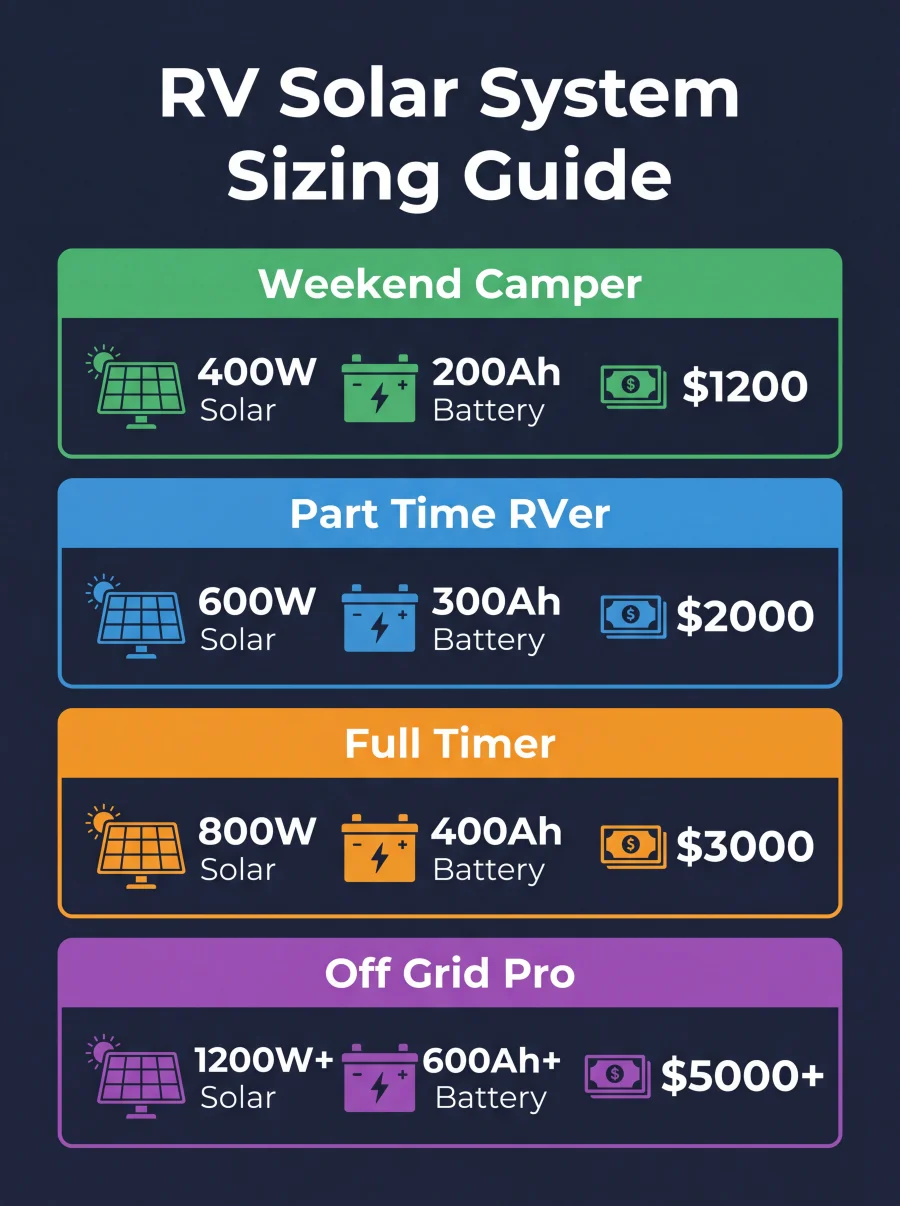
How Do I Size My RV Solar System?
Match your daily watt hour use to a tier. US Department of Energy
- 400W suits weekend trips
- 600W fits part time travel
- 800W or more supports full time living
Use this visual guide to choose the right solar setup for your RV lifestyle.
Not sure which tier suits you? Spending a week in a solar equipped rig first is easy to arrange, and our full guide to renting an RV walks through how.
How RV Solar Systems Work
Understand the components and power flow in your RV solar setup
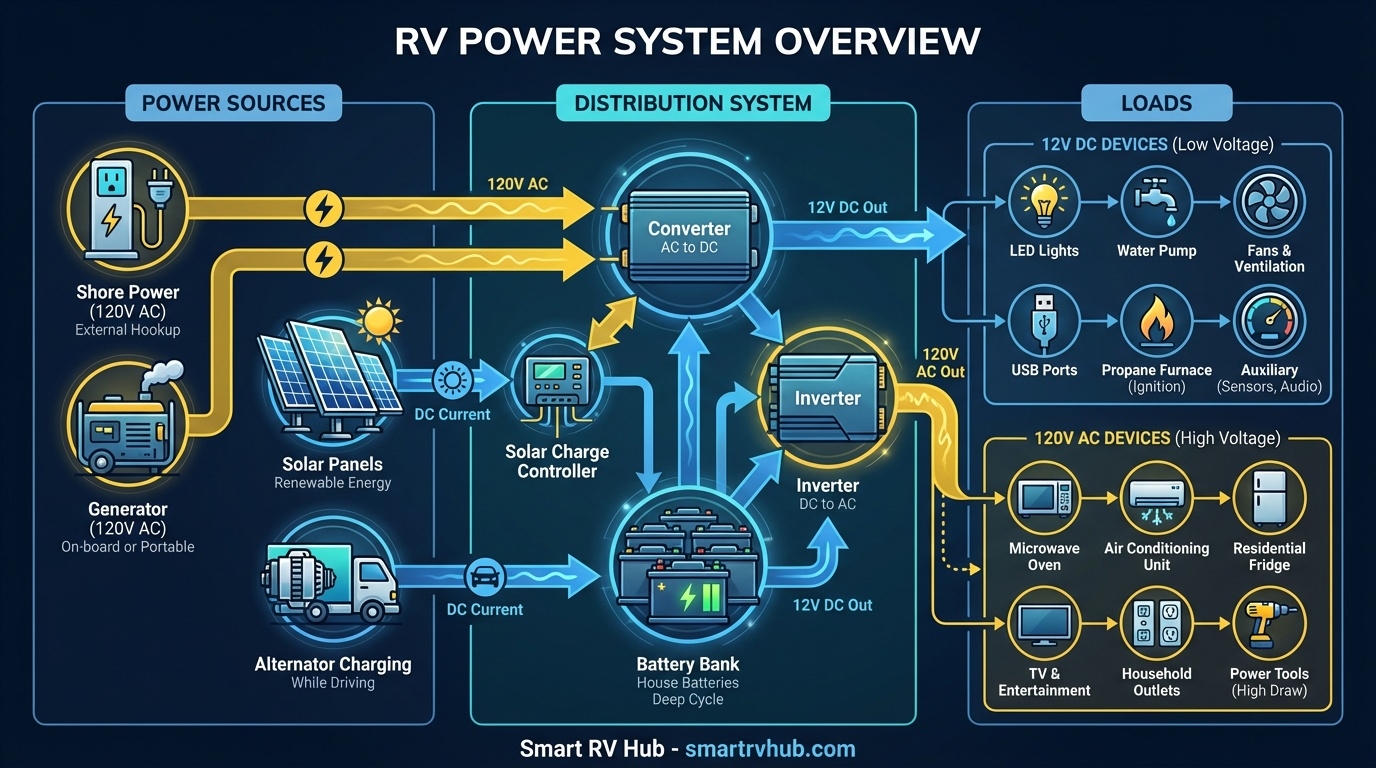
Complete RV Power System Overview
See how all power sources work together in your RV
Get Free Solar Tips by Email
Join our newsletter for weekly solar tips, product reviews, and solar equipment deal alerts.
Free by email. Unsubscribe anytime.
No spam, and you can unsubscribe anytime. See our Privacy Policy.
RV Solar System Size by Usage Type 2026
Which Solar System Size Is Right for My RV Usage Type?
Costs run from about $1,200 for a 400W weekend setup to $4,500 for an 800W full time system. Battery capacity scales with it, from 200Ah to 400Ah.
The inverter is the other half of that spend, and our guide to which inverter waveform your appliances need keeps you from buying the wrong one.
2 min read • Find your perfect solar setup.
Want detailed panel comparisons?
Visit our side by side look at the panels worth buying.
| Usage Type | Solar Panels | Battery | Est. Cost | Best For |
|---|---|---|---|---|
Weekend Camper 2 to 4 trips/month | 400W (2× 200W) | 200Ah LiFePO4 | $1,200 to $1,600 | Lights, phone charging, small fridge |
Part Time RVer 1 to 2 weeks/month | 600W (3× 200W) | 300Ah LiFePO4 | $2,000 to $2,500 | Full fridge, TV, laptop, coffee maker |
Full Timer Living in RV | 800W+ (4× 200W) | 400Ah+ LiFePO4 | $3,000 to $4,500 | All appliances, work from RV, microwave |
Off Grid Pro Extended boondocking | 1200W+ (6× 200W) | 600Ah+ LiFePO4 | $5,500 to $8,000 | Everything + A/C (with limits) |
Pro Tip: Start with a system that matches your current needs.
It's easier to add panels later than to remove them.
Most systems can be expanded by 50 to 100% with proper planning.
When you are ready to purchase, our guide to rv solar panel retailers with pre matched system kits covers authorized dealers with free shipping.
Before you order, check the current discounts on RV solar equipment to time your purchase well.
See how one retailer stacks up in our look at A1 SolarStore for RV solar kits, including shipping and support.
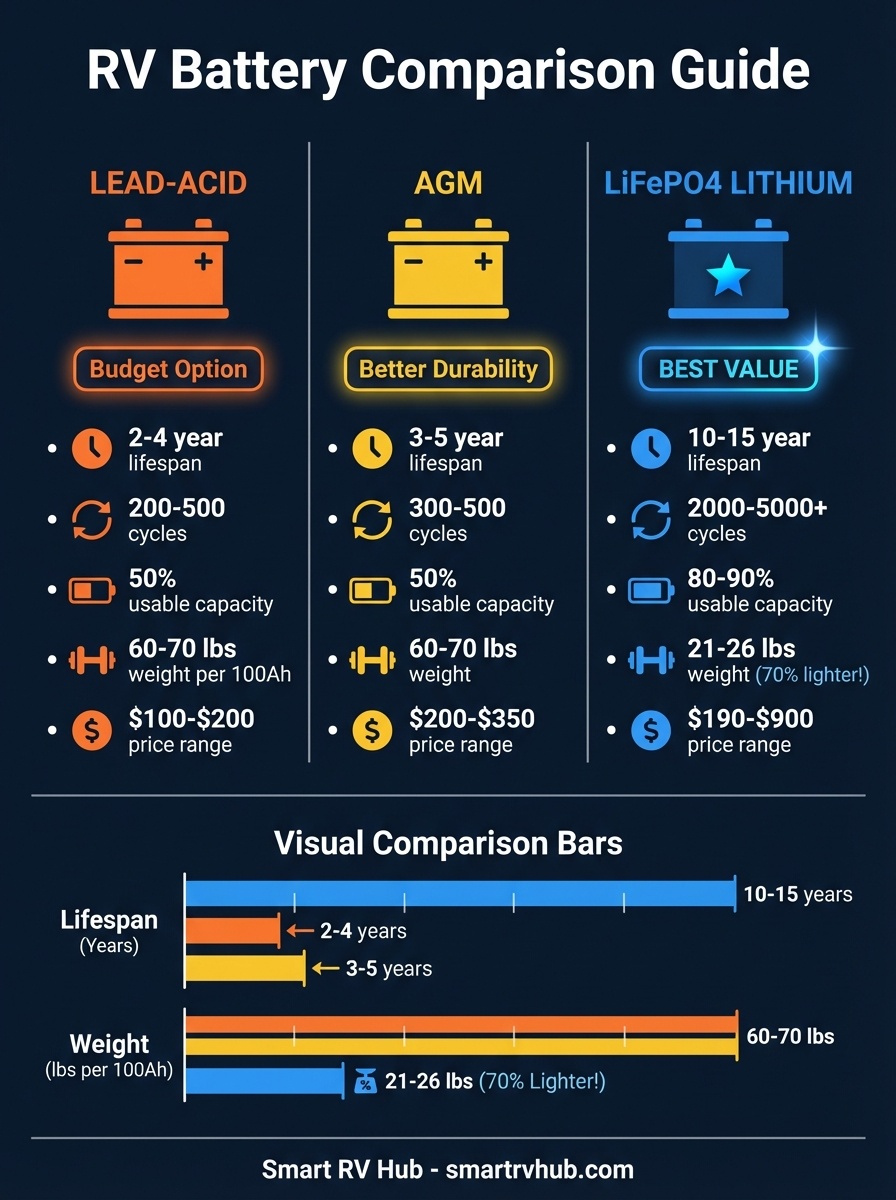
RV Battery Type Comparison Guide
Compare Lead Acid, AGM, and LiFePO4 batteries for your RV solar system. For a deep dive into the top LiFePO4 options, see our lithium battery comparison guide.
Ready to Shop for Equipment?
Our dedicated buying guides compare kits, panels, and batteries at every price point.
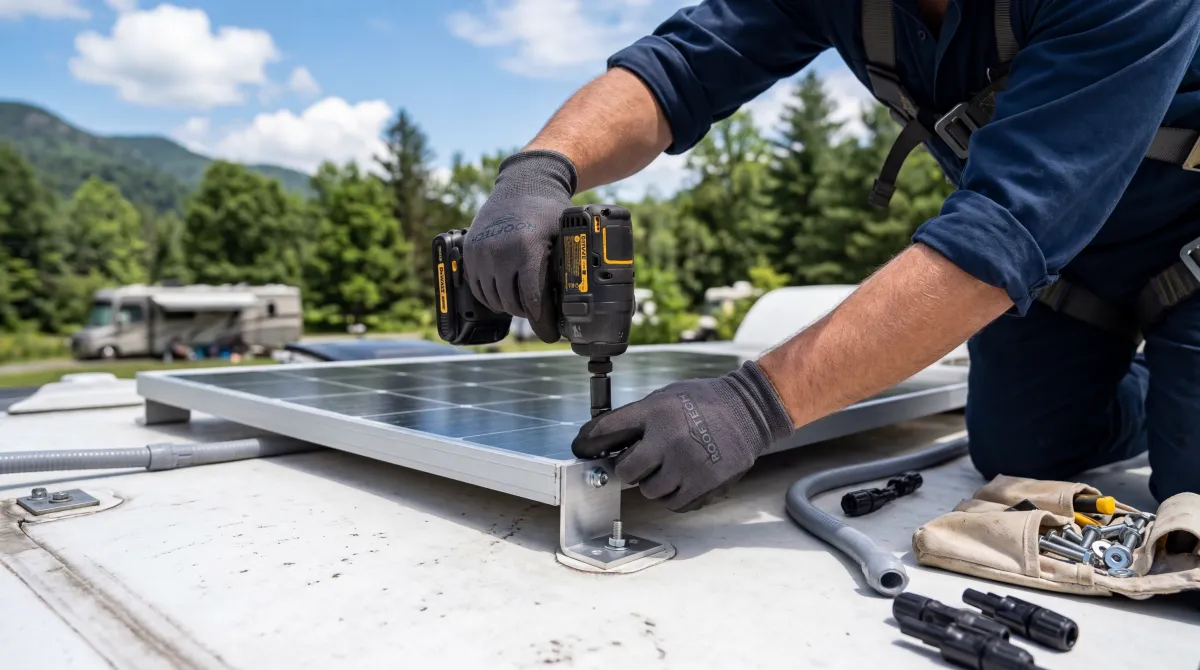
Professional Installation Available
Not ready to DIY? A1 SolarStore connects you with home service pros for solar installation work.
Request offers and compare quotes before you commit.
Affiliate link. We may earn a commission at no extra cost to you.
Related Resources & Next Steps
Continue your RV solar journey with these helpful resources
Solar Equipment & Reviews
- Ready to buy? Compare the highest rated RV solar panels for 2026 based on published manufacturer specifications and verified user reviews.
- Torn between brands? Discover which solar brand delivers better performance for your needs.
- Rigid or flexible? Compare flexible vs rigid RV solar panels for your roof.
- Starting small? See what a 200 watt RV solar kit can realistically power for weekend trips.
- Need more capacity? Find out whether a 400 watt RV solar kit covers your daily usage.
- Want to run the AC? See how many solar panels it takes to run an RV air conditioner.
- Wiring it yourself? Follow the RV solar wiring guide for fuses and wire sizing.
- Budgeting the build? Estimate your system size and cost with the solar cost calculator.
- Need precise numbers? Calculate your exact battery and solar requirements with our free tools.
- Want to optimize? Master your RV power management system for maximum efficiency.
- Still on the fence? See whether RV solar pays back for your travel pattern before you spend a dollar.
- Already installed? Keep panels clean and the system healthy with our maintenance routine.
Planning & Lifestyle
- Going full time? Explore what full time RV life really requires for solar and beyond.
- Working remotely? Set up the ultimate remote work RV office with reliable power.
- Planning adventures? Plan your solar powered RV trips safely with RV specific routing.
- Camping off grid? Stay overnight at wineries and farms with Harvest Hosts to stretch your solar powered nights.
- Not ready to buy? Try RVing with a rental first before investing in solar equipment.
Not sure where to start? Our free tools that size a solar system tell you exactly how many panels and batteries you need.
Then browse our detailed panel reviews based on published specs to find equipment for your budget.
Considering the RV lifestyle? Estimate rental costs to test RV living before making the solar investment.
Explore More Solar Resources
How to Size and Install RV Solar Power Systems
Follow these five steps to calculate your power needs and select the right panels, batteries, and equipment for your RV.
- 1
Calculate Your Daily Power Usage
Determine your daily watt hour consumption by listing all appliances and devices you use in your RV. Average RV uses 2000 to 4000 Wh per day.
- 2
Determine Sun Hours for Your Location
Check average daily sun hours for your typical travel locations. Most areas receive 4 to 7 peak sun hours per day.
- 3
Calculate Required Solar Panels
Divide daily usage by sun hours to determine required solar panel wattage. Add 20% buffer for efficiency losses and cloudy days.
- 4
Select Battery Capacity
Choose battery capacity to store 1 to 2 days of power usage. Lithium batteries offer best performance for RV solar systems.
- 5
Choose Complete System or Components
Select from complete solar kits for easy installation or individual components for custom systems. Compare options from A1 SolarStore for top RV solar solutions.
RV Solar Frequently Asked Questions
Get expert answers to common RV solar questions
How many solar panels does an RV need?
As a general guideline, most RVs need 400 to 800W of solar capacity.
Weekend campers usually need 400W, which is two 200W panels.
Full timers usually need 600 to 800W, which is three or four panels.
Those figures assume 2,000 to 4,000 watt hours of power a day.
Your own needs depend on your appliances and habits.
What size solar system for weekend vs full time RVing?
Weekend RVers need 400W solar + 200Ah battery ($1,200).
Full time RVers need 600 to 800W solar + 300 to 400Ah battery ($2,000 to 3,000).
How much does RV solar installation cost in 2026?
Complete RV solar systems typically range from $1,200 (basic 400W setup) to $3,500 plus (premium 800W plus systems).
DIY installation can save an estimated $500 to 1,000 in professional labor, depending on system complexity and local rates.
Costs include solar panels ($110 to $250 per 200W panel), charge controller ($200 to 400), and lithium battery bank ($600 to 1,500).
Can I run my RV AC on solar power?
Running AC on solar requires 1,200 to 2,000W of panels and significant battery capacity (600 to 1,000Ah lithium).
Many RVers use solar for everything except AC due to the high power requirements.
Soft start devices can help but AC remains the biggest challenge for solar systems.
Renogy vs Victron solar panels: Which is better for RVs?
Renogy offers best value with 200W panels featuring high cell efficiency and proven reliability.
Victron is the premium choice with slightly higher efficiency ratings and superior build quality.
Both deliver high real world efficiency relative to their rated output.
Choose Renogy for budget conscious installations or Victron for maximum performance.
What battery size do I need with my RV solar panels?
Battery capacity should store 1 to 2 days of power usage.
For a 400W solar system (producing ~2,000Wh per day), use 200 to 300Ah lithium battery.
For 800W systems (producing ~4,000Wh per day), use 300 to 400Ah lithium.
Lithium batteries are preferred over lead acid for deeper discharge and longer lifespan.
Should I get monocrystalline or polycrystalline solar panels?
Monocrystalline panels lead for RV installations on published specs.
They run at 19 to 22% efficiency against 15 to 17% for polycrystalline, so you get more power from less roof space.
They cost 10 to 20% more up front.
That efficiency pays back through better performance in partial shade and in cooler weather.
How long do RV solar panels last?
Quality RV solar panels typically last 25 to 30 years with minimal degradation.
Most manufacturers guarantee 80 to 85% power output after 25 years.
The charge controller usually needs replacement after 10 to 15 years, and lithium batteries last 10 to 15 years (3,000 to 5,000 cycles).
Can I install RV solar panels myself or do I need professional installation?
Many RVers successfully install their own solar systems with basic tools and electrical knowledge.
A typical DIY installation takes 1 to 2 days for a 400 to 800W system.
DIY saves $500 to $1,000 in labor costs.
Professional installation makes sense for complex systems (1,200W+), integrated battery upgrades, or guaranteed warranty coverage.
What is the difference between PWM and MPPT charge controllers?
MPPT controllers, short for Maximum Power Point Tracking, are 20 to 30% more efficient than PWM controllers.
They are worth the extra cost for RV solar.
For systems of 400W or larger, always choose MPPT.
PWM only makes sense on very small systems of 100 to 200W.
Top brands include Victron, Renogy, and Morningstar.
How much roof space do I need for RV solar panels?
Plan for approximately 8 to 10 square feet per 100W of solar capacity.
A 400W system (2x 200W panels) requires about 32 to 40 square feet, while an 800W system needs 64 to 80 square feet.
Standard rigid panels are 65×39 inches (200W) while flexible panels can conform to curved surfaces.
Will solar panels charge my RV battery while driving?
Yes, solar panels charge your battery bank continuously whenever there is sunlight, including while driving.
Your alternator provides the primary charging while the engine runs.
Solar charging during travel is supplemental but valuable for maintaining your house battery when parked between destinations.
What happens to my solar panels in winter or cloudy weather?
Solar panels work in winter and cloudy conditions but produce significantly less power than peak summer sun.
Cold temperatures can actually improve panel efficiency, but shorter days and lower sun angles reduce total output.
On overcast days, expect reduced capacity.
Snow covering panels completely blocks production until melted.
Should I get monocrystalline or polycrystalline solar panels?
Monocrystalline panels lead for RV solar installations on published specs.
They offer 19 to 22% efficiency compared to 15 to 17% for polycrystalline panels, meaning you generate more power from less roof space.
While monocrystalline panels cost 10 to 20% more upfront, the superior efficiency pays off through better performance in partial shade and lower temperatures.
For RVs where roof space is limited, monocrystalline is worth the investment.
How long do RV solar panels last?
Quality RV solar panels typically last 25 to 30 years with minimal degradation.
Most manufacturers guarantee 80 to 85% power output after 25 years.
The charge controller usually needs replacement after 10 to 15 years, and lithium batteries last 10 to 15 years (3,000 to 5,000 cycles).
Budget for battery replacement as your primary long term solar cost.
Can I install RV solar panels myself or do I need professional installation?
Many RVers successfully install their own solar systems with basic tools and electrical knowledge.
A typical DIY installation takes 1 to 2 days for a 400 to 800W system.
If you are comfortable following detailed instructions and working safely on your roof, DIY saves $500 to $1,000 in labor costs.
Professional installation makes sense for complex systems (1,200W+), integrated battery upgrades, or if you prefer guaranteed warranty coverage.
What is the difference between PWM and MPPT charge controllers?
MPPT controllers, short for Maximum Power Point Tracking, are 20 to 30% more efficient than PWM controllers. They are worth the extra cost for RV solar.
MPPT controllers extract maximum power from your panels by adjusting voltage and current, especially important in cold weather or partial shade.
For systems 400W or larger, always choose MPPT.
PWM controllers only make sense for very small systems (100 to 200W) where the 30 to 40% cost savings outweighs the efficiency loss.
Top brands include Victron, Renogy, and Morningstar.
A1 SolarStore does not carry Renogy or Morningstar. They stock charge controllers from Victron, verified August 2026.
How much roof space do I need for RV solar panels?
Plan for approximately 8 to 10 square feet per 100W of solar capacity.
A 400W system (2x 200W panels) requires about 32 to 40 square feet, while an 800W system needs 64 to 80 square feet.
Measure your usable roof space avoiding vents, AC units, and ladder areas.
Standard rigid panels are 65×39 inches (200W) while flexible panels can conform to curved surfaces.
Use our calculator above to determine your wattage needs, then verify you have adequate mounting space before purchasing.
Will solar panels charge my RV battery while driving?
Yes, solar panels charge your battery bank continuously whenever there is sunlight, including while driving.
Your alternator provides the primary charging while the engine runs.
Solar charging during travel is supplemental but valuable for maintaining your house battery when parked between destinations.
Drive often during the sunny part of the day and you can size the array slightly smaller. You gain charge from the alternator and the solar at the same time.
What happens to my solar panels in winter or cloudy weather?
Solar panels work in winter and cloudy conditions but produce significantly less power than peak summer sun.
Cold temperatures can actually improve panel efficiency (based on semiconductor physics), but shorter days and lower sun angles reduce total output.
On overcast days, expect reduced capacity. Snow covering panels completely blocks production until melted.
Four things help through winter.
- More battery capacity, so you can store what you do collect
- Panels angled steeper, so snow slides off
- Extra panel capacity beyond what your summer sums call for
- A backup charger, meaning a generator or shore power, for long cloudy spells
Solar Guides & Resources
RV Solar Installation Guide
Step by step guide to installing solar on your RV
RV Solar by State
Sun hours and sizing compared across the best solar states
Where to Buy RV Solar Panels
Compare top retailers and find the best deals
Best RV Solar Installation Kits
Complete kits for easy DIY solar installation
RV Solar Battery Guide
LiFePO4 vs AGM vs Gel, compare every battery type
RV Solar System Sizing Guide
Calculate exactly how much solar you need
MPPT vs PWM Charge Controllers
Which controller type is right for your setup
Buy RV Solar Panels
Complete buyer's guide with kit comparisons
Best RV Solar Panels 2026
Top rated panels compared and reviewed
Renogy vs Victron Comparison
Head to head comparison of the top two brands
600 Watt RV Solar Kit Review
The part timer's sweet spot, reviewed on published specs
800 Watt RV Solar Kit Review
The standard full timer build, reviewed on published specs
Sources
- Solar Photovoltaic Technology Basics — US Department of Energy
Smart RV Hub Editorial Team
RV Technology Research and Reviews
Our writers research smart RV technology full time, covering solar power, connectivity, security, and power management.
Every guide draws on published manufacturer specifications and verified owner reviews, so you can compare options with confidence.
Meet the editorial team and our review standardsReady to Break Free from Hookup Fees?
Join the growing community of RVers switching to solar independence.
Your calculator results above point to the exact system size that fits your travel style.
Now it is time to make it happen.
Affiliate link. We may earn a commission at no extra cost to you.
- Over 60 Fulfillment Centers
- Free Shipping on Qualifying Orders
- Rated Excellent on Trustpilot
- Smart RV Hub Solar Showdown Pick
Trust signals verified May 2026. Check a1solarstore.com for current details.
✓ Expert help when you need it
Shop Matched RV Solar KitsAffiliate link. We may earn a commission at no extra cost to you.
Find Off Grid Camping Spots
Now that you know your solar setup, discover 30,000+ campgrounds with RV Life Pro.
Filter by boondocking friendly locations and cell coverage.
Affiliate link. We may earn a commission at no extra cost to you.