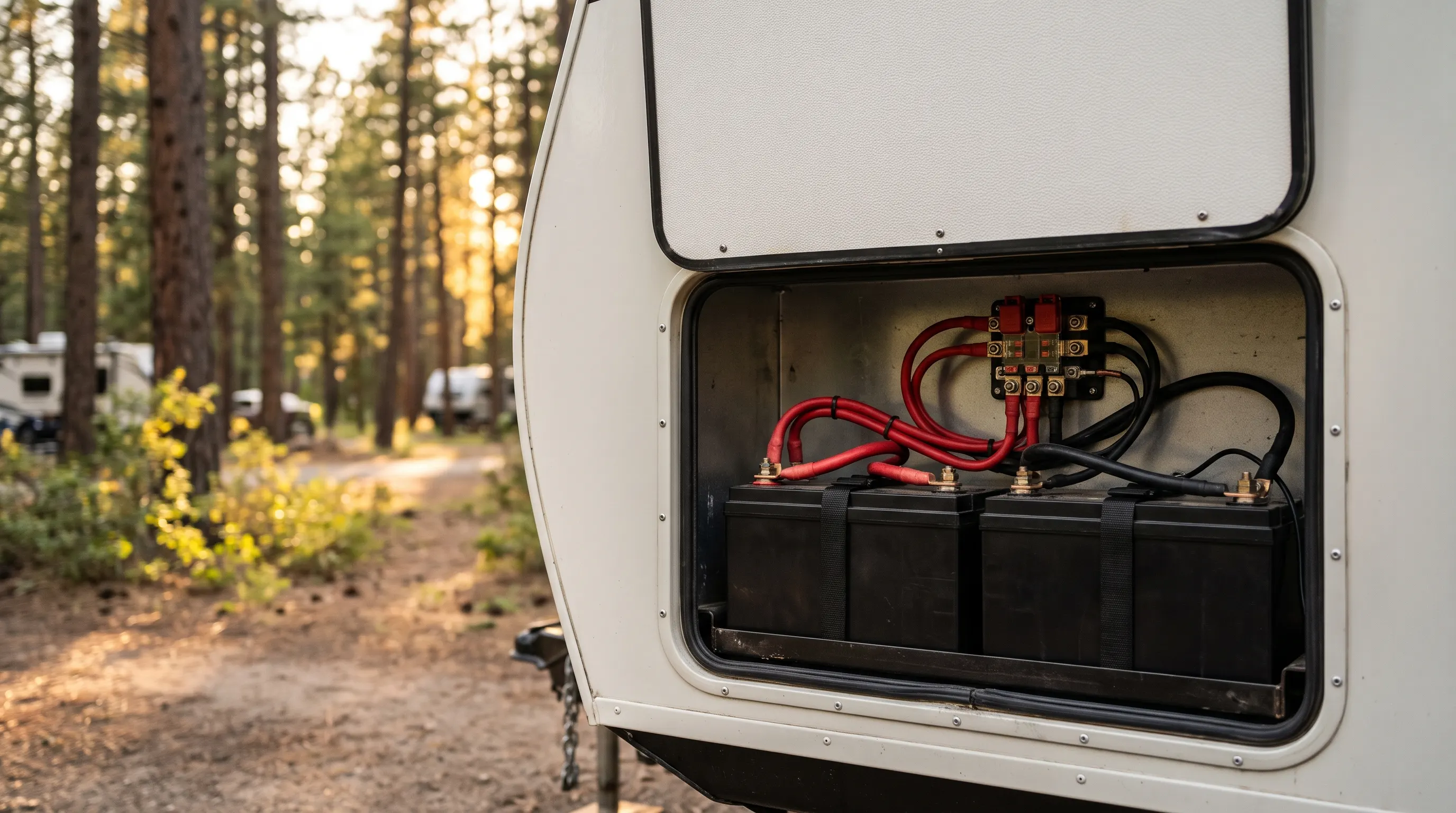
What Is an Amp Hour? RV Battery Capacity Explained
The label tells you what a battery holds, not what you can safely use.
Written from RELiON and Victron Energy published guidance, never from our own battery tests.
Affiliate Disclosure Smart RV Hub may earn a commission if you purchase from A1 SolarStore through these links, at no additional cost to you; see our full disclosure.
How Much of the Rating Can You Actually Use?
Less than the label says on lead acid, and close to all of it on lithium.
Victron advises against routinely draining lead acid past 50 percent. So a 100Ah AGM, a sealed lead acid battery, gives around 50Ah of safe daily use.
LiFePO4, the lithium iron phosphate type sold for RVs, tolerates deep cycling and gives closer to 80 to 100Ah, according to the same source.
100Ah lead acid: about 50Ah a day
100Ah LiFePO4: 80 to 100Ah a day
Size a lead acid bank by its label alone, and you plan for about twice the energy you can safely use.

Why Do Big Loads Drain Lead Acid Faster?
Lead acid is usually rated at C20, a discharge spread over 20 hours, which for a 100Ah battery is about 5 amps.
Victron notes that a 1,500 watt coffee machine pulls around 125 amps on 12 volts.
- Lead acid rating test (C20)
- about 5 amps
- 1,500 watt coffee machine
- about 125 amps
At currents like that, lead acid often falls to about half its rating.
Where Lithium Pulls Ahead
LiFePO4 suits rigs that run big loads, because Victron says it delivers roughly its rating whether drained over 20 hours or one.
What changes when you are switching a lead acid bank to lithium is covered separately.
How Big a Battery Bank Does Your RV Need?
Start from what you use in a day, and the sizer turns it into a rated capacity.
If an inverter runs household loads, work out the inverter size first, because it sets the biggest draw.
List what you run
Write down every device you use in a normal day off grid.
Find each one's watts
Read the label or manual, or multiply amps by volts for 12 volt devices.
Multiply by hours of use
A 50 watt load running 5 hours uses 250 watt hours.
Add them up and convert
Divide the daily total by the bank voltage to get the Ah drawn.
Divide by the usable share
Use 0.5 for lead acid and 0.8 for LiFePO4 to get the rated size to buy.
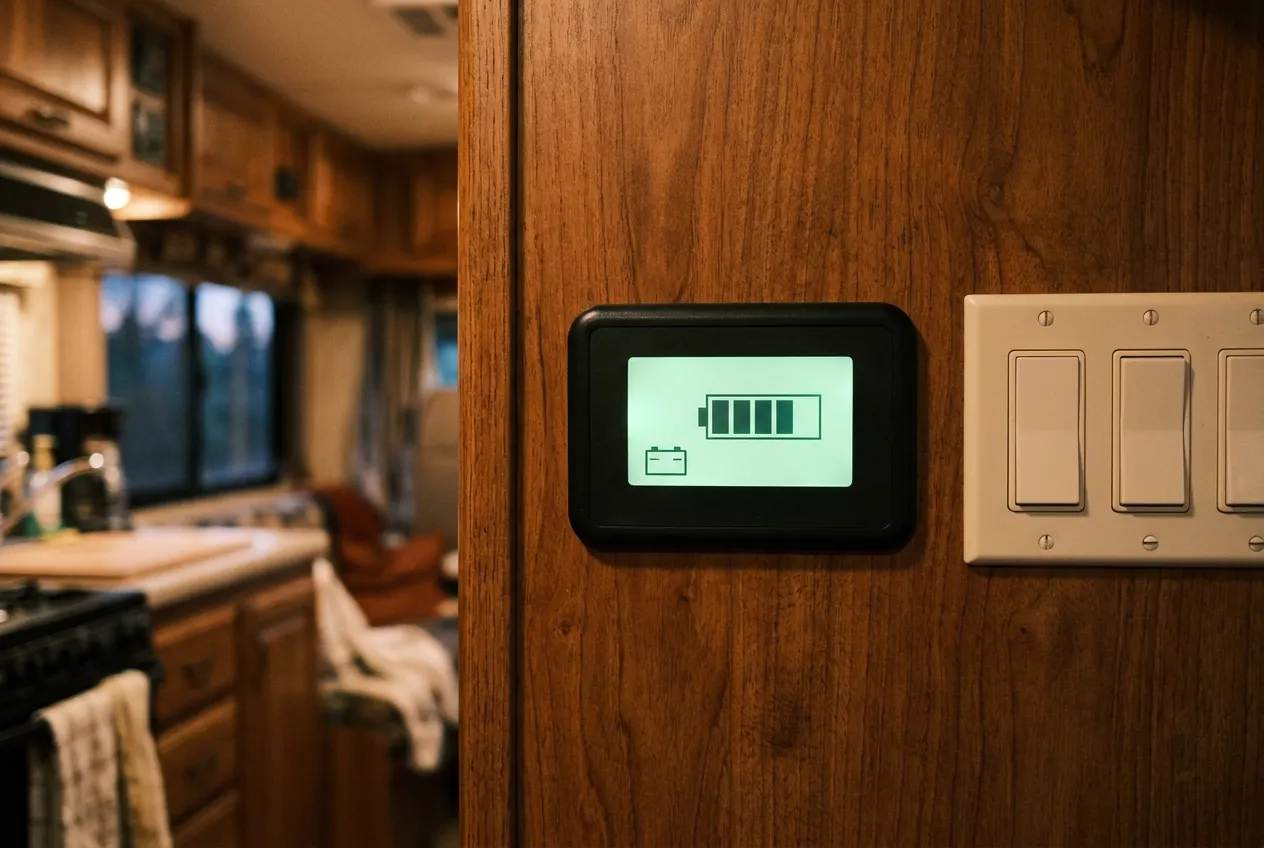
Size your battery bank
Enter what you use in a day and how long the bank must last without charging.
The sizer counts 80 percent of a LiFePO4 bank and 50 percent of a lead acid bank as usable, following Victron Energy's guidance.
Rated capacity to look for
125Ah
at 12 volts, for LiFePO4 lithium
LiFePO4 lithium125Ah
Lead acid or AGM200Ah
Lead acid needs the longer bar for the same daily use, because only about half of it is safe to use.
Ready to compare 12 volt lithium batteries for a bank this size?
Shop 12V Lithium RV Batteries at A1 SolarStoreAffiliate link. We may earn a commission if you buy, at no extra cost to you.
Email yourself this bank size
Plus the wire size and charging notes for a bank this big.
No spam, and you can unsubscribe anytime. See our Privacy Policy.
With a rated size in hand, comparing batteries becomes a short list rather than a guess.
Free shipping options on qualifying orders
Rated 4.4 of 5 on Trustpilot, checked November 2026 (opens in a new tab)Ships from over 60 US fulfillment centers, checked October 2026.
Shop 12V Lithium RV BatteriesAffiliate link. We may earn a commission at no extra cost to you.
What Is the Difference Between Amp Hours and Watt Hours?
RELiON puts it simply: amp hours are current over time, and watt hours are power over time.
Watt hours are the fairer way to compare batteries, because they include the voltage.
They are also the unit for sizing panels, battery and inverter together.
Victron sells its 12 volt lithium battery as a 12.8 volt unit, so 100Ah of it holds about 1,280 watt hours.
One 12 volt battery100Ah × 12V = 1,200Wh
Two in parallel (amp hours add up)200Ah × 12V = 2,400Wh
Two in series (volts add up)100Ah × 24V = 2,400Wh
Cold Weather Limits Charging
Victron warns that standard lithium cannot be charged below 0 degrees C, or 32 degrees F, without risking cell damage.
For cold weather trips, look for a heated model and confirm its charging limits on the datasheet.
What Else Changes the Capacity You Get?
A bank only helps if solar, shore power or the alternator can refill it before the next day.
Victron also notes that cables and fuses sized for lead acid may be too small for lithium's higher currents.
Our 12 volt wire gauge calculator checks those cables in a minute.
Where These Figures Come From
Definitions and conversions are from RELiON, and usable capacity, C20 ratings and cold limits are from Victron Energy.
We did not measure any battery for this guide, and the sizer is plain arithmetic on those published figures.
Last verified November 2026, and your battery's datasheet wins wherever it differs.
Smart RV Hub Editorial Team
RV Technology Research and Reviews
Our writers research smart RV technology full time, covering solar power, connectivity, security, and power management.
Every guide draws on published manufacturer specifications and owner reviews, so you can compare options with confidence.
Meet the editorial team and our review standardsBattery Capacity Questions
What is an amp hour?
An amp hour is a measure of charge: one amp flowing for one hour.
RELiON gives the example of a 150Ah battery supplying 150 amps for one hour or 75 amps for two hours.
How do I convert amp hours to watt hours?
Multiply the Ah figure by the battery's voltage, per RELiON: watt hours equal Ah times volts.
A 12 volt, 100Ah battery holds 1,200 watt hours on paper.
How much of a 100Ah battery can I actually use?
Victron says a 100Ah lead acid or AGM battery gives around 50Ah of safe daily use, because routine discharge past 50 percent shortens its life.
A 100Ah LiFePO4 battery gives closer to 80 to 100Ah by the same source.
How many amp hours do I need for my RV?
Add up the watt hours you use in a day, divide by the bank voltage, then divide by the usable share of your battery type.
For 1,200 watt hours a day at 12 volts, the sizer on this page gives 125Ah of LiFePO4 or 200Ah of lead acid.
Is a bigger Ah rating always better?
A bigger rating means more stored charge, but only if the bank can also be recharged in the time you have.
Solar or a generator has to put back what you take out, so bank size and charging are planned together.
Why does a lead acid battery give less when I run a big load?
Lead acid batteries are usually rated at C20, which Victron explains as a full discharge spread over 20 hours.
A 100Ah battery is therefore rated at about 5 amps.
A 1,500 watt coffee machine draws roughly 125 amps on 12 volts, by Victron's figure.
At currents like that, lead acid often drops to around half its rated capacity.
Is 100Ah at 24 volts the same as 100Ah at 12 volts?
No, because the energy depends on voltage too.
RELiON's example shows a 24 volt, 100Ah battery holding the same 2,400 watt hours as a 12 volt, 200Ah battery.
Can lithium batteries be charged in freezing weather?
Standard lithium batteries cannot be charged below 0 degrees C, which is 32 degrees F, without risking permanent cell damage, according to Victron.
Heated models exist for winter camping, so check the datasheet before you buy.
The batteries, inverter and cabling that turn stored charge into a working system.
Banks ranked by capacity, cycle life and cold weather limits.
Why the inverter and the battery are chosen together.
The cable gauge for the currents a big bank can deliver.
Panels, controller and battery costed in one place.
What changes when a lead acid bank becomes LiFePO4.
How much solar it takes to refill the bank you sized.
Next Step
Once the rated size is settled, the choice narrows to chemistry, cold weather limits and warranty.
Our comparison of lithium RV batteries lines those up side by side.
Free shipping options on qualifying orders
Rated 4.4 of 5 on Trustpilot, checked November 2026 (opens in a new tab)Ships from over 60 US fulfillment centers, checked October 2026.
Shop 12V Lithium RV BatteriesAffiliate link. We may earn a commission at no extra cost to you.