
Educational Consultant: AI Answers to Your RV Technology Questions
Get plain language answers to your RV technology questions
Type a question about solar, batteries, internet or smart systems, and the educational consultant answers it in plain language.
What this guide covers
- Ask about solar, batteries, internet, climate or smart systems in your own words
- Read the answer in plain language, one short paragraph at a time
- See the trade offs between options before you shop
- Start from five sample questions if you are not sure what to ask
Ask Your RV Technology Question
Pick a sample question or type your own, then press Enter or the send button.
Affiliate Disclosure Smart RV Hub may earn a commission if you purchase through these links, at no additional cost to you; see our full disclosure.
Welcome to your educational technology consultant!
Ask me about RV technology concepts like solar power, connectivity options, or battery systems.
Try asking:
How Does the Educational Consultant Work?
Type a question about any RV technology topic. It can be sizing a solar array, choosing a cellular booster or wiring 12 volt electronics.
The assistant explains the concepts in plain language. It lays out the trade offs, so you can judge which systems fit your needs.
It explains
- How a system works
- Trade offs between options
- What terms like MPPT mean
It will not
- Name a product to buy
- Promise savings or a payback
- Guarantee how a setup performs
Product picks stay with you, and the FAQ below explains what happens when a reply drifts into one.
Using it before an upgrade
Use it to settle a specific question about your onboard systems or to learn the basics before a larger upgrade.
Batteries are the other common thread, and our comparison of the lithium battery options RVers weigh up most covers capacity, weight, and cold weather behavior.
Pair the answers with our guides when you compare products.
How Do You Ask a Question That Gets a Useful Answer?
The more the assistant knows about your rig, the more the answer fits it.
Name your rig and what it already has
Say what you have, such as a travel trailer with two lithium batteries and one roof panel.
Say how you camp
Weekends on hookups and weeks off grid raise different power and internet questions.
Ask about one system at a time
One clear question on solar, batteries, internet or climate gets a clearer answer than five at once.
Check the answer against the maker’s manual
Specs differ between models, so confirm any figure on the product’s spec sheet before you buy.

Which Figures Answer the Most Common Questions?
Power, batteries and signal come up most, and these are the figures our guides lean on.
- Full time solar setup
- 600 to 800 watts of panels with 300 to 400 amp hours (Ah) of lithium battery
- Source: our RV solar power guide
- Usable battery depth
- How far a battery can safely drain: 80 percent for lithium (LiFePO4), 50 percent for sealed lead acid (AGM)
- Source: Victron Energy
- Cellular booster gain
- How much a booster can strengthen the signal: capped at 50 decibels for an in vehicle booster with an inside antenna
- Source: FCC rule 20.21
| Topic | Figure to know | Source |
|---|---|---|
| Full time solar setup | 600 to 800 watts of panels with 300 to 400 amp hours (Ah) of lithium battery | our RV solar power guide |
| Peak sun hours | 4 to 7 a day in most areas (hours of full strength sun) | NREL sunlight records |
| Usable battery depth | How far a battery can safely drain: 80 percent for lithium (LiFePO4), 50 percent for sealed lead acid (AGM) | Victron Energy |
| Cellular booster gain | How much a booster can strengthen the signal: capped at 50 decibels for an in vehicle booster with an inside antenna | FCC rule 20.21 |
Where the figures come from:
- According to NREL solar resource maps, most areas get 4 to 7 peak sun hours a day.
- According to Victron Energy, the practical depth of discharge is 80 percent for LiFePO4 and 50 percent for AGM.
- According to FCC rule 20.21, a mobile booster's “maximum gain shall not exceed 50 dB when using an inside antenna”.
Power questions come up more than any other. Our guide to how many panels and how much battery a setup needs answers the sizing part in full.
When Should You Ask a Technician Instead?
The consultant is a place to learn, not a sign off on an install.
Questions about how much you need belong in a calculator. Questions about safe wiring belong with a qualified RV technician.
- Ask the consultant: What is it and how does it work?
- Use a calculator: How much do I need for my rig?
- Call an RV technician: Is my wiring safe to use?
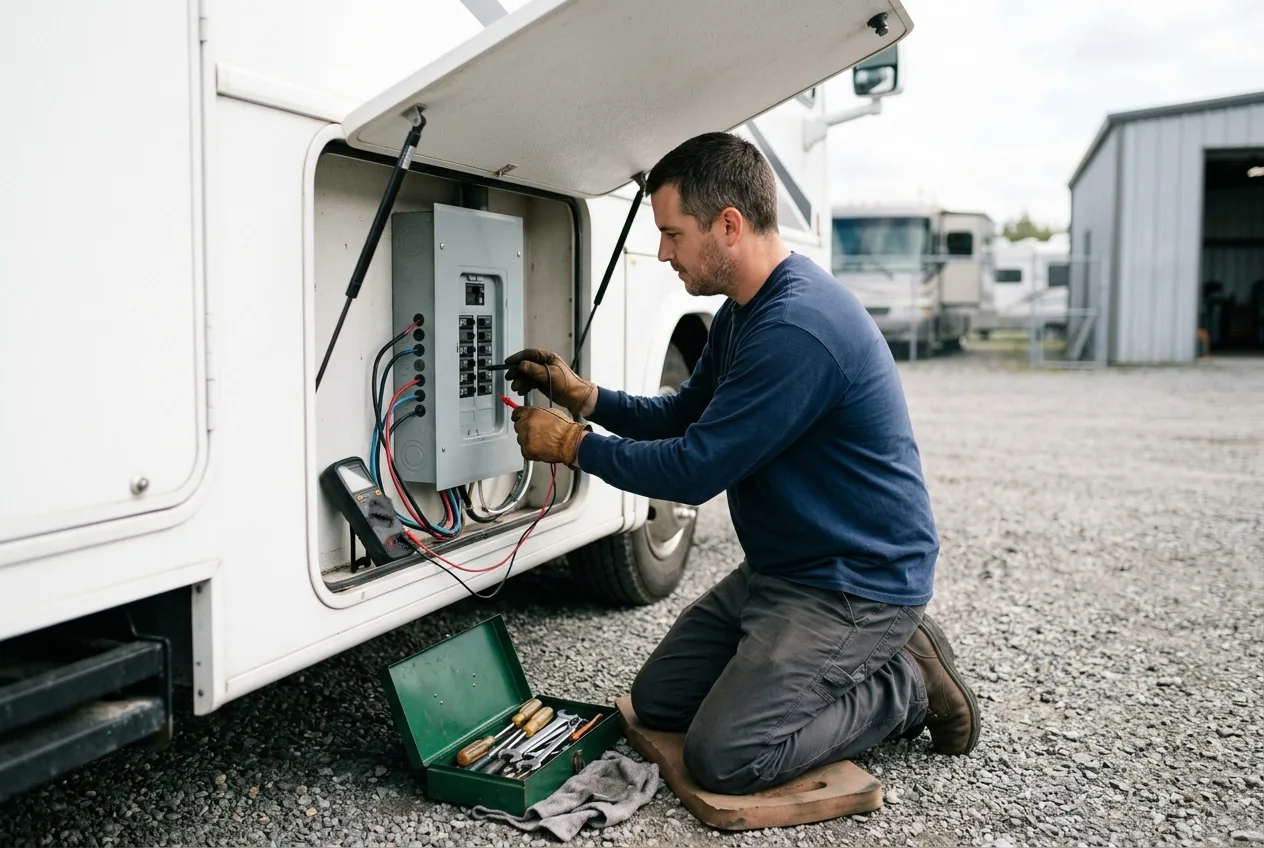
For a 12 volt run you plan to do yourself, our cable gauge calculator for RV wiring shows the wire size before you shop.
Affiliate Disclosure Smart RV Hub may earn a commission if you purchase from Outdoorsy and RV Life Pro through these links, at no additional cost to you; see our full disclosure.
Want to try these systems on a real trip, or plan where to camp? These two partner sites are a place to start your research.
Liability insurance on every booking
Book Your First RV TripAffiliate link. We may earn a commission at no extra cost to you.
Find Off Grid Camping Spots
30,000+ campgrounds (checked October 2026)
Affiliate link. We may earn a commission at no extra cost to you.
Frequently Asked Questions
What can I ask the RV educational consultant?
Ask about any RV technology topic.
That covers solar power, lithium batteries, internet and routers, climate control, remote monitoring and smart automation.
Will the consultant tell me which product to buy?
No. It explains how systems work and what you trade off between options.
It does not recommend products or make money claims.
If a reply uses wording such as “I recommend” or “you should buy”, it is swapped for a short note saying it cannot make recommendations.
Is the educational consultant free?
Yes.
You can ask questions for free and return whenever a new question comes up.
Is the assistant a substitute for professional installation advice?
No. It is an educational starting point.
For wiring, mounting, and electrical work, consult a qualified RV technician.
How accurate are the answers?
Answers draw on RV technology guidance widely published for RV owners.
An AI assistant can still get a detail wrong.
Always confirm figures against the product's specifications before you buy.
Where do I go once the assistant has answered?
Explore the related feature guides and run the calculators to apply the answer to your own rig.
Continue Your Research
Explore additional resources to help make your decision
- Technology GuideLearn how each RV system works
- RV CalculatorsBudget solar, power, and trip costs
- Intelligent RV FinderFind the RV class that suits your trips
- How Ready Are You?Find tech that matches your experience level
- Feature MatcherMatch smart features to your specific needs
- Technology ChecklistBuild a personalized research checklist
Still deciding whether to own a rig at all? Read up on renting one for a week before you commit to buying.
Related Tools
More free planning tools
Camp Cost Tracker
Log what every night on the road costs in seconds and see your real nightly average, free night savings, and membership break even point
AI Technology Readiness Assessment
Describe your experience and goals, and the AI matches you to one of three readiness tiers, plus the tech to start with
Enhanced Feature Matcher
Describe how you travel, or pick one of four example trips, and the AI explains which smart RV features suit the way you camp