RV Internet Connectivity: The Complete Guide
Cellular, Starlink, and campground WiFi, mapped into one working setup.
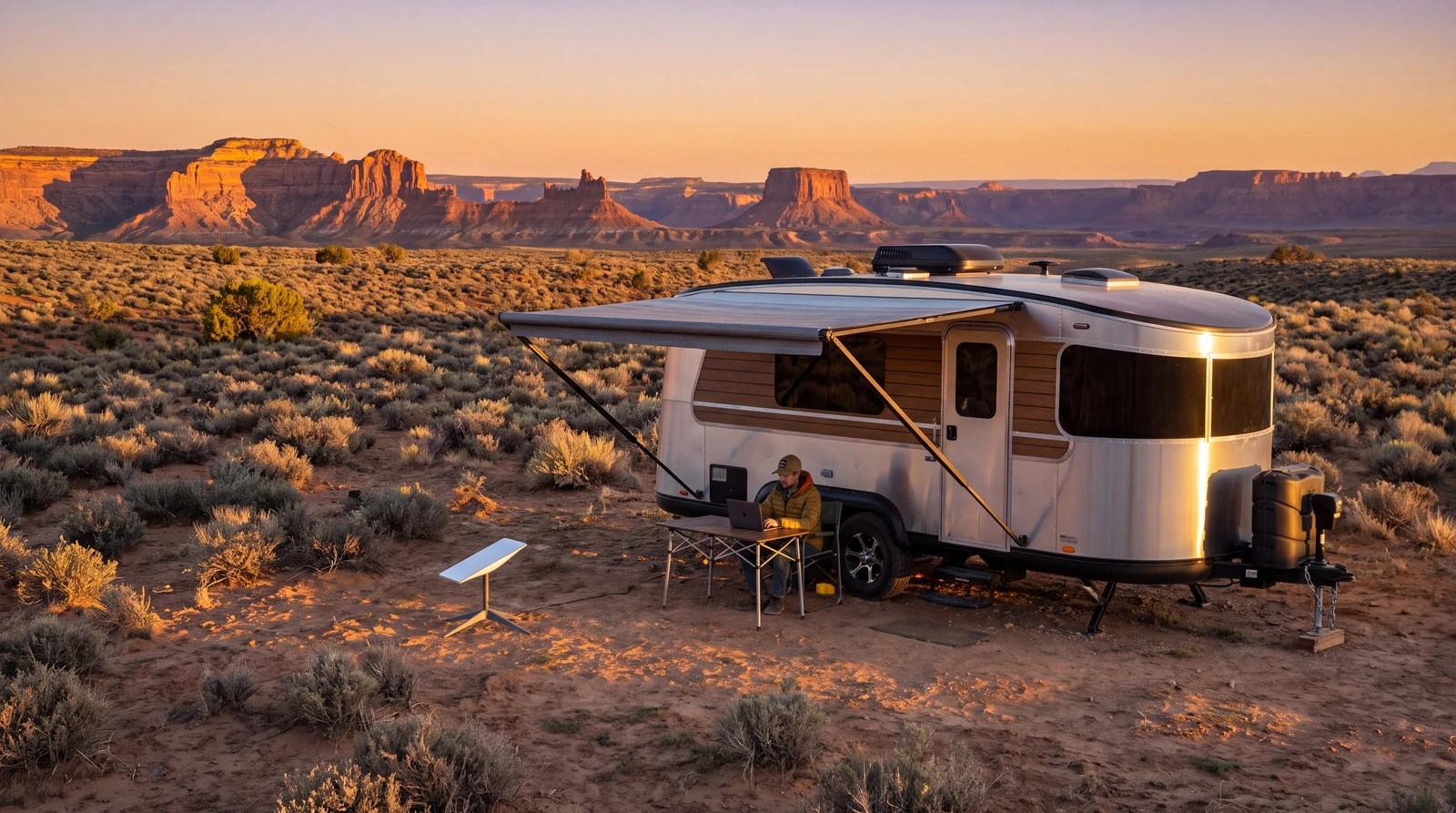
The Three Routes at a Glance
Coverage is what separates them, and cost and power draw are what you trade for it.
Each Option in Depth
Every cost and power figure below comes from published plan and spec pages, last verified August 2026.
Cellular data
Coverage
Strong along highways and around towns, patchy in remote public land.
Cost pattern
Roughly $50 to $100 a month for dedicated hotspot plans, per published plan pages.
Power draw
Low. Routers and hotspots run under 15 watts on published specs.
Best for: Travelers who stay within a night or two of towns and want the lowest running cost.
Starlink satellite
Coverage
Works wherever the dish sees open sky, including far from any tower.
Cost pattern
Hardware from $299 to $599 and Roam service tiers from roughly $50 to $165 a month, per starlink.com.
Power draw
The heaviest draw of the three. Published specs run roughly 25 to 100 watts by model.
Best for: Boondockers and remote workers who camp beyond cellular coverage.
Campground WiFi
Coverage
Only at the park, and quality varies site to site with no published guarantee.
Cost pattern
Bundled with the site fee at most parks.
Power draw
None of yours. The park runs the network.
Best for: Casual browsing and as a backup when your own connection has a bad day.
Building a Setup That Does Not Fail All at Once
The reliable pattern is a primary connection plus a different kind of backup, because two cellular plans can share the same dead zone.
A common pairing is a cellular plan for travel days and towns, with Starlink for the remote weeks, per the setups described across published full timer guides.
A signal booster extends the cellular half of that stack where a weak signal exists, which our booster guide covers in detail.
The power bill nobody quotes
Off grid, internet gear is a real load: published Starlink specs run roughly 25 to 100 watts by model, which over a day can pass 1 kWh.
That is why remote workers size their solar around the dish, and our guide to sizing solar for daily power use walks that math.
Affiliate Disclosure
This page contains affiliate links.
When you purchase through these links, we may earn a commission at no additional cost to you.
This helps support our free calculators, guides, and research tools. Read our full disclosure
If the power draw is what stands between you and remote internet, the panels and batteries that carry a dish are the place to start.
Ships fast to get you camping sooner
Rated 4.4 of 5 on Trustpilot, checked August 2026 (opens in a new tab)Fast US shipping. Other trust signals verified August 2026.
Shop RV Solar Panels and BatteriesAffiliate link. We may earn a commission at no extra cost to you.
Signal and power tips by email
What each connection option draws from the battery bank, and the plan changes worth knowing about.
Free by email. Unsubscribe anytime.
Finding Camps Where Your Setup Works
Coverage maps show a carrier's optimism, while campground reviews show what devices actually got.
Inside RV Life Pro's 30,000 plus campground listings, members report what their devices actually got at each site, per the published feature list.
For tree cover, remember that a site shaded enough to block solar is often shaded enough to block a satellite dish too.
Affiliate link. We may earn a commission at no extra cost to you.
Where These Figures Come From
We did not install, test, or benchmark any of this equipment, and nothing here reports our own speed measurements.
The sources are carrier plan pages, starlink.com, and manufacturer spec sheets, each named where its figure appears.
Last verified August 2026, and providers change plans and pricing without notice.
Smart RV Hub Editorial Team
RV Technology Research and Reviews
Our writers research smart RV technology full time, covering solar power, connectivity, security, and power management.
Every guide draws on published manufacturer specifications and verified owner reviews, so you can compare options with confidence.
Meet the editorial team and our review standardsRV Internet Questions
What is the best way to get internet in an RV?
There are three routes: a cellular data plan, a satellite service such as Starlink, and campground WiFi.
Cellular wins where coverage is good, satellite wins in remote country, and campground WiFi is best treated as a bonus rather than a plan.
Can I just use my phone's hotspot for RV internet?
For light use, yes, and it is the cheapest starting point.
Phone plans commonly cap hotspot data separately from phone data, so remote work on a hotspot usually runs into that cap and needs a dedicated data plan.
Does Starlink work while driving?
Starlink publishes in motion use as a supported option on its Roam plans with flat high performance hardware, while the standard dish is specified for stationary use.
Check the current terms on starlink.com before relying on it, because plan rules have changed several times.
How much data does full time RV internet use?
Published carrier usage guidance puts remote work with video calls past 100 GB a month, and streaming television adds quickly to that.
Published plan pages cap many cellular hotspot tiers below that, which is why published full timer setups commonly carry two connections.
What does RV internet cost per month?
Published plan pages put dedicated cellular data plans at roughly $50 to $100 a month, and Starlink Roam tiers at roughly $50 to $165 a month, last verified August 2026.
Campground WiFi is bundled with the site fee, which is part of why its quality varies so much.
Why is campground WiFi so slow?
One park connection is shared across every site, and evening demand peaks when everyone streams at once.
Parks publish no service guarantee for it, so plan around it rather than on it.
How much power does RV internet gear draw?
Published Starlink specs put its dishes at roughly 25 to 100 watts depending on model and generation, while a cellular router draws far less, commonly under 15 watts.
Off grid, that difference decides how much battery a day online costs you.
Do I need a signal booster too?
A booster helps when a weak cellular signal exists and cannot help when there is none at all.
It is a complement to a cellular plan, not a third kind of internet.
The deeper guides for each option, and the power to run them.
RV Starlink Setup Guide
Mounts, cabling, power draw, and the plan choices before the dish goes up.
Starlink vs Cellular
The two serious options compared for coverage, cost, and power.
Best RV Cellular Signal Boosters
What a booster can and cannot do for a weak bar of signal.
Power To Keep The Dish Online
Size the battery and panel bank that keeps the dish online.
The Monthly Full Time Budget
Where connectivity sits in a real monthly budget.
The RV Life Pro Trip Planner
Trip planning with campground reviews that report real signal.
Next Step
Knowing the three routes is the map. The first real decision for anyone leaving coverage behind is the satellite question.
Our Starlink vs cellular comparison settles which half of the stack to buy first.
Know costs before you go
Find Campsites with a Free 7 Day TrialAffiliate link. We may earn a commission at no extra cost to you.