
RV Matcher: Match Features to How You Actually Camp
Discover which technology features match your specific RV usage plans
Describe how you travel, and the feature matcher shows which smart RV features fit trips like yours.
What this guide covers
- Discover which smart features match your specific RV travel plans
- See up to five features listed by how closely they match your words
- Learn what each feature does before you spend money on it
- Start from four example trips if a blank box feels hard
Match Features to Your Trips
Choose the example trip nearest to yours or write your own, then run the match.
Affiliate Disclosure Smart RV Hub may earn a commission if you purchase through these links, at no additional cost to you; see our full disclosure.
AI Enhanced Feature Matcher
Describe your RV usage plans and get educational information about relevant technology features
Leave out names, phone numbers and addresses. We send your description to an AI service to find matching features, and we do not save the text. Privacy Policy
How Does the RV Feature Matcher Work?
The tool asks you to describe your planned trips in your own words, or to start from 1 of 4 example trips and adjust it.
It then lists smart RV systems by how closely they match your description, so you can focus your research and your budget.
- You describe your trips, in your own words or from one of four example trips.
- The AI picks out keywords such as remote work, internet, solar or pets.
- Those keywords meet internet, power, comfort and safety features.
- Up to five come back, best match first, each with the words that matched.
The more your description says, the better the match. Name the work you do on the road, where you camp and who travels with you.
A remote worker who writes “video calls” and “off grid” gets internet and power features near the top.
Why each shortlist differs
A weekend camper sees a different shortlist than a full timer who works on the road.
Every result shows the words that matched, so you understand why a feature came up before you spend anything.

Which Features Should Each Kind of Trip Start With?
Each of the four example trips in the tool has a natural first pair of features.
- Weekends and holidays
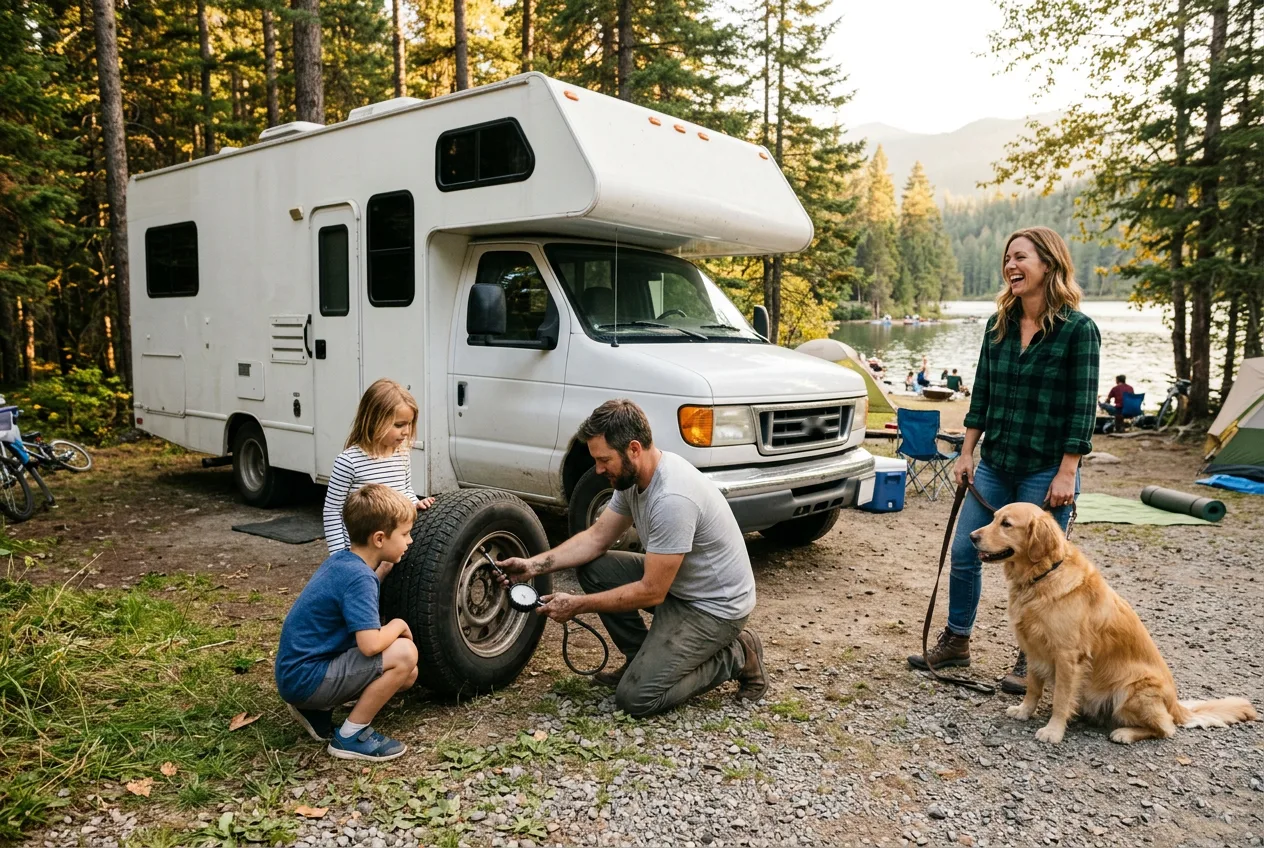
- Backup camera and tire pressure monitor
- Working from the road
- Cellular booster and solar power
- Living in it full time
- Smart energy monitoring and security cameras
- Traveling with family
- Backup camera and an inside temperature monitor for pets
| Kind of trip | Start with |
|---|---|
| Weekends and holidays | Backup camera and tire pressure monitor |
| Working from the road | Cellular booster and solar power |
| Living in it full time | Smart energy monitoring and security cameras |
| Traveling with family | Backup camera and an inside temperature monitor for pets |
Three figures shape those first picks:
- According to FCC rule 20.21, a vehicle booster with an inside antenna can strengthen a phone signal by at most 50 decibels.
- According to the National Solar Radiation Database, most areas receive 4 to 7 peak sun hours (hours of full strength sun) per day.
- According to Victron Energy, the practical limit is draining 80 percent of a lithium (LiFePO4) battery and 50 percent of a sealed lead acid (AGM) one.
Typical RV solar system size
Most RVs need 400 to 800 watts of solar, according to our guide to RV solar power.
Weekend campers usually need 200 to 400 watts, and full timers 600 to 800 watts with 300 to 400 amp hours (Ah) of lithium battery.
If solar is anywhere on your shortlist, the honest assessment of whether solar earns its place on your rig is worth reading first.
Routing and campground search sit alongside those features, and we compare the trip planning apps that handle RV safe routing in a separate guide.
What Does the Match Percent Mean?
Each result carries a badge such as “60% match”. Every feature in the matcher has a short list of tag words, such as internet, solar or camera.
It is the share of that feature’s tag words your description hit, so it rewards a detailed description.
- Cellular signal booster: 3 of 5 tag words, 60 percent
- Solar panel ready: 2 of 5 tag words, 40 percent
- WiFi range extender: 1 of 4 tag words, 25 percent
- A high match means your words fit. It does not rate the product.
A lower match is still worth a look if the feature solves a problem you have. The percent tells you about your words, not about the product.
Affiliate Disclosure Smart RV Hub may earn a commission if you purchase from RV Life Pro and Outdoorsy through these links, at no additional cost to you; see our full disclosure.
These are the partners our guides point to once you have a shortlist.
Annual plan trial for new subscribers, cancel before it bills (terms checked October 2026)
RV safe routes and campsites
Start Your Free 7 Day TrialAffiliate link. We may earn a commission at no extra cost to you.
Try Before You Invest
Not sure about solar? Rent an RV whose listing includes solar, and test your real power needs before you buy a system.
Affiliate link. We may earn a commission at no extra cost to you.
Frequently Asked Questions
What does the RV feature matcher do?
It reads a description of how you travel and shows which smart RV features relate to it.
Each result lists the words from your description that it matched, plus a short explanation.
Is the feature matcher free to use?
Yes.
The tool is free and you can run it as many times as you like as your travel plans change.
What does the match percent on a result mean?
It is the share of a feature’s tag words that your description hit.
Three of five words shows as 60 percent.
It measures how well your words fit the feature, not how good any product is.
Which RV features should I prioritize first?
Power and connectivity usually come first, because most other systems depend on them.
The matcher lists its results best match first, so the top one fits your description most closely.
Do I need technical knowledge to use it?
No. The questions use plain language about how you travel, not technical specifications.
Each result explains why the feature relates to your style of trip.
What should I do after I get my feature matches?
Use the technology checklist to plan your research, then compare specific products.
The calculators size solar and power for the features you choose.
Explore Individual Features
Learn more about each smart feature in detail. The catalog and the 5 tools below build on your matches.
- All Smart FeaturesBrowse our complete feature catalog
- Check Your Tech Comfort LevelFind tech that matches your experience level
- AI Educational ConsultantAsk detailed RV technology questions
- RV CalculatorsRun the numbers on solar, fuel, and towing
- Technology ChecklistCreate a research checklist for your matched features
- Intelligent RV FinderMatch an RV type to how you travel
Not settled on a rig yet? Borrow one for a trip and read what to check before a first rental pickup.
Related Tools
Explore other tools to help you make smart RV technology decisions
Camp Cost Tracker
Log what every night on the road costs in seconds and see your real nightly average, free night savings, and membership break even point
AI Technology Readiness Assessment
Describe your experience and goals, and the AI places you at one of three readiness levels with the tech to start with
AI Educational Consultant
Ask a question about solar, connectivity, climate or smart automation and get a plain language answer from our AI assistant