Portable Solar Panels for RV: How to Pick the Right Size
A foldable panel does one thing no roof array can do at any wattage, and sizing it against your real daily draw is what makes it worth the money.
Written from published specs and category reviews, never from first person testing.
Affiliate Disclosure
This page contains affiliate links to A1 SolarStore.
When you purchase A1 SolarStore through these links, we may earn a commission at no additional cost to you.
This helps support our free calculators, guides, and research tools. Read our full disclosure
The Problem a Roof Array Cannot Solve
Shade over the rig is shade over the panels, because a roof mounted array cannot separate itself from the vehicle.
The problem lands hardest in exactly the places you wanted to park, since wooded state parks and summer heat both push you under trees.
So the battery stops keeping up on the days you most wanted to sit still, and the generator comes back out.
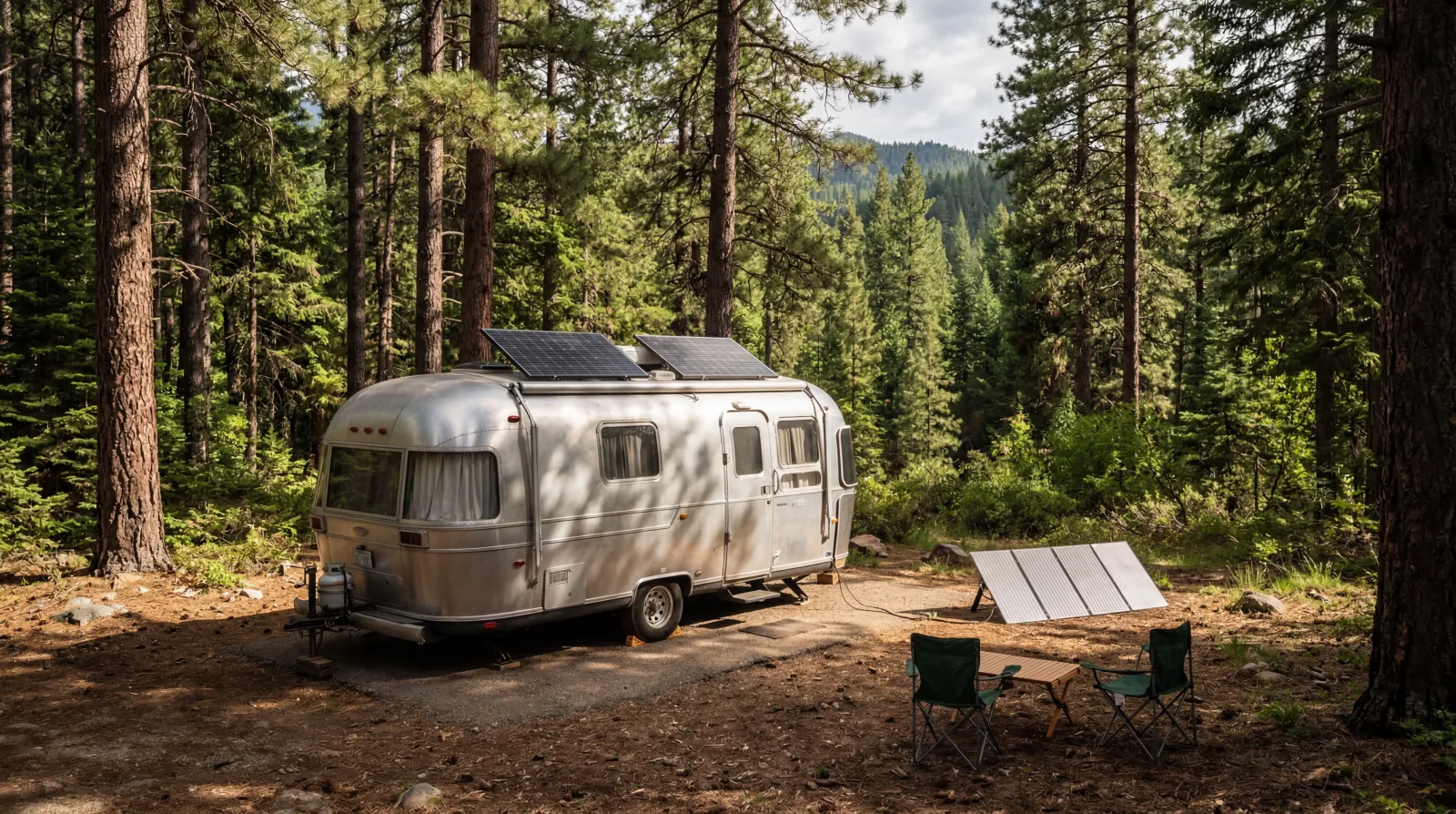
The portable solution is plain enough to sound like a trick: leave the rig in the shade and walk the panel out on an extension cable into full sun.
That is the whole case for buying one, and two more jobs follow from the same freedom.
Nothing is drilled and nothing is wired, which suits a rented rig and a van conversion you have not finished.
What Each Size Actually Recovers
Portable solar panels for RV use are sold by wattage, so size the panel against your daily draw rather than the number on the box.
Every figure above is a rough planning estimate at five sun hours after typical system losses, not a measurement from a test we ran.
The 100W tier is a top up for phones, lights and a laptop rather than a supply.
The 200W tier holds an ordinary 12 volt compressor fridge on a clear day, which is where most buyers land.
Only the 400W tier clears a fridge plus lights and devices on its own, and by that point you are carrying and stowing a lot of panel.
If your draw is still a guess, the sizing guide turns an appliance list into a watt hour figure in four steps.
Which One Fits How You Camp?
The right answer follows your parking, your ownership and how long you stay out.
Portable or rooftop for the way you camp?
Pick the line that sounds most like you to see which one actually fits.
Portable wins
A panel on an extension cable walks out into the sun while the rig stays cool under the trees.
This is the one job a roof mounted array cannot do at any wattage.
Look for an adjustable kickstand, an MPPT controller and a connector that matches your rig.
Size it against your real daily draw rather than the number on the box, then buy from whichever brand fits your budget.
Work out my daily watt hoursWhich Brands Lead the Category
These names recur across published category reviews read in September 2026, and any of them is a reasonable place to start.
OutdoorGearLab reports the Renogy 200W Portable as its top overall pick in its 2026 roundup, and SolarReviews reports the folding Jackery SolarSaga 200 at a published 24.3 percent cell efficiency.
Go Power, Rich Solar and BougeRV also carry foldable RV lines, and Go Power publishes plug and play kits from 90W to 200W.
Those are not affiliate links and we earn nothing from them, so buy from whichever of them fits your budget.
What to Check Before You Order
The connector
Foldable kits ship with clamps, an SAE plug or MC4, and rigs with a factory sidewall port rarely match the first thing in the box.
PWM or MPPT
MPPT recovers noticeably more in weak light, which matters more on a portable panel because you are often chasing a patch of sun.
Folded size and weight
You carry this twice a day, so check the folded footprint against the bay you will actually stow it in.
The kickstand angle
An adjustable stand is worth more real output than a slightly higher rating, because angle to the sun drives harvest.
One more thing catches people out, and it is the same trap as a rooftop build.
A panel charges a battery, so the bank behind it decides how much of that harvest you keep, covered in the RV solar battery guide.
If the roof is still on the table, the flexible against rigid comparison covers the curved roof case that sends some buyers to portable by mistake.
The Cost Comparison Nobody Runs
Portable looks cheaper because you buy less wattage, not because the wattage is cheaper.
Compare cost per watt rather than cost per unit, and the rooftop route usually wins for anyone keeping the rig.
Rich Solar publishes a 50W RV and camping kit at a list price of $199.99, read September 2026, which is a useful anchor for how quickly small portable wattage adds up.
For the honest payback math on a fixed install, our worth it analysis runs the break even against campground fees.
- Over 60 Fulfillment Centers
- Free Shipping on Qualifying Orders
- Rated Excellent on Trustpilot on Trustpilot, checked August 2026 (opens in a new tab)
Trust signals verified August 2026. Check a1solarstore.com for current details.
Built to last your RV adventures
Rated 4.4 of 5 on Trustpilot on Trustpilot, checked August 2026 (opens in a new tab)Fast US shipping. Other trust signals verified August 2026.
Shop RV Batteries and SolarAffiliate link. We may earn a commission at no extra cost to you.
Still Deciding Between Portable and Rooftop?
One email a week on RV power, sizing and setup, written the same way this page was.
Free by email. Unsubscribe anytime.
Smart RV Hub Editorial Team
RV Technology Research and Reviews
Our writers research smart RV technology full time, covering solar power, connectivity, security, and power management.
Every guide draws on published manufacturer specifications and verified owner reviews, so you can compare options with confidence.
Meet the editorial team and our review standardsPortable RV Solar Questions
Are portable solar panels worth it for an RV?
They are worth it when shade, a rental agreement or a roof you cannot drill rules out a fixed array.
For an owner who parks in the open and keeps the rig for years, a rooftop kit costs less per usable watt hour and needs no setting out.
What size portable solar panel do I need for my RV?
Size it against your daily draw rather than the panel rating.
As a rough planning figure a 12 volt fridge alone uses about 600 watt hours a day, which a 200W foldable panel can hold on a sunny day, while a fridge plus lights and devices needs the 400W tier to clear on its own.
Can a portable solar panel run an RV fridge?
As a rough planning figure a 200W foldable panel recovers about 700 watt hours on a clear day at five sun hours, which covers a typical 12 volt compressor fridge.
An absorption fridge running on electric draws far more, so check which type is in your rig before sizing.
Do portable solar panels work in the shade?
The panel itself does not, which is exactly the point of buying one.
You park the rig in shade and walk the panel out on an extension cable into full sun, which is the one job a roof mounted array cannot do at any wattage.
How do portable RV solar panels connect to the battery?
Most foldable units ship with a charge controller and alligator clamps or an SAE plug for the battery terminals.
Many rigs also carry a factory sidewall solar port, and connector standards vary between makers, so confirm the fitting before ordering.
Are portable solar panels better than rooftop panels?
Neither is better in general, because they solve different problems.
Portable buys you shade tolerance and no installation, and rooftop buys you harvest every hour you are parked with nothing to set out or stow.
Which brands lead the portable RV solar category?
Renogy, Jackery, Go Power, Rich Solar and BougeRV all appear repeatedly across published category reviews.
OutdoorGearLab reports the Renogy 200W Portable as its top overall pick in its 2026 roundup, and SolarReviews reports the folding Jackery SolarSaga 200 at a published 24.3 percent cell efficiency.
How do I choose between the leading portable panels?
Match the wattage to your daily draw first, then judge the hardware.
An adjustable kickstand is worth more real output than a slightly higher rating, an MPPT controller recovers noticeably more in weak light, and the connector has to match your rig, so check all three before the brand name.
We earn nothing from any portable panel seller, so treat the brands named here as a starting list rather than a recommendation.
Can I use a portable panel with a power station?
Yes, and it is the most common way they are sold.
A foldable panel paired with a power station from a maker such as Bluetti, Jackery or EcoFlow gives you a self contained setup with nothing wired into the rig at all.
Is a portable panel enough on its own for full time RV living?
Rarely, because it only harvests while it is out and pointed at the sun.
Full timers who stay off grid for days generally run a rooftop array as the supply and keep one portable panel for shaded sites.
How much roof space would the same wattage need instead?
Roughly eleven square feet per 200W rigid panel, so a 400W rooftop array wants around twenty two square feet of clear roof.
Measure around vents and the air conditioner shroud first, since layout rather than total area is what usually decides the answer.
Do portable panels need a different charge controller?
They need one, and most kits include it, but check whether it is PWM or MPPT.
MPPT recovers noticeably more in weak light, which matters more on a portable panel than on a roof because you are often chasing a patch of sun.
Keep Sizing the System
Complete RV Solar Guide
The hub this portable comparison sits under.
RV Solar Panels Compared
The rigid rooftop panels the kits are built from.
200 Watt RV Solar Kit
Picture the same wattage bolted down instead of set out.
Run Your Own Sizing Numbers
Turn your appliance list into a watt hour figure.
Lithium Batteries for RVs
The bank that decides how much harvest you keep.
Is RV Solar Worth It?
The break even math, without the sales pitch.