RV Comfort Guide: A Home on Wheels
Practical upgrades for better sleep, climate control, and livable space.
📋 What you'll discover
- Practical tips for more comfortable RV trips and extended stays
- Upgrade your sleep, climate, and living space without guessing
- Discover products recommended based on published specs and verified user reviews
- Make your RV feel like somewhere you actually want to be
Affiliate Disclosure
This page contains affiliate links.
When you purchase through these links, we may earn a commission at no additional cost to you.
This helps support our free calculators, guides, and research tools. Read our full disclosure
Comfort starts with where you stay and how you route the trip, so these two planning tools come first.
Explore RV Rental Options
Your adventure is waiting.
Pick up an RV near you and start exploring without the commitment of ownership.
Perfect for first timers or spontaneous getaways.
Affiliate link. We may earn a commission at no extra cost to you.
Find Off Grid Camping Spots
Now that you know your solar setup, discover 30,000+ campgrounds with RV Life Pro.
Filter by boondocking friendly locations and cell coverage.
Affiliate link. We may earn a commission at no extra cost to you.
Planning a comfort focused trip? Read our rundown of where to rent a well equipped rig to compare platforms before you book, or explore free overnight parking options that include wineries, farms, and unique properties.
Sleep Quality
Build a sleeping setup that actually works
- Invest in a quality RV mattress or mattress topper
- Use blackout curtains for better sleep cycles
- Consider a white noise machine for camp sounds
- Maintain optimal bedroom temperature (65-68°F)
Climate Control
Keep temperature and humidity where you want them
- Use ceiling fans to improve air circulation
- Install thermal window coverings
- Monitor humidity levels (30-50% ideal)
- Consider a mini split system for efficiency
Air Quality
Stop stale air before it becomes a problem
- Install air purifiers with HEPA filters
- Use exhaust fans while cooking
- Open windows when weather permits
- Replace HVAC filters regularly
Lighting
Get the right light for every part of the day
- Use LED bulbs for energy efficiency
- Install dimmer switches for ambiance
- Add task lighting in work areas
- Consider color changing smart bulbs
Kitchen Comfort
Turn a cramped galley into somewhere you want to cook
- Organize with space saving storage solutions
- Use quality cookware that heats evenly
- Install good ventilation above the stove
- Create comfortable seating for meals
Bathroom Comfort
Small space, but it does not have to feel that way
- Use space saving shower organizers
- Install good lighting around the mirror
- Consider a composting toilet for comfort
- Use moisture absorbing materials
How Do RV Rooftop, Mini Split, and Portable AC Compare?
Rooftop ACs cost $400 to $1,200 and deliver 13,500 to 15,000 BTU.
Mini split systems cost $1,500 to $3,000 and use 500 to 1,200W, making them the better fit for solar powered RVs.
Portable units start at $200 but draw the most power per BTU.
Quick reference for choosing the right climate control system
| Feature | Rooftop A/C | Mini Split | Portable A/C |
|---|---|---|---|
| Cost | $400 to $1,200 | $1,500 to $3,000 | $200 to $600 |
| Cooling Capacity | 13,500 to 15,000 BTU | 12,000 to 18,000 BTU | 8,000 to 12,000 BTU |
| Energy Efficiency | Moderate | Excellent | Low |
| Noise Level | Moderate Loud | Very Quiet | Moderate Loud |
| Heating Option | Many models (heat strips) | Some models | |
| Power Draw | 1,200 to 1,800W | 500 to 1,200W | 800 to 1,400W |
| Installation | Professional | Professional | DIY Friendly |
| Best For | Most RVs, proven reliability | Full timers, solar systems | Backup, occasional use |
Investment Tip: Mini split systems cost more upfront but are generally more energy efficient than rooftop units.
For solar powered RVs or full timers, the energy savings can be significant over time.
Pair a mini split with an off grid solar system to run it without hookups.
Rated Excellent on Trustpilot, fast US shipping
Trust signals verified May 2026.
Shop RV Solar Kits for Off Grid CampingAffiliate link. We may earn a commission at no extra cost to you.
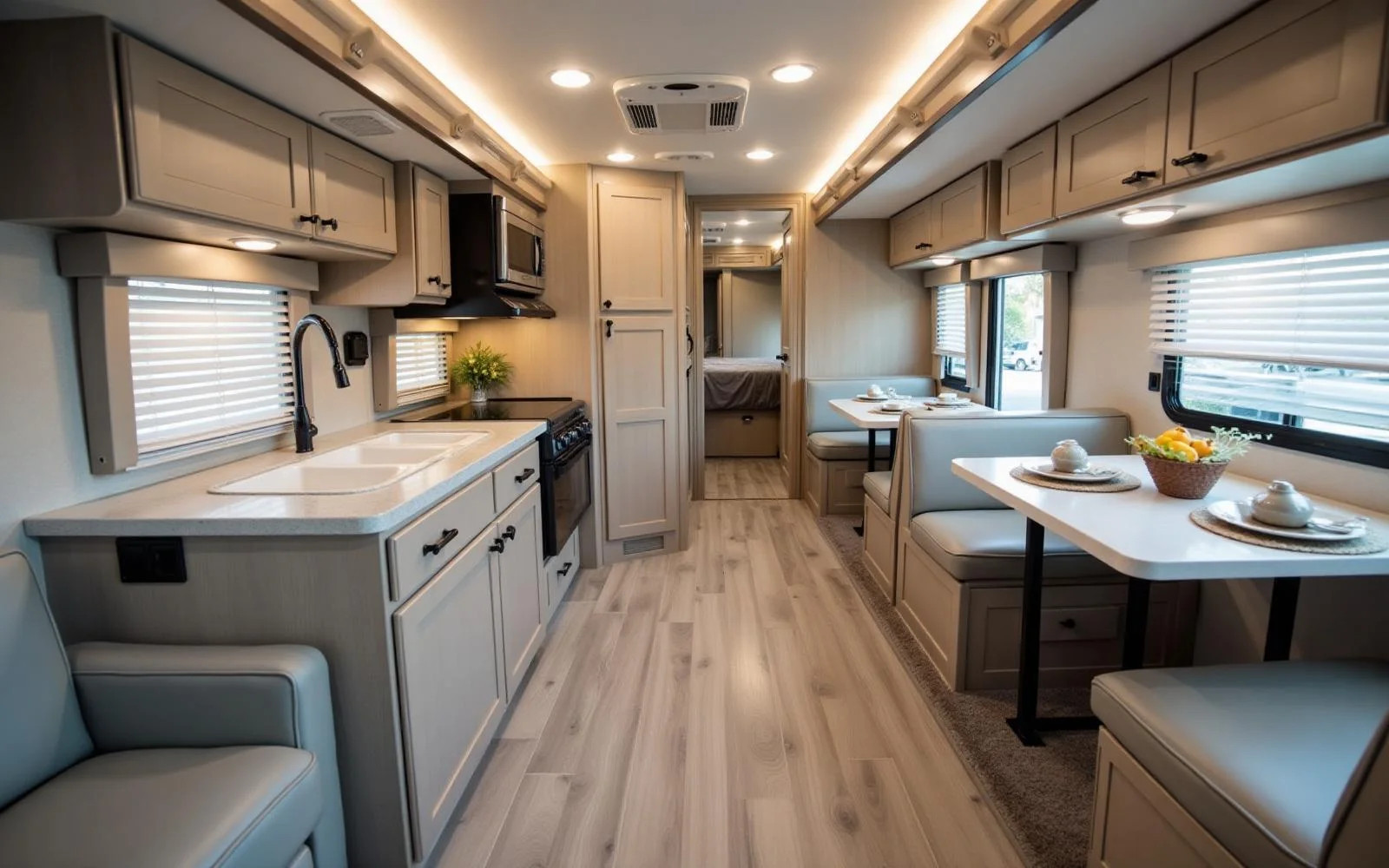
Advanced Comfort Tips
Space Optimization
- ✓Use multifunctional furniture
- ✓Install fold down tables and surfaces
- ✓Use vertical storage wherever walls allow
- ✓Choose lighter color schemes to open up the space
Noise Reduction
- ✓Add sound dampening materials
- ✓Use soft furnishings to absorb sound
- ✓Install weather stripping around doors
- ✓Consider quieter appliances when upgrading
Personal Touches
- ✓Display family photos and artwork
- ✓Use familiar scents and candles
- ✓Bring comfortable pillows and blankets
- ✓Create dedicated spaces for hobbies
Winter Comfort
- • Use thermal window coverings
- • Add extra insulation where possible
- • Keep moisture levels low to prevent condensation
- • Use safe heating sources and ensure ventilation
Summer Comfort
- • Use reflective window covers
- • Maximize air circulation with fans
- • Park in shade when possible — sites on the Harvest Hosts network of farms and wineries often have excellent natural shade
- • Use awnings and outdoor spaces
Which RV Mattress Type Is Best for Sleep Quality and Durability?
Memory foam and hybrid mattresses score highest for comfort across all sleeper types and last 8 to 12 years.
Latex offers the longest lifespan at 12 to 15 years for buyers who want a natural material and are willing to spend $800 to $2,500.
Choose the right mattress for better RV sleep quality
| Mattress Type | Comfort Level | Price Range | Durability | Best For |
|---|---|---|---|---|
| Memory Foam | Excellent | $400 to $1,500 | 8 to 10 years | Pressure relief, side sleepers |
| Latex | Excellent | $800 to $2,500 | 12 to 15 years | Natural materials, responsive feel |
| Innerspring | Good | $300 to $1,000 | 6 to 8 years | Traditional feel, back sleepers |
| Hybrid | Excellent | $600 to $2,000 | 8 to 12 years | Foam comfort plus spring support, suits most sleepers |
| Adjustable Air | Customizable | $1,000 to $3,000 | 10 to 15 years | Couples with different preferences |
Pro Tip: RV mattresses often need custom sizes due to non standard dimensions. Always measure your existing mattress or platform before purchasing.
Ready to Upgrade Your RV Mattress?
Brentwood Home makes mattresses in RV specific sizes including Short Queen, RV King, and Three Quarter, with free shipping and a generous trial period.
This link goes straight to Brentwood Home. We earn nothing from it.
RV Comfort Frequently Asked Questions
How can I improve sleep quality in my RV?
Better RV sleep comes down to three things.
- A decent mattress or topper, at $300 to $800 for memory foam or hybrid
- Complete darkness, using blackout curtains or window covers
- A bedroom held between 65 and 68°F
Add white noise to mask campground sounds, use moisture wicking bedding for humidity control, and stick to a consistent sleep schedule even while traveling.
Factory RV mattresses are thin and uncomfortable. Our guide to RV mattress sizes, foam types, and what thickness works best covers everything you need to know before ordering.
What is the best temperature to keep an RV for comfort?
Aim for 68 to 72°F during the day and 65 to 68°F at night. RVs lose and gain heat faster than houses due to thinner walls, larger window areas, and smaller HVAC units.
Use ceiling fans to keep air moving, and thermal window coverings to slow heat gain and loss. Zone your heating or cooling so it works only on the spaces you are in.
Keep humidity between 30 and 50% to prevent mold.
How do I reduce noise inside my RV?
Noise comes in through walls, gaps, and hard surfaces.
Adding sound dampening material like Dynamat to walls and ceiling ($200 to $500) cuts road and generator noise.
Weather stripping around doors and windows seals the gaps.
Soft furnishings such as curtains, rugs, and cushions absorb what gets through.
For generator noise specifically, look at mounting upgrades or switching to solar.
White noise machines or fans can also mask unavoidable sounds from neighboring campers.
What are the best space saving solutions for RV living?
Multifunctional furniture does the heavy lifting.
- Dinettes that convert to beds
- Ottomans with storage inside
- Fold down surfaces for a workspace
Wall mounted organizers and overhead cabinets use vertical space that often goes wasted.
Under bed storage drawers help too. Lighter colors and good lighting make the whole space feel bigger than it is.
Collapsible or nesting kitchenware, door organizers, and regular purges of unused items round out the approach.
How can I improve air quality in my RV?
Run exhaust fans while cooking to remove odors and humidity. Open windows when weather allows for a proper air exchange, and replace HVAC filters monthly (or every 2 to 3 months at minimum).
A portable HEPA air purifier in the main living area makes a noticeable difference. Combat humidity with DampRid or a small dehumidifier to stop mold before it starts.
Skip harsh chemical cleaners and choose low VOC products instead. For propane appliance use, keep the space ventilated and put a carbon monoxide detector in the sleeping area.
What lighting works best in RVs for comfort?
LED lighting is the practical choice for RVs: low draw, minimal heat, long life.
Dimmable LEDs give you ambiance control. Use warm white (2700 to 3000K) for living areas and bedrooms, and bright white (4000 to 5000K) for task lighting in the kitchen and bathroom.
Three more lights finish the job.
- Under cabinet lighting in the kitchen
- Reading lights beside the seating
- Motion activated lights for night trips to the bathroom
How much does it cost to upgrade RV comfort features?
Basic upgrades run $1,000 to $3,000 in total and cover seven things.
- A mattress or topper, $300 to $800
- Blackout curtains, $100 to $300
- LED lighting, $150 to $400
- An air purifier, $100 to $250
- A white noise machine, $30 to $100
- Kitchen organization, $100 to $300
- Bathroom improvements, $200 to $400
The next level ($3,000 to $8,000) adds a mini split system and solar. Full timer builds with residential appliances, a washer and dryer combo, and custom furniture can reach $10,000 to $20,000.