
Smart RV Technology Guide
What You'll Learn From This Guide
Everything you need to understand RV technology options and make confident purchasing decisions.
4 Interactive Tools
Assessment quiz, feature matcher, lifestyle planner & checklist
12 Major Sections
Comprehensive coverage from basics to advanced decision making
50+ Research Questions
Specific questions to ask dealers for each technology category
All Experience Levels
From first time buyers to RV technology enthusiasts
Quick Access to Popular Sections
Affiliate Disclosure
This page contains affiliate links.
When you purchase through these links, we may earn a commission at no additional cost to you.
This helps support our free calculators, guides, and research tools. Read our full disclosure
Use this comprehensive guide to understand RV technology features and make informed decisions that match your travel lifestyle.
Affiliate link. We may earn a commission if you book, at no extra cost to you.
Affiliate link. We may earn a commission if you subscribe, at no extra cost to you.
📋 What you'll discover
- Understand all smart RV technology options available today
- Compare systems side by side with expert analysis
- Find the right technology for your specific RV type
- Learn installation basics and compatibility requirements
RV Technology Guide: Choose the Right Tech Before You Spend a Dollar
Your guide to RV connectivity, power, and smart automation.
Make informed buying decisions backed by expert reviews and real owner feedback.
Affiliate Disclosure
This page contains affiliate links.
When you purchase through these links, we may earn a commission at no additional cost to you.
This helps support our free calculators, guides, and research tools. Read our full disclosure
Interactive RV Technology Tools
Use our free tools to find the right RV technology setup for your needs.

AI Technology Readiness Assessment
Answer a few questions about your experience level and travel goals. The tool matches you with technology options that fit how you actually camp.

AI Technology Checklist
Build a research checklist for your RV technology needs. Download a list of questions to ask dealers and features to check before you buy.
More Interactive Tools
Explore additional AI powered tools to help you research and plan your RV technology setup

Intelligent RV Finder
Find an RV that matches your lifestyle and budget using guided questions and side by side comparisons.

AI Educational Consultant
Ask questions and get detailed information about RV technology from our AI assistant.
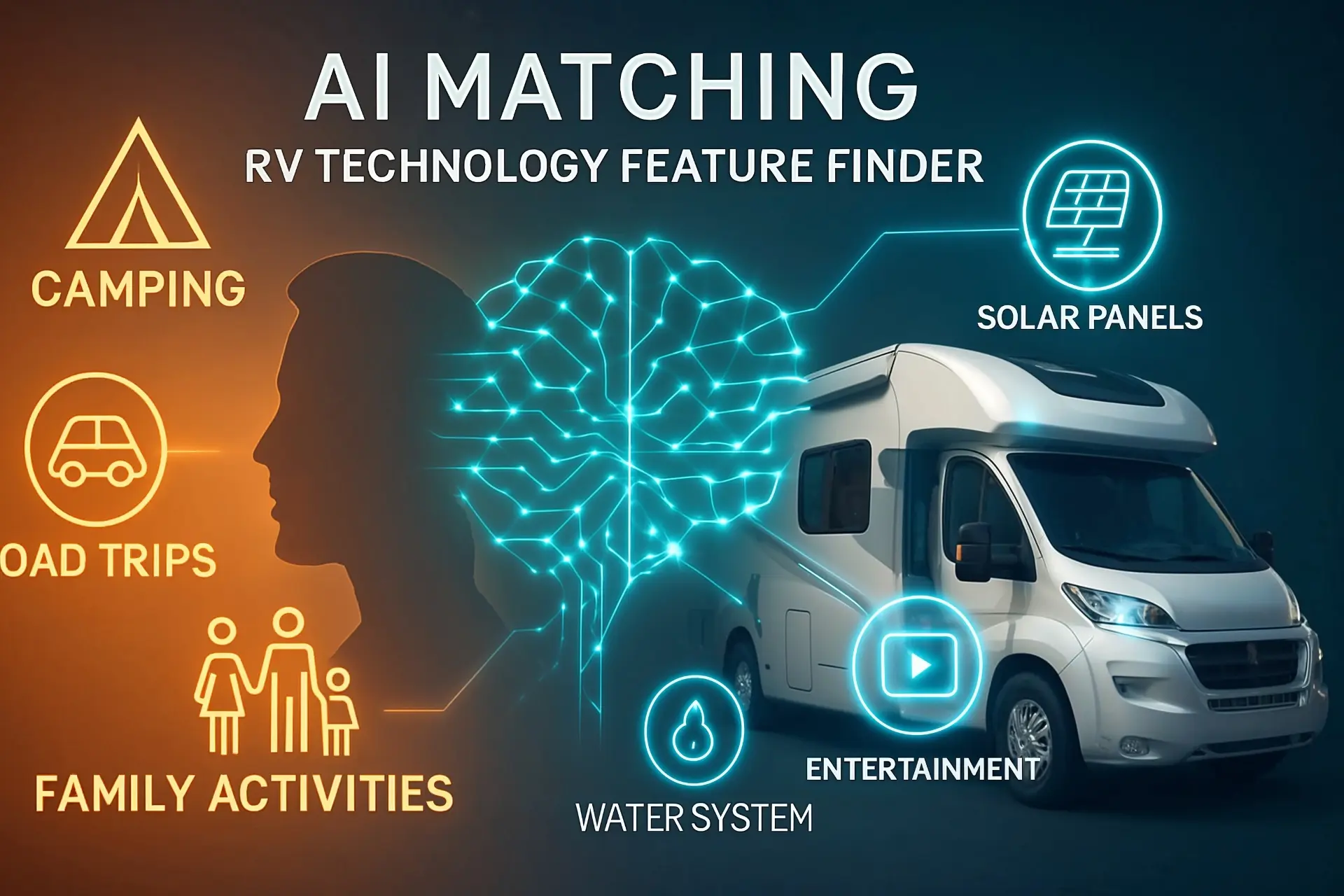
AI Feature Matcher
Describe your RV usage plans and discover which technology features match your needs.
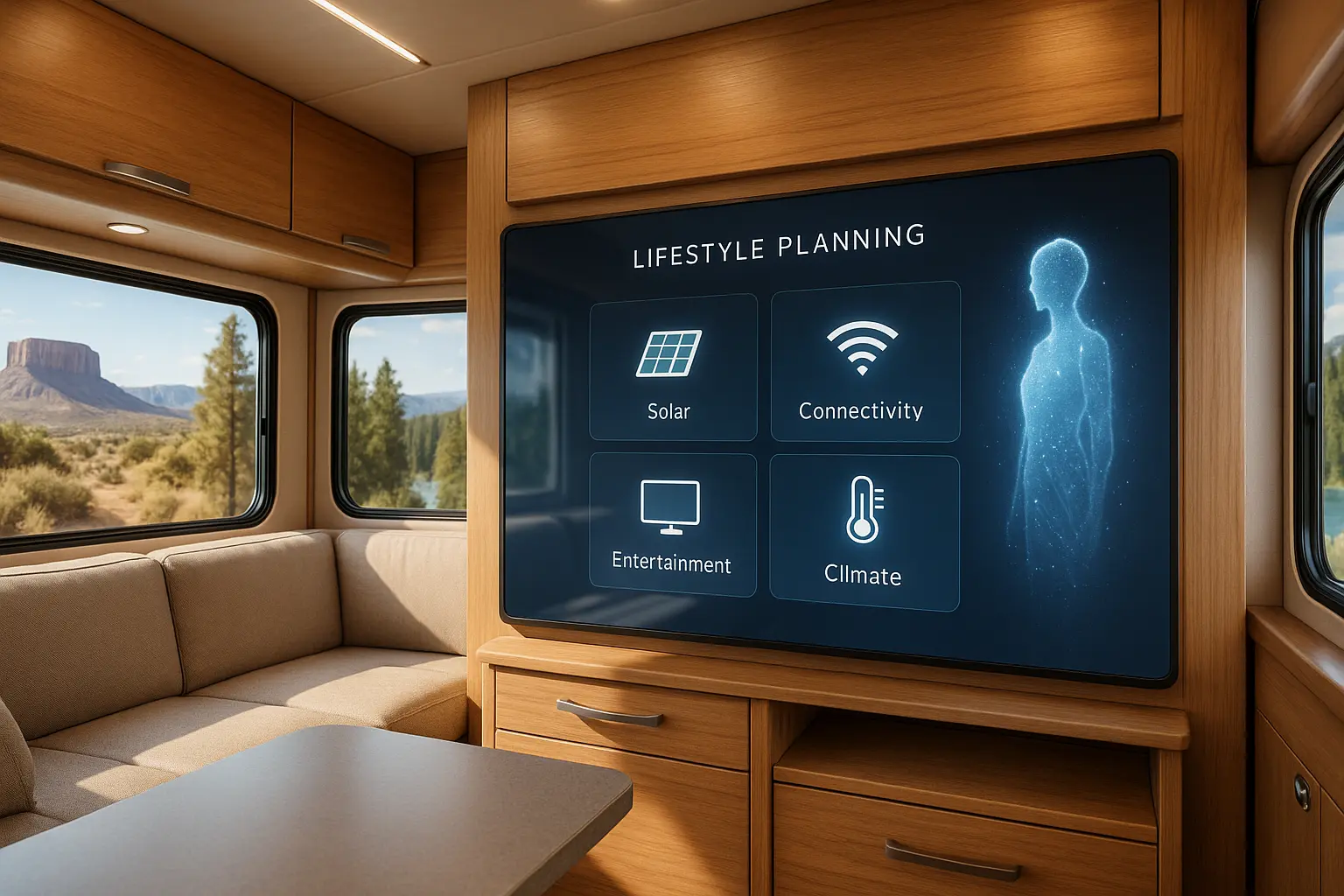
AI Lifestyle Planner
Find the right technology setup for your lifestyle and travel plans.
What Counts as Smart RV Technology in 2026?
Smart RV technology covers three categories.
- Connectivity. WiFi boosters, cellular routers and satellite internet.
- Power management. Lithium batteries and solar.
- Control systems. App based monitoring of tanks, climate and lighting.
Want to know how we evaluate every product and feature? Learn about the research methodology behind these recommendations.
RV technology has moved quickly over the past decade.
Modern RVs now ship with connectivity options, power management systems, and digital controls that earlier models simply did not have.
This educational guide helps potential RV buyers understand technology categories and learn what questions to ask when evaluating different options.
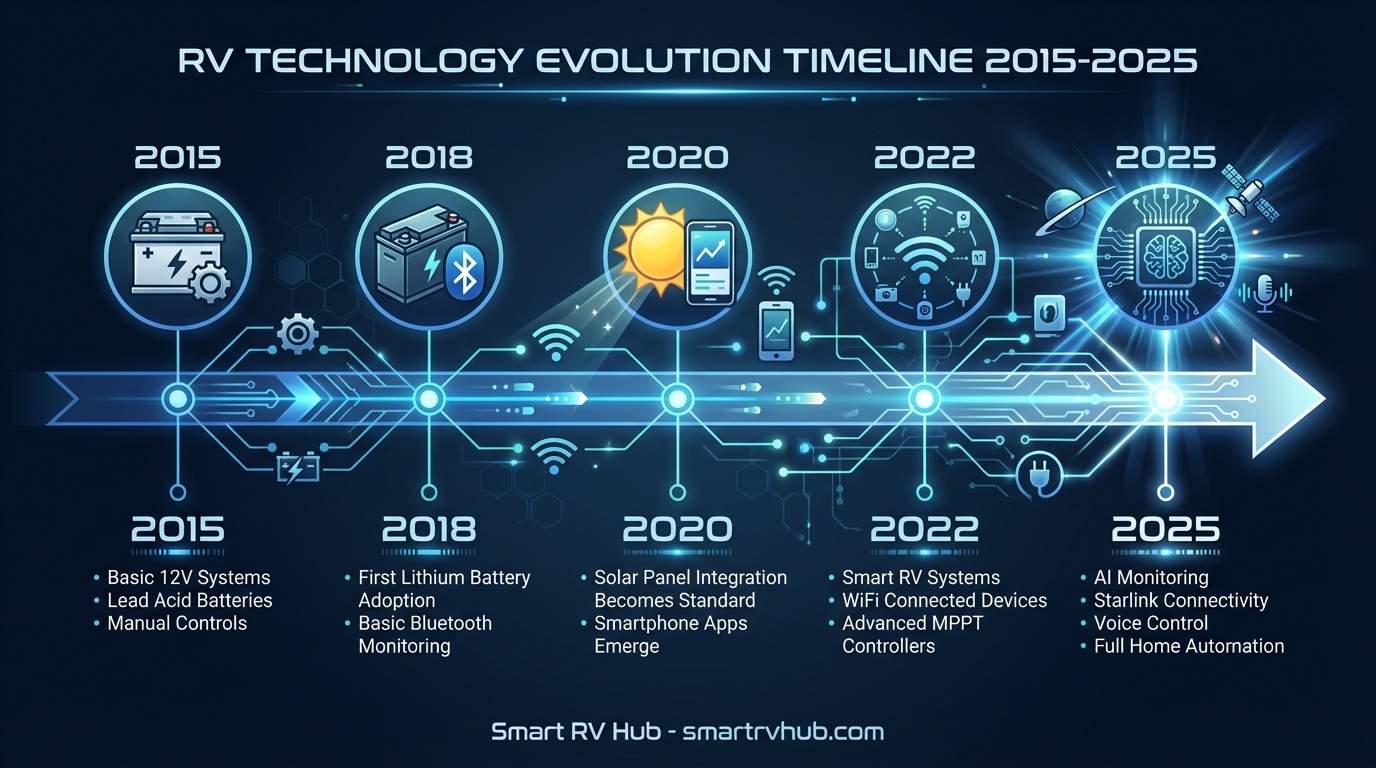
RV Technology Evolution Timeline
See how RV technology has advanced from basic 12V systems in 2015 to today's AI monitoring and Starlink connectivity.

Understanding RV Connectivity Technology
Historical Development of Connectivity Solutions
WiFi Signal Enhancement
Most newer RVs include some form of WiFi signal boosting capability.
These systems typically use external antennas to improve reception from campground networks or cellular data.
Questions to ask dealers:
- • What type of antenna system is included?
- • Does the system support multiple device connections?
- • How does the system handle signal switching between sources?
Cellular Data Integration
Many manufacturers now offer factory installed cellular capabilities.
These systems may include built in modems and data plans from various carriers.
Questions to explore with dealers:
- • Which cellular carriers are supported?
- • What are the ongoing data plan costs and options?
- • Can the system be used while driving?
Satellite Internet Preparation
Some models include preparation for satellite internet systems like Starlink.
This typically means pre installed mounting points and cable routing.
Consider asking:
- • What satellite systems are supported?
- • What additional equipment would be needed?
- • Are installation services available?
Affiliate link. We may earn a commission if you book, at no extra cost to you.
RV Connectivity Options Comparison
Quick reference guide to help you understand your connectivity options
| Feature | WiFi Booster | Cellular Router | Starlink/Satellite |
|---|---|---|---|
| Upfront Cost | $100 to $300 | $200 to $500 | $299 to $599 |
| Monthly Cost | $0 (uses existing) | $50 to $150 per month | $50 to $165 per month |
| Coverage Area | Campground WiFi range | Cellular coverage | Nearly anywhere |
| Speed (Typical) | 5 to 25 Mbps | 25 to 100 Mbps | 50 to 250 Mbps |
| Works While Moving | |||
| Works in Remote Areas | Limited | ||
| Setup Complexity | Easy | Moderate | Moderate |
| Best For | Weekend campers, campground users | Part time RVers, road warriors | Full timers, remote workers |
Pro Tip: Many RVers combine multiple solutions. A WiFi booster for campgrounds plus a cellular router for travel provides the best balance of cost and coverage.

Power Management Technology Categories
Evolution of RV Power Systems
Traditional Lead Acid Systems
Entry level RVs typically include lead acid or AGM battery systems.
These provide basic power storage with established charging patterns.
Questions to discuss with manufacturers:
- • What is the total amp hour capacity of the battery bank?
- • What type of charging system is included?
- • How long do the batteries typically last with normal use?
Lithium Battery Integration
Higher end models now commonly include lithium battery systems.
These generally offer longer cycle life and faster charging capabilities.
Questions to discuss with manufacturers:
- • What type of battery monitoring is included?
- • How does the system handle charging from multiple sources?
- • What warranty coverage applies to the battery system?
Solar Power Integration
Many RVs now include solar panel preparation or factory installations.
Solar systems can supplement charging when adequate sunlight is available. For a complete breakdown of panel types, sizing, and charge controllers, see our deeper dive into building an off grid power system.
Consider exploring:
- • What solar capacity is included or can be added?
- • How does solar integrate with other charging sources?
- • What monitoring capabilities are provided?
Affiliate link. We may earn a commission if you book, at no extra cost to you.
RV Battery Type Comparison
Understanding battery options for your RV power system
| Feature | Lead Acid | AGM | Lithium (LiFePO4) |
|---|---|---|---|
| Cost (100Ah) | $100 to $150 | $200 to $300 | $600 to $1,200 |
| Usable Capacity | 50% (50Ah) | 50% (50Ah) | 80 to 100% (80 to 100Ah) |
| Cycle Life | 200 to 300 cycles | 500 to 800 cycles | 2,000 to 5,000 cycles |
| Weight (100Ah) | 60 to 70 lbs | 60 to 70 lbs | 25 to 30 lbs |
| Maintenance | Regular (water) | None | None |
| Charge Speed | Slow (8 to 12 hrs) | Moderate (6 to 10 hrs) | Fast (2 to 4 hrs) |
| Cold Weather | Poor | Moderate | Good (with heater) |
| Best For | Budget setups, occasional use | Mid range, weekend camping | Full timers, solar systems |
Cost Analysis: While lithium costs 4 to 8x more upfront, the 10x longer lifespan and 2x usable capacity often makes it cheaper per cycle. For full time RVers, lithium typically pays for itself within 2 to 3 years.
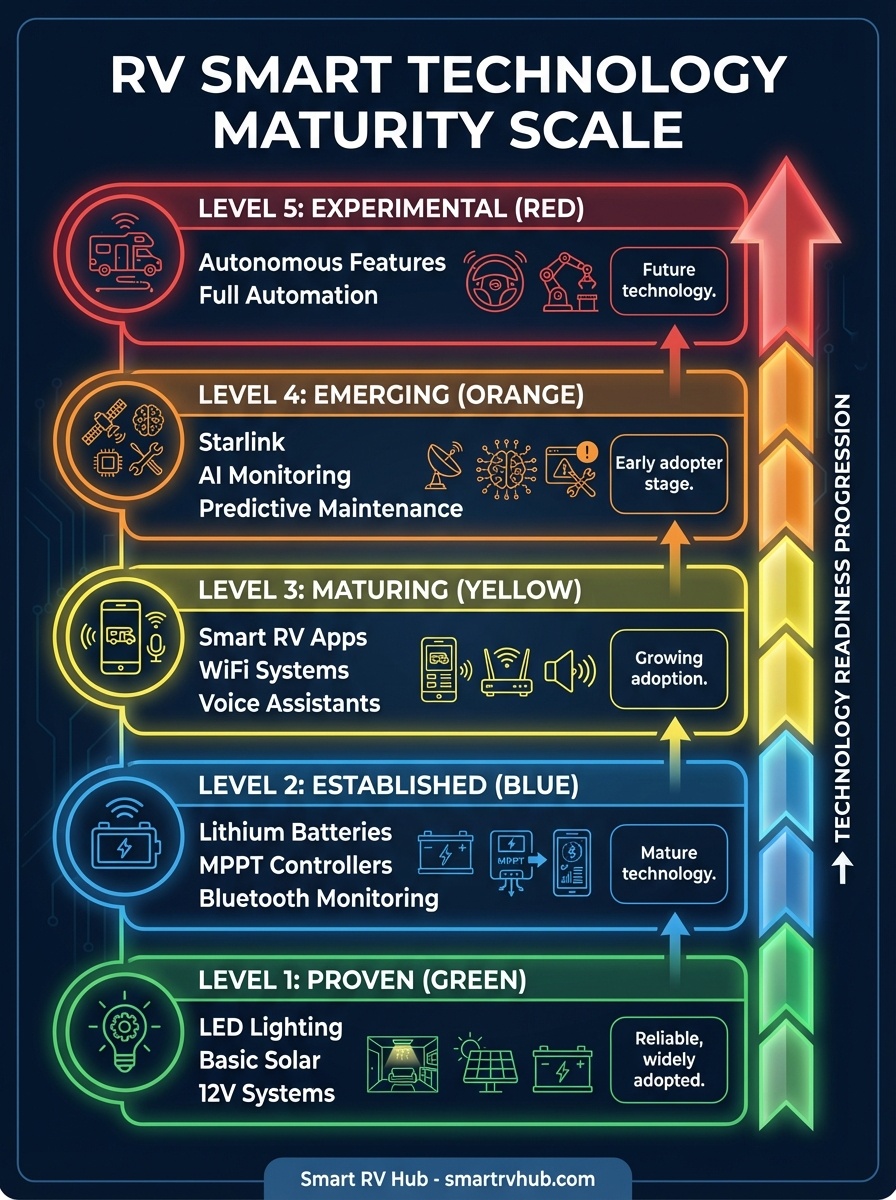
RV Smart Technology Maturity Scale
Understand where different RV technologies fall on the maturity scale, from proven basics to experimental features.
WiFi Boosters vs Cellular: Which is Right for You?
Compare connectivity options to choose the right solution for your RV internet needs
| Feature | WiFi Booster | Cellular Hotspot | Starlink |
|---|---|---|---|
| Monthly Cost | $0 (one time purchase) | $50 to $100 | $50 to $165 |
| Setup Cost | $150 to $400 | $50 to $200 | $299 to $599 |
| Speed Potential | Depends on campground | 5 to 100 Mbps | 50 to 200 Mbps |
| Coverage Area | Campground WiFi only | 85 to 95% coverage | Nearly anywhere |
| Best For | Weekend campers, campgrounds | Mobile workers, reliable backup | Remote locations, full timers |
| Reliability | Variable | Good | Excellent |
✓ Routes safe for your rig
Start Your Free 7 Day TrialAffiliate link. We may earn a commission at no extra cost to you.
Battery Technology Deep Dive
Key differences between battery chemistries for RV use
| Feature | Lead Acid | AGM | Lithium (LiFePO4) |
|---|---|---|---|
| Usable Capacity | 50% | 50 to 70% | 80 to 100% |
| Cycle Life | 200 to 300 cycles | 400 to 600 cycles | 3,000 to 5,000 cycles |
| Weight (100Ah) | 60 to 70 lbs | 60 to 65 lbs | 25 to 30 lbs |
| Lifespan | 2 to 4 years | 3 to 5 years | 10 to 15 years |
| Cost per 100Ah | $100 to $200 | $200 to $350 | $800 to $1,200 |
| Maintenance | High (water refills) | Low | None |
| Best For | Budget systems, occasional use | Moderate use, no maintenance | Full time, solar systems, weight savings |
Total Cost of Ownership: While lithium batteries cost 4 to 6× more upfront, they last 5 to 7× longer and provide 2× usable capacity.
Over 10 years, lithium actually costs less per usable watt hour than lead acid or AGM batteries.
Rated Excellent on Trustpilot, fast US shipping
Trust signals verified May 2026.
Compare RV Solar Kits and PricesAffiliate link. We may earn a commission at no extra cost to you.
Explore Smart RV Features
Frequently Asked Questions
What does smart RV technology include?
Smart RV technology covers three main areas:
- Connectivity, meaning WiFi boosters, cellular signal enhancers and satellite internet
- Power management, meaning lithium batteries, solar panels and energy monitoring
- Control systems, meaning app based climate control, lighting automation and remote monitoring
These systems work together to give you greater control, comfort, and independence while traveling.
How much does it cost to upgrade an RV with smart technology?
Costs vary widely depending on what you install.
A basic WiFi booster starts around $50 to $200, while RV cellular signal boosters typically run $400 to $1,000.
A lithium battery upgrade runs $1,000 to $5,000 depending on capacity.
A complete solar system with panels, charge controller, and batteries ranges from $2,000 to $10,000.
Full smart automation systems that integrate all these components can total $5,000 to $20,000 installed.
Can I install smart RV technology myself or do I need a professional?
Many upgrades are DIY friendly, including WiFi boosters, cellular antennas, basic solar panel kits, and smart plugs or switches.
Three jobs are worth handing to a certified RV electrician:
- Lithium battery conversions
- Hardwired solar installations
- Integrated control systems
They need correct wiring, fuse protection and compatibility with your existing electrical system.
Incorrect installation can void warranties or create fire hazards.
Which smart RV technology upgrade is most important?
For many RVers, reliable internet connectivity and a solid power management system deliver the biggest quality of life improvement.
A cellular booster or mobile hotspot keeps you connected for work, navigation, and entertainment.
A lithium battery and solar setup provides energy independence for boondocking.
Start with whichever matches your camping style, then add control and automation features later.
Will smart RV technology work with my existing RV?
Most smart RV upgrades are compatible with any RV regardless of age or manufacturer.
Portable devices like WiFi boosters, cellular antennas, and solar generators require no permanent modifications.
Hardwired upgrades like lithium batteries and integrated control panels may require adapter kits or wiring modifications depending on your RV's existing electrical system.
Check voltage and amperage compatibility before purchasing.
What technology features are worth the extra cost in an RV?
The upgrades worth paying for are the ones that earn their keep every day:
- Lithium batteries, which last 10 to 15 years against 3 to 5 years for lead acid
- Solar power, which frees you from generator noise and hookups
- Reliable internet, which makes working from the road possible
Avoid gimmicky features like voice controlled lights or automated leveling on entry level RVs.
Start with the core systems, meaning power management and connectivity, before adding convenience features.
Can I upgrade RV technology after purchase or should I buy it pre installed?
Solar panels, lithium batteries, and connectivity systems are often better installed aftermarket.
You get exactly what you want, often at lower cost, with better component choices.
Factory solar is frequently undersized, at 200 to 300W when you need 600 to 800W.
Structural features are the exception.
Slide out mechanisms and chassis mounted generators should be factory installed.
Budget $3,000 to $8,000 for a full aftermarket package covering solar, lithium, an inverter and connectivity.
What is the minimum viable technology package for full time RV living?
Full time RVers need five things:
- 600 to 800W of solar with an MPPT controller
- A 300 to 400Ah lithium battery bank
- A 2,000 to 3,000W inverter for laptops and kitchen appliances
- A cellular hotspot with unlimited data
- Basic monitoring for battery and tank levels
This foundation costs $4,000 to $7,000 and supports comfortable off grid living and remote work.
Add Starlink, with hardware from $299 to $599 and Roam plans from $50 to $165 a month per starlink.com, if you work from places with no cellular coverage.
How much power do common RV appliances use?
Knowing what each item draws is the starting point for sizing a solar system:
- LED lights, 5 to 15W each
- Laptop, 50 to 100W
- Phone charger, 10 to 20W
- Residential refrigerator, 150 to 400W running and 800 to 1,200W on startup
- Microwave, 1,000 to 1,500W
- Air conditioner, 1,200 to 1,800W
- Electric kettle, 1,000 to 1,500W
- Hair dryer, 1,200 to 1,800W
Many RVers use 2,000 to 4,000 watt hours per day.
The heavy three, meaning air conditioning, the microwave and a hair dryer, usually need shore power or a generator.
Running them on battery takes 1,200W or more of solar and 600Ah or more of lithium.
What technology trends should RV buyers watch in 2026?
Four developments are worth following:
- All electric RVs such as the Winnebago eRV and Airstream eStream, with 250 to 300 miles of range
- Vehicle to load systems, which let an electric truck power your RV
- AI energy management that learns your usage and tunes solar and battery performance
- Starlink Mini, a compact satellite internet option
Solid state battery technology also promises around twice the energy density of today's cells.
For a 2026 purchase the proven options remain the smart choice, meaning lithium LiFePO4, MPPT solar and cellular connectivity.
Continue Your Technology Education
Explore the next chapters of this RV technology guide
Control Systems & Technology Tiers
Learn about control and monitoring systems, understand technology tier levels, and compare different RV categories.
Research & Decision Framework
Work through the trade offs, build a research plan, and arrive at your buying decision with confidence.
✓ Expert help when you need it
Rated Excellent on Trustpilot, fast US shipping
Trust signals verified May 2026.
Compare RV Solar Kits and PricesAffiliate link. We may earn a commission at no extra cost to you.