Inline vs Canister RV Water Filters: Which Do You Need?
One threads onto the spigot, the other mounts to the rig.
How you camp decides which is the right answer.
Already have one and something is wrong? The questions at the foot of this page cover pressure drops and telling the two apart.
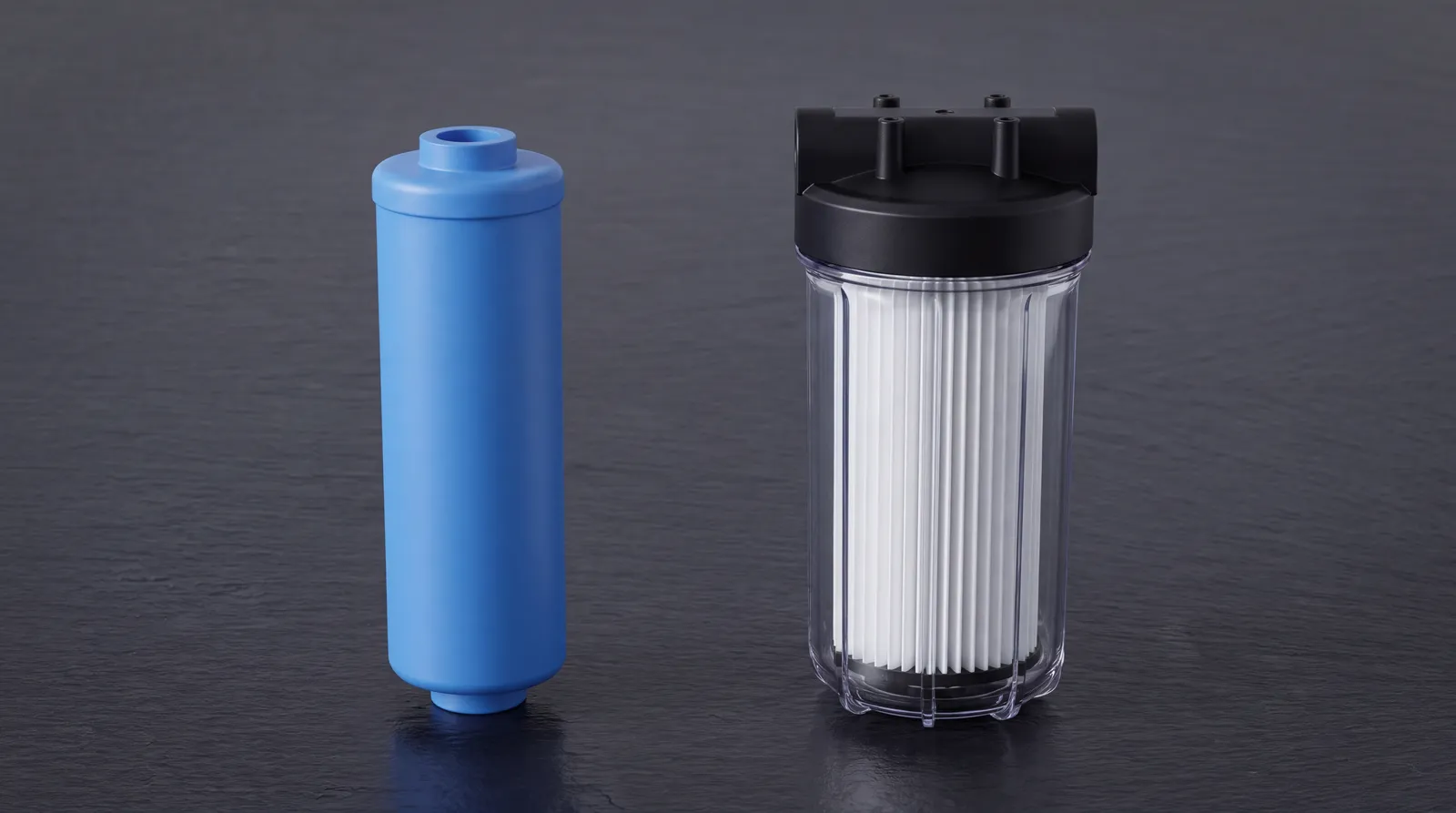
Telling the Two Apart
Inline hose filter
A single sealed cartridge, usually under a foot long, that threads straight onto the campground spigot.
When it is spent you throw the whole unit away, because there is nothing inside to replace.
Canister system
A housing mounted to a wall or utility bay, with a lid you unscrew to change the cartridge inside.
The housing stays for years and only the cartridge is consumable.
Where each format actually wins
Neither wins on all four, which is why the answer follows how often you camp.
The Two Compared, Point by Point
Every figure below is taken from published manufacturer specifications, last verified August 2026.
Installation
Inline
Screws onto the spigot in about five minutes with no tools.
Canister
Mounted permanently, one to four hours depending on the system.
Typical micron rating
Inline
Around 20 micron, published as sediment and taste duty.
Canister
Commonly 0.5 micron, down to 0.1 micron absolute on the finest units.
What it removes
Inline
Sediment, chlorine taste, larger particles.
Canister
The above plus chemicals, and organisms on the finest ratings.
Rated cartridge life
Inline
Published ratings commonly run a few hundred to a few thousand gallons.
Canister
Published ratings run higher for the same period, and much higher against a basic cartridge.
Flow rate
Inline
Adequate for one fixture, drops noticeably as the cartridge loads.
Canister
Higher published flow, because the cartridge is physically larger.
Upfront cost
Inline
Based on published listings, roughly 20 to 60 dollars for a basic cartridge, more for a multi stage portable.
Canister
Based on published listings, roughly 150 to 400 dollars.
Portability
Inline
Moves between rigs and rentals with no trace.
Canister
Stays with the rig it is fitted to.
Best suited to
Inline
Weekend campers and anyone in a rental.
Canister
Full timers, families, and anyone on variable water.
Not sure which fits your setup?
RV water filter guides, including how to pick a type and when to replace it, in your inbox as we publish them.
Free by email. Unsubscribe anytime.
Which Fits How You Camp
A few weekends a year, established parks
InlineTreated municipal water needs sediment and taste duty, which is exactly what an inline filter is rated for.
Several weeks a year, mixed parks
Either, leaning canisterCartridge cost starts to favor the canister once you are running real volume through it.
Full time on the road
CanisterA new supply every week is the case for deeper filtration and longer rated cartridge life.
Rural parks on well water
BothAn inline unit at the spigot acts as a sediment stage and protects the finer cartridge behind it.
Renting the rig
InlineNothing gets mounted and nothing gets modified, so it goes back with you.
Filling from untreated sources
Canister, plus a UV stageNeither format purifies on its own, so this calls for 0.2 micron absolute or UV behind a pre filter.
Running Both Together
This is not a strict either or, and pairing them is common where the water carries visible grit.
The inline unit sits at the spigot and catches the coarse material first.
The canister behind it then only has to deal with what got through, which is what stretches its rated cartridge life.
How These Were Compared
Both formats were compared on published manufacturer specifications, and on NSF and ANSI 42 and 53 certification where a manufacturer publishes it.
No unit was handled, so nothing here reports how either performed in use.
Prices and specifications come from published listings, last verified August 2026, and they change without notice.
Smart RV Hub Editorial Team
RV Technology Research and Reviews
Our writers research smart RV technology full time, covering solar power, connectivity, security, and power management.
Every guide draws on published manufacturer specifications and verified owner reviews, so you can compare options with confidence.
Meet the editorial team and our review standardsInline and Canister Filter Questions
How do I tell whether I have an inline or a canister filter?
An inline filter is a single sealed cartridge that screws directly onto the campground spigot, usually under a foot long.
A canister filter is a housing mounted to a wall or bay with a lid you unscrew to change the cartridge inside.
Is a canister filter worth the installation effort?
It depends on how often you camp rather than on the filtration alone.
Based on published cartridge ratings, canister systems last several times longer per cartridge, so the effort pays back faster for full timers than for a few weekends a year.
Does an inline filter remove enough to be safe?
Inline filters are typically rated at 20 microns, which published specifications describe as sediment and taste duty rather than bacteria removal.
For treated campground water that is usually adequate, and for untreated sources it is not.
How much more does a canister system cost to run?
The housing costs more up front, but published cartridge ratings are far higher, so the cost per gallon can land lower.
Work it out by dividing the system price plus three years of cartridges by the gallons those cartridges are rated for.
Can I use an inline filter and a canister system together?
Yes, and it is a common setup where the water carries visible grit.
The inline unit acts as a sediment stage at the spigot, which extends the life of the finer cartridge inside the canister.
Can I switch from inline to canister later?
Yes, and nothing is wasted, because the inline filter keeps working as a pre filter at the spigot.
The canister housing is the only new purchase, since cartridges are consumable either way.
Which type loses less water pressure?
Canister systems generally publish higher flow rates, because the housing takes a physically larger cartridge with more surface area.
An inline filter nearing the end of its rated life is a common cause of a sudden pressure drop.
Which type is better for boondocking?
Neither on its own, because both are filtration rather than purification.
Untreated sources call for a 0.2 micron absolute stage, which removes bacteria and protozoa but not viruses, with a UV purifier behind a pre filter for those.
Picking a specific model, and fitting whichever type you choose.
Best RV Water Filters
Ten filters compared, with the picks for each type.
RV Water Filter Installation
Fitting whichever type you land on, step by step.
RV Water Systems
Where the filter sits in the wider plumbing.
Your Season By Season Maintenance List
When each cartridge type is due for replacement.
Camping Where Water Is Untreated
Why untreated sources change the answer entirely.
RV Winterization Checklist
Both types come out before the first freeze.
Our Assessment
Start with inline. Move to canister once your camping pattern earns it back in cartridge cost.
Once you have decided, our ranked filter comparison covers specific models in both formats.